
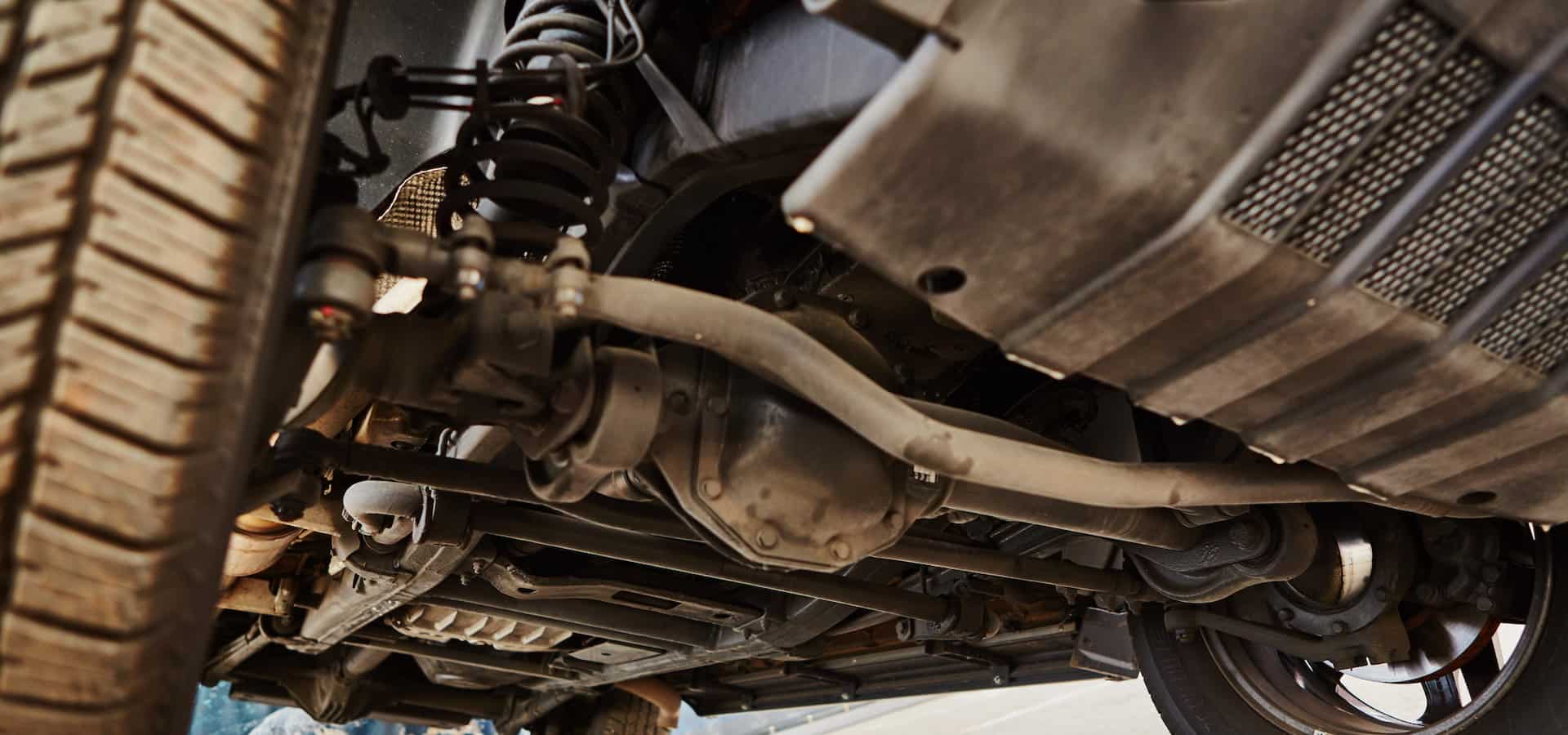
Lexus Suspension Repair at Elevation Auto Repair
Lexus builds its ride quality around a suspension philosophy that leans heavily on isolation and refinement, and that means the components wear differently than what you'd find on a rougher-riding brand. When the plushness disappears or a clunk creeps in, you want a shop that knows how a GS, RX, or LS is supposed to feel from behind the wheel.
Suspension repair on a Lexus covers control arm bushings, ball joints, struts and shocks, sway bar links, and – on many models – the air suspension and adaptive dampers that make these cars ride the way they do. Getting it right involves more than swapping parts:
- Air-equipped LS and GX models use height sensors and compressor systems that need proper calibration after service, not just a bolt-on repair.
- Adaptive Variable Suspension (AVS) on F Sport and LS platforms can log faults that require scanning and resetting once components are replaced.
- Lexus torque specs and alignment tolerances are tight – close enough leads to early tire wear and steering pull.
What you can expect when you bring your Lexus to us:
- Fast, accurate diagnosis so you're not paying for guesswork
- OEM-grade or better parts matched to your model and trim
- A precision alignment after suspension work is completed
- Clear communication about what needs attention now versus later
Symptoms – How to Know You Need This Service
Lexus owners are used to a quiet, composed ride, so suspension trouble often announces itself through small changes you'll feel before anything else. Watch for these signs:
- A clunk or knock over bumps – often worn control arm bushings, sway bar end links, or strut mounts
- Steering wander or the car pulling to one side, which can point to alignment or worn ball joints
- Uneven or feathered tire wear, a telltale sign of alignment and worn suspension components
- The car sitting low or unevenly on air suspension models like the LS or GX – schedule soon
- A rougher, "busy" ride that has lost the signature Lexus smoothness
- Nose-diving under braking or excessive body roll in corners, usually tired struts or shocks
- An AVS, suspension, or air suspension warning on the dash
Most of these mean you should schedule soon before the wear spreads to related parts. If you feel loose or vague steering, a wheel that feels like it might separate, or a sudden drop in ride height, stop driving and have the vehicle inspected right away – those point to ball joint or air spring failure.
Common Suspension Repair Issues on Lexus Vehicles
Lexus platforms share plenty of Toyota DNA, but the luxury tuning introduces wear paths you won't see on the economy side. These are the patterns we address most often:
- Air suspension compressor and strut failure on LS 460/600h (XF40) and LX 570 (URJ201) – the AHC/air struts sag overnight, and the compressor overworks itself trying to keep ride height, eventually burning out.
- Adaptive Variable Suspension (AVS) actuator faults on GS, IS-F, and RC F models – electronic dampers throw ride-control warnings when a solenoid or actuator sticks, often mistaken for a simple strut issue.
- Lower control arm and ball joint wear on RX 350 (2010-2015) – clunking over bumps as the bushings and integrated ball joints degrade, a known wear path on this high-mileage crossover.
- Front strut mount and bearing noise on ES 350 (2007-2018) – a groan or creak when turning at low speed as the upper mount bearing dries out.
- Rear shock leaks and sagging on GX 460 with KDSS – the Kinetic Dynamic Suspension System complicates diagnosis, since a leaking accumulator can mimic a worn shock.
- Sway bar end links and stabilizer bushings across IS 250/350 (XE20/XE30) – rattling over rough pavement, one of the earliest and cheapest fixes when caught in time.
Which Lexus Models We See for Suspension Repair
We service suspension work across the Lexus lineup, from daily-driver sedans to the air-sprung flagships. Find your car below:
- ES (XV60/XV70, 2013–present) – front strut mounts and control arm bushings are common on higher-mileage cars
- IS (XE20/XE30, 2006–present) – including IS F and F Sport variants with firmer tuning and, on some, AVS dampers
- GS (2006–2020) – rear multilink bushings and F Sport adaptive setups
- RX (2010–present, RX350/RX450h) – struts, sway bar links, and rear shocks on this high-mileage crossover
- LS (460/600h and newer LS500/LS500h) – air suspension and AVS work requiring calibration
- GX 460 (2010–present) – rear air suspension and Kinetic Dynamic Suspension components
- LX 570 (2008–2021) – complex air and adaptive suspension shared with the Land Cruiser platform
- NX and UX (2015–present) – newer compact platforms with front struts and control arm wear
F Sport, F, and air-equipped models involve added calibration steps, and we handle those in-house. If you have a rare early Lexus or a heavily modified coilover setup, call first so we can confirm parts availability before you come in.
Lexus builds suspensions that ride softer and last longer than most competitors, but that refinement comes from specific engineering choices – adaptive dampers, air suspension on the LS and LX, and tightly-toleranced bushings that owners often assume never wear out. When something does drift out of spec, the symptoms are subtle at first, which is exactly why fast, accurate diagnosis matters. At Elevation Auto Repair, we pinpoint the worn component and get you back on the road without guessing your way through parts.
Causes & Risks – What Happens if Ignored
Denver's freeze-thaw cycles, gravel-strewn mountain roads, and long highway commutes accelerate suspension wear faster than the temperate climates these cars were tuned for. Age, rubber degradation, and the added complexity of air and adaptive systems mean small problems compound quickly on a Lexus.
A leaking air strut on an LS or LX, left unaddressed, forces the compressor to cycle constantly until it fails – turning a single-strut repair into a strut-plus-compressor job. Worn control-arm bushings on an RX chew through tires and stress adjacent joints within a few thousand miles of driving.
- A neglected air compressor overheats and fails, dropping ride height and adding a costly module to the repair.
- Worn ball joints on the RX progress from a clunk to play that damages the wheel bearing and CV components.
- Leaking struts allow the tire to bounce, scalloping the tread and ruining otherwise good tires.
- Failing strut mounts let the strut shift, throwing off alignment and accelerating uneven tire wear.
- Ignored KDSS or AVS faults leave stability tuning compromised, reducing control in emergency maneuvers.
What starts as a rattle you can live with often becomes a multi-component repair – and a real safety concern – if it sits too long.
Safety Impact – Why Suspension Repair Matters
Suspension is the foundation everything else on your Lexus depends on. When it degrades, braking distance, steering precision, and electronic stability all suffer because those systems assume the tires stay planted.
- Braking and ABS – a bouncing tire from a dead strut lengthens stopping distance and confuses wheel-speed data.
- Vehicle Stability Control (VSC) and traction control – rely on consistent contact patch; worn dampers make these systems intervene late.
- Steering feel and alignment – failing bushings and mounts introduce wander and vague response.
Know the difference between urgent and schedulable:
- Stop driving now – a corner has visibly dropped, the car pulls hard during braking, or you hear metal-on-metal clunking over every bump.
- Schedule soon – occasional creaks when turning, a mild rattle over rough roads, or an air suspension light that clears on restart.
A documented, known suspension fault left unrepaired can also complicate a liability claim after an incident, which is one more reason to address problems promptly rather than defer them.
How Lexus Suspension Repair Actually Works
Most Lexus models pair conventional struts and control arms with electronics that a generic shop can overlook. Air-suspension and AVS-equipped cars store ride-height and damper calibration data that must be handled correctly, or the car throws faults even after the mechanical repair is perfect.
On an LS or LX with air suspension, replacing a strut is only half the job – the system needs ride-height recalibration through Lexus-specific software so the sensors read the new component correctly. AVS dampers require the control module to relearn actuator positions.
- Ride-height calibration – air and AHC systems must be re-zeroed with factory tooling after strut or sensor work.
- KDSS handling on GX/LX – the hydraulic system needs correct sequencing so the bars settle at proper preload.
- Torque and sequence specs – Lexus bushings and subframe fasteners are torqued at ride height, not on the lift, to avoid preloading the rubber. <li
Lexus builds suspensions to disappear under you – quiet, composed, and forgiving. That refinement is exactly why a failing bushing or worn strut can hide for months before you notice a change. Models like the GS and IS (especially the 2006-2013 GS/IS on the N-platform) lean on precise geometry, and the GX/LX and RX carry weight that punishes tired components fast. Diagnosing that correctly the first time is how we get you back on the road quickly instead of guessing your way through parts.
How We Diagnose Suspension Repair Issues on Lexus
A rattle over a Denver pothole rarely tells the whole story. Our process pairs Lexus-appropriate scan work with hands-on inspection so we isolate the actual source fast.
- Interview and history – When does the noise or pull happen? Cold start, braking, cornering, or over bumps?
- Techstream scan – We pull chassis and body codes, check ride-height sensor data on air-suspension LX/GX models, and review AVS (Adaptive Variable Suspension) faults on F Sport and LS platforms.
- Road test – We drive it to reproduce clunks, wander, uneven tire feedback, and steering-return complaints under real load.
- Lift inspection – Visual check of control-arm bushings, sway-bar end links, strut mounts, ball joints, and tie rods for cracked rubber, weeping shocks, or torn boots.
- Measurement – Alignment readings, ride-height comparison side to side, and play checks that separate a bad bushing from a failing bearing.
Scan data confirms electronic faults; hands and eyes confirm mechanical wear. The GS/IS often shows lower control-arm bushing failure and rear upper-arm play, while air-ride GX/LX models can throw height-sensor and compressor faults that mimic worn springs. Once we know the real cause, you get a clear repair plan and an itemized quote before anything is touched.
Suspension Repair on Lexus: Repair vs. Replacement
Not every suspension complaint means a full corner rebuild. We match the fix to the wear.
- Genuine repair – Retorquing a loose end link, replacing a single cracked bushing, adjusting alignment, or resealing a serviceable component when the rest of the assembly is healthy.
- Partial replacement – Swapping one worn ball joint or strut mount while keeping the good spring and knuckle, or replacing a leaking air strut on an LX while the compressor still tests strong.
- Full replacement – Cascading wear where a tired strut has taken out the mount and bearing, safety-critical failures like a separated ball joint, or cases where labor to rebuild approaches the cost of a complete loaded strut assembly.
On higher-mileage GS/IS cars, replacing loaded struts as a pair often makes more sense than chasing individual parts, since matched rates keep handling balanced. On air-suspension GX/LX platforms, we test the compressor and sensors before condemning struts so you don't pay for parts you don't need. We lay out the options, explain the trade-offs, and let you choose – we never default to the biggest invoice.
How to Make Your Lexus Suspension Repair Last Longer
Good parts installed correctly still depend on how the car is driven and cared for afterward.
- Driving habits – Slow down for Denver potholes and unmarked dips, avoid curb strikes, don't overload the RX/GX beyond rated capacity, and brake smoothly to reduce nose-dive stress on struts and mounts.
- Owner checks – Listen for new clunks over bumps, watch for uneven tire wear, feel for steering wander, and glance under the car for oily film on shock bodies or a corner sitting low.
- Brand-specific care – Use OEM or OEM-quality bushings and struts that match Lexus ride rates, keep AVS and air-suspension software current, and follow the scheduled alignment and inspection intervals.
Safe DIY includes visual inspections, keeping tires properly inflated and rotated, and reporting changes early. Leave ball joints, control arms, air-strut service, and anything torque-critical or safety-related to the shop – Lexus suspension fasteners have specific torque and angle specs, and getting them wrong undermines the repair. Catching a torn boot or weeping strut early is the cheapest way to protect the work you already paid for, and a quick inspection between services keeps small issues from turning into full assembly replacements.
Lexus builds ride comfort into everything from the ES sedan to the GX body-on-frame SUV, which means suspension work has to respect how each platform was engineered. Air suspension on the LS 460 and LX 570, the adaptive variable dampers on the RC F and IS F, and the load-leveling rear setup on the GX 460 all behave differently from a conventional strut-and-spring layout. Getting the diagnosis right the first time keeps you off the road for less time and away from parts you never needed.
What to Expect When You Bring Your Lexus In
We keep the process clear from the moment you schedule so you always know what stage your Lexus is in.
- Drop-off or appointment – Reserve a time or leave the vehicle with us. Loaner and shuttle options are available, and after-hours key drop makes early mornings easy.
- Initial inspection – A technician checks control arm bushings, ball joints, strut mounts, sway bar links, and the air or adaptive damper system on models equipped with them.
- Written estimate – You get an itemized breakdown that separates what needs attention now from what can wait, with no add-ons you didn't approve.
- Communication during the work – We update you as parts arrive and confirm before any change to the plan.
- Pickup walkthrough – We show you the replaced components and explain what we found.
Leave personal items in the vehicle if you like – we note them and keep the cabin as you left it. Before your Lexus goes back to you, we complete a road test and re-scan any relevant modules, including ride-height calibration on air-equipped models. If anything feels off after pickup, bring it back and we'll recheck it.
Why Choose Elevation Auto Repair for Lexus Suspension Repair
Suspension repair on a Lexus rewards knowing the platform. We track Lexus TSBs and software updates that affect ride height sensors, adaptive damper control, and air compressor behavior – the kind of detail that separates a real fix from a parts swap.
- Platform-aware diagnosis – We recognize sagging rear air springs on the LX and GX, worn lower control arm bushings on IS and GS models, and rattling strut mounts common to higher-mileage ES and RX generations.
- Calibration done right – Air suspension and adaptive damper systems get ride-height and sensor calibration after component replacement, not just a bolt-on.
- End-to-end ownership – The same shop handles diagnosis, repair, alignment, and post-repair verification, so nothing falls through the cracks.
As your Denver dealership alternative, we handle everything from a single ball joint to full air-strut replacement, then confirm the results with a road test and scan-tool check. You get straight answers, clean handling, and longer tire life – without paying for repairs your Lexus doesn't need.
Our Lexus Services
- Air Conditioning AC Repair
- Battery Repair Replacement
- Brake Repair & Brake Fluid Change
- Check Engine Light Diagnostics
- Clutch Repair & Replacement
- Coolant Leak Repair
- Cooling System Repair
- Drive Shaft Repair
- Engine Repair
- Exhaust & Catalytic Converter Repair
- Head Gasket Repair & Replacement
- Oil Change
- Oil Leak Repair
- Scheduled Service Maintenance
- Steering Repair
- Cambelt Timing Belt Replacement
- Transmission Repair
- Tune Up
- Wheel Alignment