
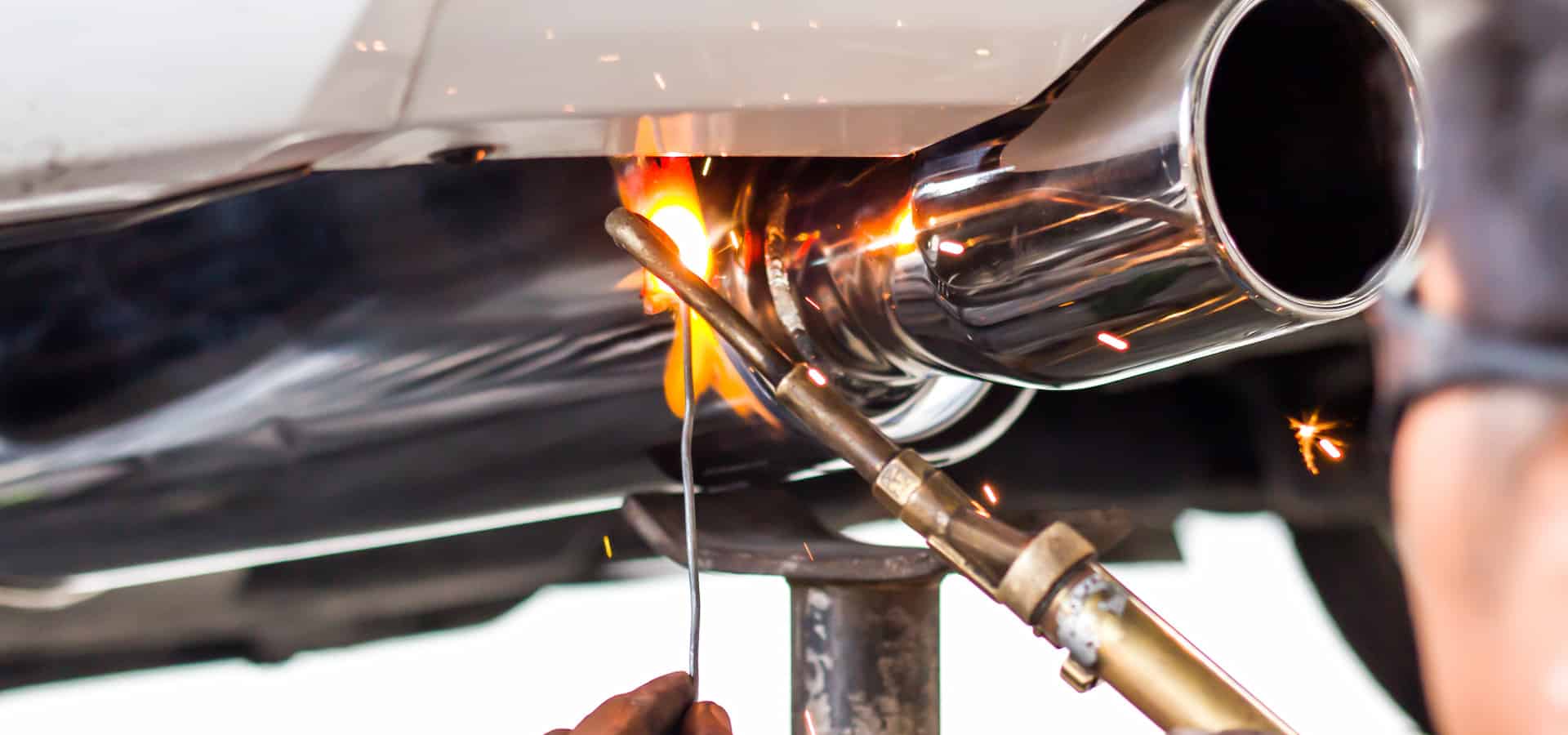
Lexus Exhaust & Catalytic Converter Repair at Elevation Auto Repair
Lexus builds its emissions systems to tighter tolerances than most drivers realize, and that precision is exactly why a botched exhaust repair shows up so quickly on the dash. A generic muffler shop welds in a universal cat, clears the code, and sends you off – then the P0420 or P0430 returns because the replacement converter never met the oxygen-storage spec the ECU expects.
We approach it differently. Lexus catalytic converter and exhaust work on platforms like the GX and LX V8s or the 2GR-FE V6 depends on getting the air-fuel data right first, verifying upstream and downstream O2 sensor readings before condemning a converter. Many "bad cat" complaints trace back to sticking VVT-i solenoids or a lazy oxygen sensor, not the converter itself.
Proper repair also means honoring factory flange torque specs and gasket sequencing so exhaust leaks don't skew sensor readings. On several V8 GX and LX applications, converters are integrated close to the manifold, so heat management and correct hardware matter.
- Honest diagnostics that confirm the real fault before we replace parts
- Direct-fit or OEM-grade converters that satisfy Lexus emissions thresholds
- Proper sensor testing on both bank 1 and bank 2 circuits
- Clear communication on what you need now versus what can wait
Symptoms – How to Know You Need This Service
Lexus owners tend to notice exhaust problems early because these cars are so quiet at baseline. Here's what usually brings drivers in:
- You may notice a check engine light with P0420 or P0430 – often a converter efficiency or O2 sensor issue
- A rattling sound under the floor, especially over bumps, hinting at a broken internal catalyst substrate
- A rotten-egg or sulfur smell pointing to a saturated or failing converter
- Loss of power and sluggish acceleration from a partially clogged cat
- A louder-than-normal exhaust note or a low drone signaling a leak at a flange or flex pipe
- Vibration through the floor at idle from a cracked pipe or failed hanger
- Reduced fuel economy tied to bad oxygen sensor feedback
Schedule soon for a lit check engine light, mild rattles, or a slight smell. Stop driving immediately if you have a strong sulfur odor combined with heavy loss of power, glowing-hot exhaust components, or a burning smell in the cabin – a plugged converter can overheat and become a fire risk.
Common Exhaust & Catalytic Converter Repair Issues on Lexus Vehicles
Lexus builds long-lasting exhaust systems, but heat cycling, Colorado altitude, and the way certain V6 and V8 platforms route their manifolds create predictable trouble spots. Here are the failure patterns we see most often on Denver-area Lexus vehicles.
- Integrated exhaust manifold catalysts on 3MZ-FE and 2GR-FE V6 engines – Many RX330, RX350, ES330, and Camry-platform Lexus models place the cat close-coupled to the manifold. Internal substrate breakdown here throws P0420/P0430 and often requires a full manifold-cat assembly rather than a bolt-on cat.
- Cracked exhaust manifolds on early 4.7L 2UZ-FE V8 (GX470, LX470, early Land Cruiser-based platforms) – Repeated hot-cold cycling cracks the manifold flanges and studs, producing a tick at cold start that fades as metal expands.
- Failed flex pipe and downpipe joints on 1UR-FE / 3UR-FE V8 (LS460, GX460, LX570) – The braided flex coupler fatigues and separates, causing an exhaust leak ahead of the O2 sensor and a droning cabin noise.
- Rear (post-cat) O2 sensor faults – Aging air-fuel and heated oxygen sensors on high-mileage IS250/IS350 and ES350 models mimic a bad converter and set false efficiency codes.
- Rusted rear muffler and resonator sections – Road salt on older GS and IS sedans eats the rear axle-back components, causing rattles and hanger failures.
- Hybrid exhaust corrosion on RX450h / CT200h – Cooler exhaust temperatures let condensation collect, accelerating rot in the mid-pipe.
Which Lexus Models We See for Exhaust & Catalytic Converter Repair
We handle exhaust and catalytic converter work across most Lexus platforms in the Denver area. If you can find your model below, we can help:
- RX (2GR-FE / 2GR-FKS V6) – RX330, RX350, RX450h hybrids; front-drive and AWD variants both common
- ES (ES300h, ES350) – V6 and hybrid four-cylinder platforms, frequent O2-sensor-driven P0420 complaints
- IS (IS250, IS300, IS350; XE20 and XE30 chassis) – 4GR-FSE and 2GR variants; IS F with the 5.0L 2UR-GSE we service as well
- GS (GS300/GS350/GS450h) – dual-bank converter setups needing careful bank 1/bank 2 diagnosis
- GX 470 & GX 460 – V8 platforms with manifold-mounted converters and heat-sensitive hardware
- LX 470 & LX 570 – 2UZ-FE and 3UR-FE V8s; larger dual-exhaust systems
- LS (LS430, LS460) – flagship V8 exhaust and converter work
- NX and UX – newer turbo and hybrid compact platforms
Hybrid models like the RX450h and ES300h require extra care around exhaust routing near hybrid components, and we account for that. For older or heavily modified aftermarket exhaust setups, we'll be upfront if a repair falls outside what we can properly emissions-verify. Bring it in and we'll confirm exactly what your Lexus needs.
Causes & Risks – What Happens if Ignored
Most Lexus exhaust problems trace back to heat cycling, age, road salt, and the close-coupled catalyst design that exposes substrates to extreme temperatures. Denver's altitude and temperature swings speed up flange cracking and flex-pipe fatigue.
A small leak or a single efficiency code rarely stays small. Waiting turns an inexpensive sensor or gasket job into a converter replacement, and a failing converter can take downstream components with it.
- Ignoring a P0420/P0430 for months often lets a partially clogged converter overheat and melt its substrate, raising backpressure and choking power.
- A cracked 2UZ-FE manifold left unrepaired lets exhaust wash over nearby wiring and O2 sensor connectors, adding electrical faults to the repair.
- A separated flex pipe on an LS460 dumps hot gas near the transmission and floor pan, risking heat shield and wiring damage.
- Rich or lean running from a false-reading O2 sensor can dump raw fuel into a healthy converter and destroy it.
- Rusted hangers eventually let the exhaust drop, contacting the driveshaft or road surface.
The safety line is simple: any exhaust leak forward of the passenger cabin, or a converter hot enough to smell, moves from "schedule soon" to "handle now."
Safety Impact – Why Exhaust & Catalytic Converter Repair Matters
An exhaust problem on a Lexus is not just a noise issue. Leaks upstream of the cabin can introduce carbon monoxide, and a plugged converter changes how the whole engine responds when you need power to merge or climb a grade.
- Stop driving now: exhaust or sulfur smell inside the cabin, glowing-hot converter, loud roar with visible smoke, or a dragging/dropped exhaust component.
- Schedule soon: a persistent check-engine light with P0420/P0430, a cold-start tick that fades, a low drone at highway speed, or a mild loss of throttle response.
A restricted converter also skews the air-fuel data the ECU relies on, which can affect drivability during hard braking or evasive maneuvers where consistent power delivery matters. On hybrid Lexus models, exhaust faults can trigger reduced-power modes that limit acceleration without warning.
There is a liability angle too. A known exhaust leak or missing converter that goes unaddressed before an emissions test failure or a carbon-monoxide incident is far harder to defend than a documented repair. We give you a clear, honest diagnosis so nothing gets deferred by accident.
How Lexus Exhaust & Catalytic Converter Repair Actually Works
Your Lexus exhaust system does two jobs: it routes hot gas away from the cabin and cleans it through the catalytic converter, while wide-band air-fuel sensors and downstream oxygen sensors feed the ECU real-time data. The computer compares upstream and downstream readings to judge converter efficiency, which is exactly what triggers those P0420/P0430 codes.
What makes Lexus work different from a generic muffler-shop approach is the tight integration between the converter, the sensors, and the engine software.
- Close-coupled and integrated manifold-cat designs on many V6 platforms mean the correct OEM-fit part matters – a cheap universal cat often re-triggers the same code.
- Air-fuel ratio sensors need proper diagnosis with factory-level tooling (Techstream-style data) to separate a bad sensor from a bad converter before any part is replaced.
- Manifold and downpipe bolts follow specific torque and tightening sequences to prevent warping and repeat leaks.
- Hybrid Lex
How We Diagnose Exhaust & Catalytic Converter Repair Issues on Lexus
A P0420 or P0430 code on a Lexus rarely means the converter itself has failed. On the 2GR-FE V6 (ES 350, RX 350) and 2UR-FSE V8 (LS, GS), a lazy air-fuel or downstream oxygen sensor throws the same code – and generic shops swap the cat without confirming it. We start with the sensor data before touching hardware.
- Pull all pending and stored codes with a Techstream-capable scan tool, reading freeze-frame data to see the conditions when the fault set.
- Graph the upstream air-fuel ratio sensor against the downstream O2 sensor in live data – a healthy converter keeps the rear sensor voltage flat while the front oscillates.
- Check for exhaust leaks at the flex pipe and manifold flanges, a known trigger for false rich/lean readings on higher-mileage GX and RX models.
- Perform a visual inspection of the entire system – heat shields, hangers, rusted mid-pipes, and the converter substrate for rattle or melting.
- Run a road test to reproduce the fault under load and confirm whether the reading tracks with throttle and RPM.
- Measure back-pressure where a clogged substrate is suspected, since a restricted cat behaves differently than a chemically degraded one.
Once we know whether the issue is a sensor, a leak, or the converter itself, we build a clear repair plan and a written quote so you approve the actual fix – not a guess.
Exhaust & Catalytic Converter Repair on Lexus: Repair vs. Replacement
Not every exhaust complaint needs a new converter. We match the repair to what the data and inspection actually show.
- Genuine repair: Replacing a failed downstream O2 sensor, sealing a leaking flange gasket, or swapping a corroded hanger on an ES or IS often clears the fault entirely – the converter stays.
- Partial replacement: On RX 350 and GX 460 platforms with dual bank exhaust, one bank's converter or a rusted mid-pipe section can be replaced while the opposite side and muffler remain serviceable.
- Full replacement: A physically melted or rattling substrate – often caused by an ignored misfire or oil consumption on higher-mileage 1MZ/3MZ engines – calls for the full converter assembly, since patching a collapsed cat just fails again.
When repair cost climbs toward the price of a new OEM-grade assembly, or when the failure is safety-related like an exhaust leak near the cabin, replacement is the honest recommendation. We lay out both paths, explain what each buys you in reliability, and let you choose – no pushing the biggest ticket.
How to Make Your Lexus Exhaust & Catalytic Converter Repair Last Longer
Converters and exhaust components on a well-kept Lexus can outlast most cars – if the engine feeding them stays healthy.
Driving habits that help
- Let the engine reach operating temperature before hard acceleration, especially in Denver's cold mornings, so the cat lights off cleanly.
- Avoid short trips that never fully warm the system – repeated cold cycles trap moisture and accelerate rust on mid-pipes.
- Address any misfire, rough idle, or rich-running condition promptly, since unburned fuel is what destroys a converter substrate.
Owner maintenance you can do
- Listen for new rattles, ticking, or a droning exhaust note and report changes early.
- Glance under the vehicle for surface rust, hanging pipes, or dangling heat shields.
- Never ignore a check engine light – a small sensor fault left running can turn into a converter failure.
Brand-specific care
- Use OEM-spec oil and stay on Lexus's service intervals to prevent oil consumption that contaminates the cat.
- Keep ECU software current, since updated fuel and O2 sensor calibrations affect converter longevity.
Simple visual checks and prompt attention to warning lights are safe for owners. Leave sensor replacement, exhaust welding, and converter work to us – it involves hot components and emissions-critical systems best handled with the right equipment.
What to Expect When You Bring Your Lexus In
On Lexus V6 and V8 platforms, a P0420 or P0430 code often gets blamed on the catalytic converter when the real culprit is an upstream air-fuel ratio sensor or a worn front cat flange on the 2GR-FE and 3UR-FE engines. We start by verifying, not guessing.
- Drop-off or scheduled appointment – Tell us the symptoms: rattling on cold start, sulfur smell, droning at highway speed, or a check engine light. Grab personal items from the cabin; we secure the vehicle either way.
- Initial inspection – We lift the car, inspect the exhaust from manifold to tailpipe, check flex-pipe and heat-shield integrity, and pull live data with a factory-level scan tool to read O2 sensor switching and catalyst efficiency.
- Written estimate – You get a clear breakdown of what needs replacing versus what's still serviceable, with any applicable Lexus TSBs noted.
- Communication during the work – We reach out before doing anything beyond the approved scope. No surprise add-ons.
- Pickup walkthrough – We show you the old parts and explain what changed.
Loaner and shuttle options help you stay mobile, and after-hours pickup is available when you need it. Before the keys go back, we road test the vehicle and re-scan to confirm catalyst efficiency has recovered and no codes return. If anything feels off afterward, bring it back and we'll recheck it.
Why Choose Elevation Auto Repair for Lexus Exhaust & Catalytic Converter Repair
Lexus exhaust work rewards attention to detail. Federal versus California emissions cats differ by part number, and installing the wrong unit on an RX, ES, GX, or IS will trip codes again within a few drive cycles. We match components to your VIN and emissions spec.
- Brand-specific diagnostics – We interpret Lexus-specific freeze-frame data and catalyst monitor readiness rather than throwing parts at a P0420.
- TSB and software awareness – Some efficiency codes on later platforms trace back to ECM calibration updates, not hardware, and we check for those first.
- Platform quirks – Manifold-mounted cats on GR-series V6s, flex-pipe cracking on higher-mileage GX and LX models, and heat-shield rattle that mimics internal cat failure.
- Correct fasteners and torque – New gaskets, proper flange torque, and anti-seize where the OEM procedure calls for it.
We own the job start to finish – diagnosis, repair, and post-repair verification under one roof. That means fewer comebacks, a cleaner emissions monitor, and a Lexus that drives quiet and pulls the way it should.
Our Lexus Services
- Air Conditioning AC Repair
- Battery Repair Replacement
- Brake Repair & Brake Fluid Change
- Check Engine Light Diagnostics
- Clutch Repair & Replacement
- Coolant Leak Repair
- Cooling System Repair
- Drive Shaft Repair
- Engine Repair
- Head Gasket Repair & Replacement
- Oil Change
- Oil Leak Repair
- Scheduled Service Maintenance
- Steering Repair
- Suspension Repair
- Cambelt Timing Belt Replacement
- Transmission Repair
- Tune Up
- Wheel Alignment