Dodge Exhaust & Catalytic Converter Repair at Elevation Auto Repair
A botched exhaust or catalytic converter repair on a Dodge can cost you far more than the part itself – wrong cat substrate triggers repeat P0420 codes, and a mismatched replacement on a HEMI or Pentastar can throw the fuel trims off and dump you back into limp mode. Getting it right the first time takes someone who knows how these platforms actually behave.
Exhaust and catalytic converter work covers everything from the manifold and downpipe to the mid-cat, resonator, muffler, and the oxygen and downstream sensors that report to the PCM. On a Dodge, the difference between a proper repair and a generic patch usually comes down to two things:
- Software-aware diagnostics – the 5.7L and 6.4L HEMI along with the 3.6L Pentastar rely on precise upstream/downstream O2 sensor readings, so we scan with equipment that reads live catalyst efficiency data rather than just clearing a code.
- Correct converter specification – federal versus CARB-compliant cats and the exact substrate matter, especially on emissions-tied VINs.
- Proper torque and gasket sequencing on manifold-to-head and flange connections to prevent the exhaust leaks these engines are known for.
Here's what you can expect from us:
- Honest diagnostics that separate a real cat failure from a bad sensor or leak
- OEM-aligned parts and correct converter matching for your VIN
- Clear communication before any work begins – no surprise add-ons
- Repairs done to keep your Dodge safely and legally on the road
Symptoms – How to Know You Need This Service
Exhaust problems rarely stay quiet. On a Dodge, you may notice several of these before the system fully gives up:
- Check engine light with P0420 or P0430 – the classic catalyst-efficiency codes on HEMI and Pentastar engines.
- Rotten-egg or sulfur smell from the tailpipe, a strong sign of a failing converter.
- Loud rumble or drone that gets worse under acceleration – often a cracked manifold, blown flange gasket, or rusted-through mid-pipe.
- Sluggish acceleration and poor fuel economy when a clogged cat restricts flow.
- Rattling underneath at idle or over bumps, usually a broken heat shield or a collapsed catalyst substrate.
- Hissing or ticking near the exhaust manifold on cold start – a common HEMI manifold bolt or gasket issue.
- Fumes noticeable inside the cabin.
Schedule soon for smells, codes, and rough performance. Stop driving immediately if you smell exhaust inside the cabin, hear a loud sudden roar, or feel the vehicle losing power dramatically – those point to a leaking or dangerously restricted system that puts your safety at risk.
Common Exhaust & Catalytic Converter Repair Issues on Dodge Vehicles
A botched exhaust repair on a Dodge often shows up as a P0420 that never clears, a rattling heat shield, or a converter that clogs again within a year. Getting the diagnosis right the first time saves you from paying twice. Here are the patterns we see most across the Dodge lineup.
- P0420/P0430 catalyst efficiency codes on 5.7L HEMI RAM 1500 and Charger/Challenger: The rear O2 sensor reads a lazy converter, but the actual culprit is frequently a failed downstream sensor or an upstream misfire cooking the cat over time.
- Manifold-to-catalytic converter cracks on 3.6L Pentastar (2011+ Grand Cherokee, Charger, Journey): The integrated manifold design and thermal cycling lead to hairline cracks and exhaust leaks at the flange, triggering lean codes and a ticking noise on cold start.
- Cracked exhaust manifolds and broken bolts on 5.7L/6.4L HEMI: Manifold bolts back out or snap flush with the head, causing an exhaust tick that worsens as the engine warms and cools.
- Rusted-through mid-pipe and muffler assemblies on Colorado-driven Dakota, Durango, and RAM trucks: Road salt and freeze/thaw cycles perforate the underbody piping and resonators long before the converter itself fails.
- Loose or rattling heat shields on Journey, Avenger, and Caravan: Spot welds fatigue and the shield buzzes at idle or specific RPM ranges.
- Clogged converters from oil consumption on higher-mileage Pentastar and EcoDiesel platforms: Excess oil or coolant contamination glazes the substrate, restricting flow and killing throttle response.
Which Dodge Models We See for Exhaust & Catalytic Converter Repair
We service the full modern Dodge lineup, and these are the platforms that most often come in for exhaust and catalytic converter work:
- Charger & Challenger (LX/LD/LA, 2006–present) – 3.6L Pentastar, 5.7L, 6.4L 392, and supercharged 6.2L Hellcat. High-output SRT and Hellcat variants use larger-diameter exhaust and often need specific converter and downpipe attention.
- Durango (WD, 2011–present) – Pentastar and HEMI variants, commonly seen for downstream sensor and mid-cat issues.
- Grand Caravan (RT, 2008–2020) – 3.6L Pentastar, frequent flex-pipe and rear cat failures with age.
- Journey (JC, 2009–2020) – 2.4L and 3.6L, typically manifold gasket and converter efficiency codes.
- Dakota & Durango (earlier 2000s HEMI/Magnum V6/V8) – rust-driven mid-pipe and manifold work common on higher-mileage trucks.
- Ram-badged Dodge pickups (pre-2011) – 4.7L and 5.7L exhaust and cat repairs.
SRT, 392, and Hellcat models take extra care because of their performance exhaust design and emissions specifications. If you're driving a heavily modified or aftermarket-tuned setup, let us know up front so we can match parts correctly. For rare classic or pre-2000 Dodge models, reach out first and we'll tell you honestly whether we're the right fit.
Causes & Risks – What Happens if Ignored
Most Dodge exhaust problems trace back to a mix of Denver's climate, thermal stress, and a few platform design choices. Road salt attacks the underbody, altitude changes fueling loads, and HEMI manifold bolts simply weren't built to survive endless heat cycles.
Ignoring a small leak or a lazy converter rarely stays small. A single cracked manifold flange feeds unmetered air to the O2 sensors, which throws off fueling and slowly poisons the catalyst.
- Ignoring a P0420 for months typically lets an upstream misfire or oil consumption issue destroy the converter substrate entirely.
- A minor exhaust leak on a 3.6L Pentastar flange can turn into warped flanges and a full converter-manifold replacement once heat cycling widens the crack.
- Snapped HEMI manifold bolts left unaddressed can lead to a burned gasket, scored sealing surface, and eventually cylinder head machining.
- A clogged converter creates backpressure that strains the transmission and can trigger limp mode on the 8-speed and older 5/6-speed automatics.
- Rusted mid-pipes drop exhaust under the cabin, raising carbon monoxide exposure risk for occupants.
What starts as a rattle or a check engine light becomes a driveability, safety, and wallet problem. We diagnose the root cause first so you replace the converter once, not twice.
Safety Impact – Why Exhaust & Catalytic Converter Repair Matters
Exhaust integrity is a genuine safety system on any Dodge. Leaks route carbon monoxide toward the cabin, and a converter meltdown can pump enough heat to scorch underbody components or start a fire on dry grass.
- Stop driving now: Strong exhaust smell inside the cabin, glowing-hot converter, sulfur/rotten-egg odor with power loss, or a converter rattling loose enough to drop.
- Stop driving now: Sudden severe power loss with the vehicle entering limp mode – often a fully plugged converter.
- Schedule soon: Intermittent P0420, a cold-start exhaust tick on a Pentastar or HEMI, or a heat-shield buzz at idle.
- Schedule soon: Slight sulfur smell under load or a check engine light that clears and returns.
Carbon monoxide is odorless and dangerous, and a leaking exhaust near the cabin puts every passenger at risk. There's also a liability angle: a known exhaust defect left unrepaired before an emissions failure or an incident can complicate insurance and registration. Addressing it promptly keeps you legal, comfortable, and safe on the road.
How Dodge Exhaust & Catalytic Converter Repair Actually Works
Your Dodge's exhaust system routes gases from the manifolds through one or more catalytic converters, where precious-metal coatings convert harmful emissions before they exit the tailpipe. Upstream and downstream O2 sensors constantly compare oxygen levels so the PCM can confirm the converter is doing its job – that comparison is exactly what sets a P0420 or P0430.
Dodge's implementation adds a few wrinkles that change how the repair has to be done correctly.
- Integrated manifold-converter designs on many Pentastar applications mean flange sealing and torque sequence matter as much as the part itself.
- HEMI manifold bolt extraction often requires proper drilling and thread repair rather than brute force to protect the cylinder head.
- OEM-grade converters matched to your engine and emissions calibration prevent repeat efficiency codes that cheap universal cats often trigger.
- Post-repair
Botching exhaust work on a Dodge gets expensive fast. A misdiagnosed rattle on a 5.7L HEMI Ram, a downstream O2 code chased with a new converter it never needed, or a rushed weld on a rusted flange can turn a modest fix into a repeat visit. Catalytic converters on these platforms are pricey OEM assemblies, and Colorado's high-altitude emissions testing leaves no room for guesswork. We get it right the first time.
How We Diagnose Exhaust & Catalytic Converter Repair Issues on Dodge
A P0420 or P0430 rarely tells the whole story. We build the picture from data, then confirm it with our hands and ears.
- Full scan and freeze-frame pull – We connect a factory-aligned scan tool to read Dodge/Mopar-specific codes, upstream and downstream O2 sensor voltages, and short/long-term fuel trims that expose whether the converter or a sensor is the real culprit.
- Live data comparison – Watching downstream O2 response against upstream tells us if the catalyst is still doing its job – a common check on 3.6L Pentastar Chargers, Challengers, and Grand Caravans throwing efficiency codes.
- Visual inspection on the lift – We look for cracked flex pipes, rusted-through mid-pipes on older Durangos and Dakotas, loose heat shields (a frequent HEMI rattle source), and blown gaskets at the manifold.
- Backpressure and temperature testing – A restricted converter shows measurable backpressure and a temperature split across the cat body.
- Road test – We verify noise, hesitation, and rattle under load and confirm the code doesn't return.
From there you get a plain-language explanation of what failed, what's still good, and a clear quote before any work starts.
Exhaust & Catalytic Converter Repair on Dodge: Repair vs. Replacement
Not every exhaust complaint means a new converter. We sort it into honest categories.
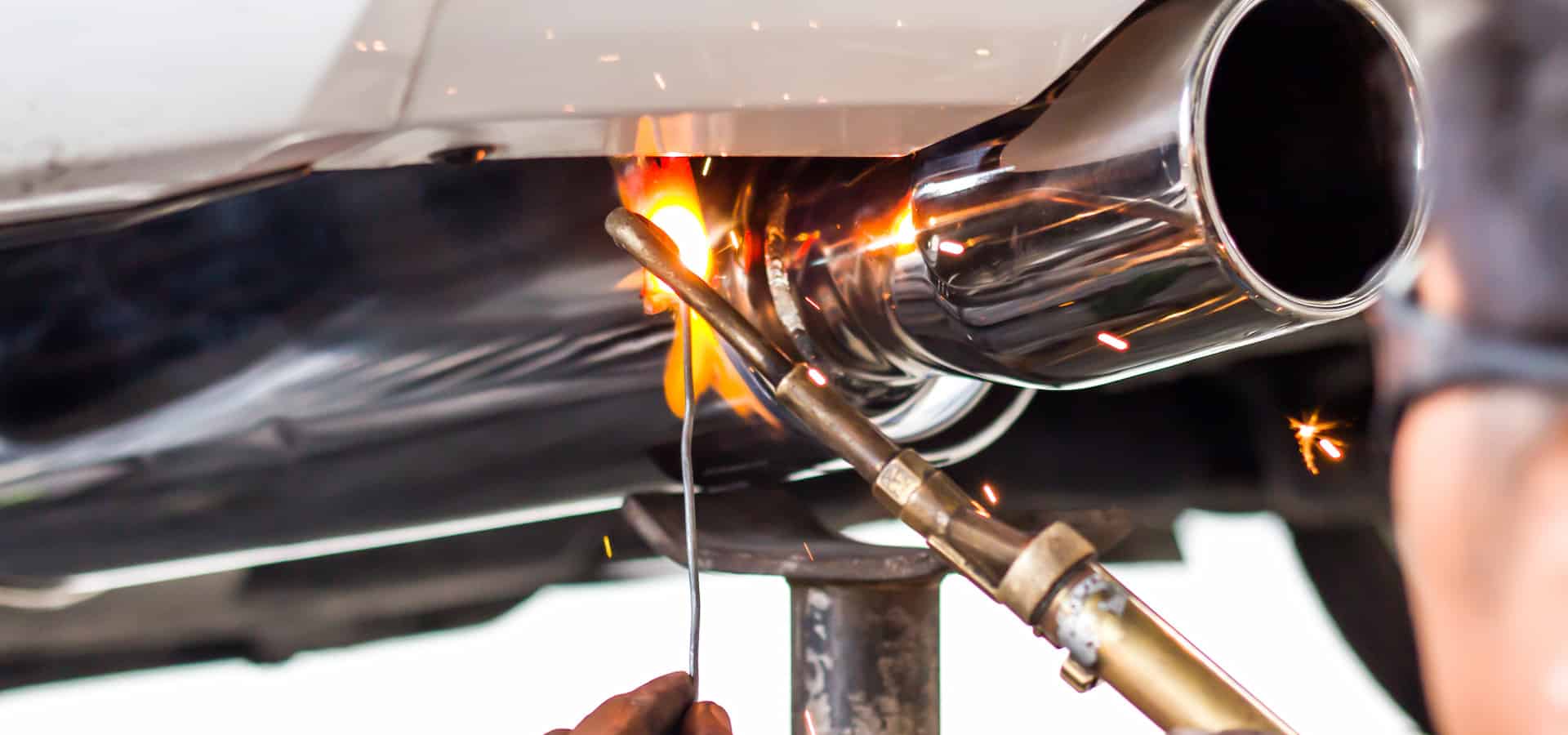
- Genuine repair – Loose heat shields on HEMI-powered Rams and Chargers, a single failed O2 sensor mimicking a cat failure, a leaking manifold gasket, or a clamp and gasket at a slip joint. These are straightforward fixes that restore function without touching the catalyst.
- Partial replacement – A cracked flex pipe or rusted mid-pipe section on an older Durango or Dakota can be sectioned and replaced while keeping the good converter and muffler. Same goes for one failed converter on a dual-bank Pentastar where the opposite bank still passes.
- Full replacement – When a converter is internally collapsed, contaminated by a burning-oil or rich-fuel condition, or the surrounding pipe is rotted, replacing the assembly is safer and often more economical than repeated partial fixes.
We walk you through each option with the data behind it, so you choose the fix that fits the vehicle and your budget – not the biggest invoice.
How to Make Your Dodge Exhaust & Catalytic Converter Repair Last Longer
Converters and exhaust joints last longer when the engine runs clean and you catch small problems early.
- Drive it warm – Let a cold Dodge idle briefly before hard acceleration; repeated cold-throttle loads shorten catalyst life, especially in Denver winters.
- Fix misfires and oil consumption promptly – Raw fuel or burning oil is the fastest way to poison a converter on HEMI and Pentastar engines.
- Listen and look – Rattles under the floor, a louder exhaust note, or a check-engine light are early warnings worth reporting.
- Rinse road salt – Undercarriage washes slow the flange and pipe rust that plagues older Durangos, Dakotas, and Grand Caravans.
Stick with OEM-grade oxygen sensors and Mopar-spec fluids, keep powertrain software current, and follow Dodge's recommended service intervals. Safe DIY includes visual checks, monitoring warning lights, and keeping the undercarriage clean. Leave welding, converter replacement, and O2 sensor diagnosis to us – these are emissions and safety-critical systems where a shortcut costs more than it saves.
What to Expect When You Bring Your Dodge In
A botched catalytic converter job on a Dodge can trip a P0420 or P0430 code that never clears, foul downstream O2 sensors, or leave a HEMI droning at highway speed. We built our process to avoid exactly that.
- Drop-off or appointment – Schedule ahead or leave the vehicle after hours in our secure lot. Tell us what you're hearing: a rattle from the converter substrate, a rasp from a cracked flex pipe, or a rich smell.
- Initial inspection – We put your Dodge on the lift and inspect the manifold, mid-pipe, converter housing, hangers, and O2/AFR sensors, then pull live data with a scan tool to confirm whether the cat is actually failing or a sensor is lying.
- Written estimate – You get a clear breakdown of parts and labor before we touch anything. No surprise add-ons.
- Communication during the work – We text or call with findings and get your approval before proceeding. Loaner and shuttle options are available so you stay mobile.
- Pickup walkthrough – We show you the old parts, explain what failed, and review any preventative items we flagged.
Leave personal items in the cabin if you like – we don't disturb them. Before you drive off, we road test the vehicle and re-scan to confirm readiness monitors set and no codes return. If anything feels off afterward, bring it back and we'll recheck it.
Why Choose Elevation Auto Repair for Dodge Exhaust & Catalytic Converter Repair
Exhaust work on late-model Dodge platforms is unforgiving. Federal-spec converters must match the calibration, or the PCM never sets the catalyst monitor. We source the right part and verify it does its job.
- Platform-specific know-how – Familiarity with 5.7L and 6.4L HEMI manifold-bolt breakage on Ram/Charger/Challenger, tick-prone lifters that mimic exhaust noise, and 3.6L Pentastar cat efficiency codes on Journey, Durango, and Grand Caravan.
- TSB and software awareness – We check for applicable Dodge bulletins and PCM updates before condemning a converter, since a recalibration sometimes resolves a false efficiency code.
- End-to-end ownership – The same shop diagnoses, repairs, and verifies. We don't hand off the road test or skip the post-repair scan.
As your Denver dealership alternative, we handle everything from a single leaking flex pipe to a full mid-pipe and sensor replacement – with honest diagnostics and no unnecessary parts.
Our Dodge Services
- Air Conditioning AC Repair
- Battery Repair Replacement
- Brake Repair & Brake Fluid Change
- Check Engine Light Diagnostics
- Clutch Repair & Replacement
- Coolant Leak Repair
- Cooling System Repair
- Drive Shaft Repair
- Engine Repair
- Head Gasket Repair & Replacement
- Oil Change
- Oil Leak Repair
- Scheduled Service Maintenance
- Steering Repair
- Suspension Repair
- Cambelt Timing Belt Replacement
- Transmission Repair
- Tune Up
- Wheel Alignment