Dodge Drive Shaft Repair at Elevation Auto Repair
A botched drive shaft job on a Dodge shows up fast – vibration that shakes the cabin at highway speed, a driveline clunk on takeoff, or worse, a shaft that lets go and leaves you stranded. Getting it right the first time protects your transmission, your differential, and your wallet.
Drive shaft work connects power from the transmission or transfer case to the axles, so precision matters. Dodge platforms complicate this in specific ways. The RWD and AWD Charger and Challenger (LX/LD/LC, 2006 and up) run a two-piece shaft with a center support bearing that fails and a flex disc (guibo) on some builds. The RAM 1500 (DS/DT) and Durango use CV-jointed shafts and, on AWD/4WD models, front prop shafts feeding the transfer case. We phase-align multi-piece shafts and torque flanges to Dodge specs so the balance you paid for actually holds.
- Straight-answer diagnosis using driveline inspection and runout measurement, not guesswork
- Correct handling of center support bearings, U-joints, CV joints, and flex discs by platform
- Proper phasing, balancing, and flange torque so vibration doesn't return
- Fast turnaround that gets you safely back on the road
Symptoms – How to Know You Need This Service
Driveline problems tend to announce themselves. Here's what you may notice on a Dodge before a shaft or joint fails outright.
- Vibration that builds with speed – often felt in the seat or floor above 45 mph, a classic sign of a worn U-joint or failing center support bearing on Charger/Challenger two-piece shafts
- Clunk on acceleration or when shifting into gear – worn U-joints or a loose flange yoke
- Squeaking or clicking that speeds up with the vehicle – a dry or dying U-joint needing attention soon
- Shudder on takeoff – common with a deteriorating flex disc or CV joint on RAM/Durango AWD shafts
- Rusty brown dust around the U-joint caps – seal failure letting grease out and grit in
- A loud metallic bang or sudden loss of drive – stop driving immediately and have it towed; a shaft may be separating
Vibration and squeaks mean schedule soon. A hard clunk paired with driveline noise, or any banging under the floor, means stop and call us before the shaft drops.
Common Drive Shaft Repair Issues on Dodge Vehicles
Dodge's mix of rear-wheel-drive cars, 4x4 trucks, and AWD platforms means drive shaft complaints show up in patterns we see again and again on Denver vehicles.
- U-joint failure on Ram 1500/2500/3500 (2009-present DS/DJ platform): Non-greaseable factory U-joints wear out with mileage, producing a driveline clunk on acceleration and rusty "brinelling" dust around the caps.
- Center support bearing wear on two-piece Ram shafts: Longer wheelbase and Mega Cab trucks use a carrier bearing that dries out, causing a growling vibration between 45-65 mph that worsens under load.
- Rear CV / driveshaft joint on Charger, Challenger, and 300 (LX/LD platform): RWD V6 and Hemi cars use a driveshaft with a CV-style flex joint at the transmission that develops a shudder on takeoff as it ages.
- PTU and rear shaft issues on AWD Charger/300: The active AWD system's rear driveline connection can develop play and vibration when the disconnect components wear.
- Front axle shaft and CV wear on 4x4 Ram and Durango (WD/WK platforms): Torn CV boots let grit into the joint, leading to clicking on turns and eventual joint failure.
- Slip yoke and spline wear: On lifted or high-mileage Ram trucks, a dry slip yoke binds and transmits a distinct clunk when shifting between drive and reverse.
Which Dodge Models We See for Drive Shaft Repair
We service the Dodge platforms Denver drivers bring in most, and we know where each one tends to give trouble. Find your vehicle below.
- Charger & Challenger (LX / LD / LC, 2006–present) – RWD and AWD; two-piece rear shafts with center support bearing wear, and flex disc issues on certain builds. SRT and Hellcat variants see harder driveline loads that accelerate U-joint and bearing wear
- Durango (WD / WK2, 2011–present) – AWD models with front prop shafts to the transfer case; center bearing and CV joint concerns common with age and mileage
- RAM 1500 (DS & DT, 2009–present) – 2WD and 4WD; front and rear shafts, U-joints, and CV-jointed rear shafts on longer wheelbase trucks
- RAM 2500 / 3500 (heavy duty) – robust U-joint shafts that take a beating under towing loads
- Journey, Grand Caravan – FWD-based; driveline noises here often trace to CV axles rather than a traditional shaft, and we'll tell you honestly which it is
Older discontinued models and rare imports fall outside what we routinely stock parts for, but reach out and we'll let you know before you make the trip.
A driveline problem on a Dodge rarely announces itself politely. What starts as a subtle vibration at highway speed on a Ram 1500 or a clunk when a Charger drops into gear can end with a two-piece shaft dropping onto the pavement if the wrong part gets guessed at. Getting the diagnosis right the first time – and turning the truck or car around quickly – is the difference between a straightforward repair and a tow bill. That's the standard we hold ourselves to at Elevation Auto Repair.
Causes & Risks – What Happens if Ignored
Most Dodge driveline wear traces back to a few sources: sealed U-joints that can't be re-greased, Colorado's road salt and temperature swings drying out bearings and boots, and the towing and off-road duty these trucks are built to handle. Age and mileage do the rest.
Waiting is where a small job turns into a big one. A worn U-joint that gets ignored doesn't stay a U-joint problem.
- Ignoring a clunking U-joint on a Ram for months typically chews up the yoke ears and can score the transmission tailshaft or differential pinion – now you're replacing more than a joint.
- A dry center support bearing left alone can seize, whipping the shaft and damaging the crossmember or exhaust.
- A torn CV boot on a Durango or 4x4 Ram lets the grease escape and dirt in, converting a boot replacement into a full axle shaft.
- A failing driveshaft on an LX-platform Charger can eventually separate, which risks the shaft dropping and striking the road or brake lines.
The safety line gets crossed once vibration turns to shudder under power, or a clunk becomes a bang – that means play has grown to the point of imminent failure. Bring it in and we'll pinpoint it fast.
Safety Impact – Why Drive Shaft Repair Matters
The drive shaft sits at the center of how your Dodge puts power to the ground, and a failure there cascades into systems you count on to stay in control.
- Stability and traction control: A seized or separated shaft confuses wheel-speed inputs, which can trigger unexpected ABS, ESC, or traction intervention.
- Braking and brake lines: A dropped shaft can whip against undercarriage brake and fuel lines, risking a leak.
- Steering feel on 4x4 Rams and Durangos: A failing front CV or axle joint affects how the truck tracks and turns.
- Loss of drive entirely: A separated shaft leaves you coasting with no power and a potential undercarriage impact.
Stop driving now if: you hear a loud bang on acceleration, feel a violent shudder, or see fluid leaking after a driveline noise.
Schedule soon if: you notice a mild highway vibration, a single clunk when shifting into gear, or clicking on tight turns.
A known driveline defect left unaddressed before an incident can also complicate an insurance or liability claim, so documented repair matters.
How Dodge Drive Shaft Repair Actually Works
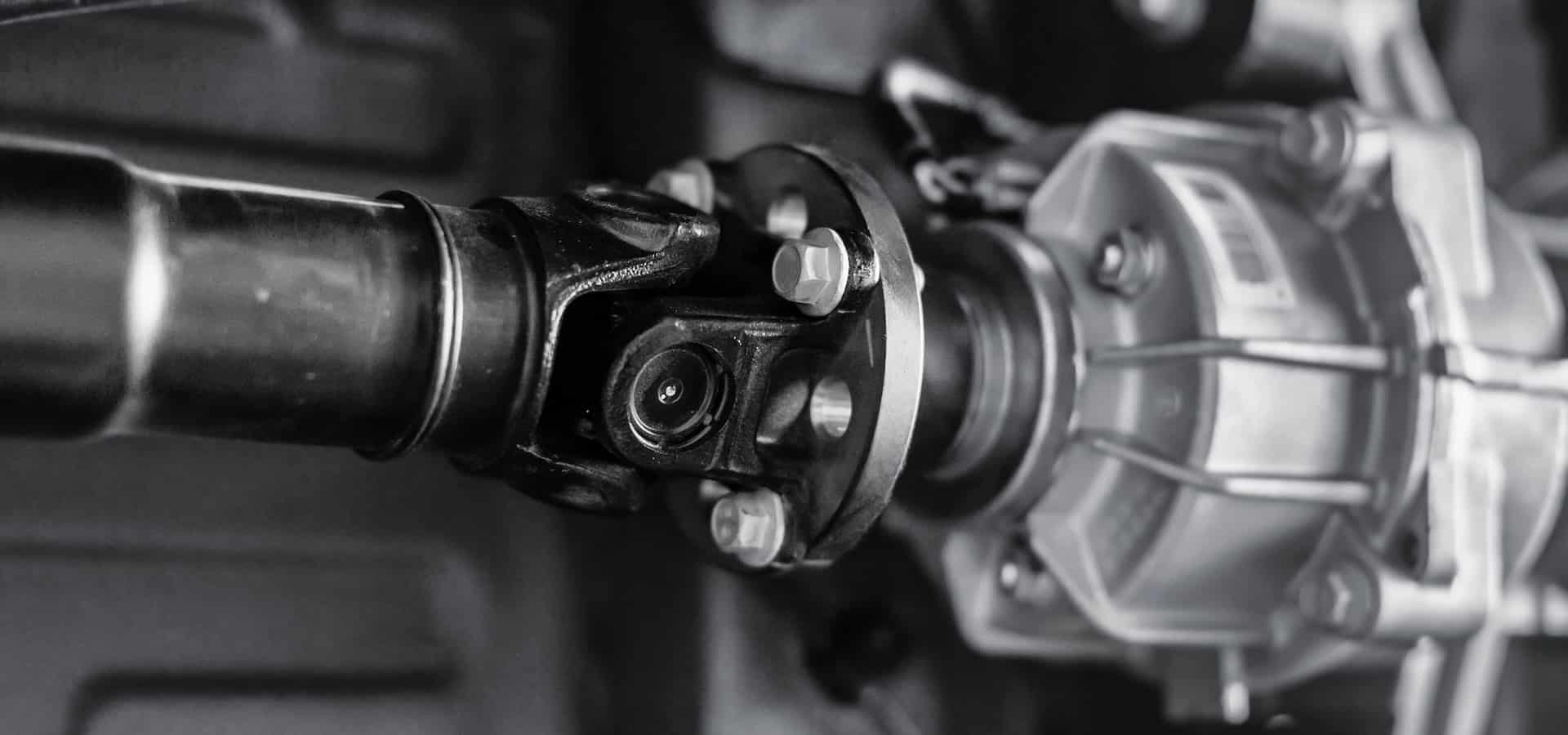
Your Dodge's drive shaft is a balanced steel or aluminum tube that transfers torque from the transmission or transfer case to the axle, using U-joints or CV-style joints to flex as the suspension moves. On two-piece truck shafts, a center support bearing keeps the long assembly stable.
What sets Dodge work apart is the attention to balance and platform-specific hardware. Ram and LX-platform shafts are dynamically balanced from the factory, so component replacement and reassembly have to preserve that balance or a new vibration appears.
- Phasing matters: Two-piece Ram shafts must be reassembled in the correct clocking, or you'll induce a driveline vibration.
- Torque and sequence specs: Driveshaft flange, U-bolt, and center bearing fasteners have specific values that keep the assembly true.
- Electronic parking brake and AWD:
A misdiagnosed driveline on a Dodge gets expensive fast – a vibration blamed on the drive shaft can actually trace back to a worn CV axle, a collapsed transmission mount, or a failing carrier bearing. Guess wrong and you pay twice. On rear-drive platforms like the LX/LD Charger and Challenger, or the DT-generation Ram 1500, the two-piece shaft with its center support bearing and U-joints hides several failure points that look identical from the driver's seat. Getting the pinpoint right the first time is where a fast, honest diagnosis earns its keep.
How We Diagnose Drive Shaft Repair Issues on Dodge
We start with the symptom and narrow it down quickly, because a shaking driveline can come from a dozen sources on these platforms.
- Scan the modules – We pull codes with a wiTECH-compatible scan tool to read the PCM, ABS, and AWD transfer case data on models like the AWD Charger, which can flag driveline speed mismatches.
- Road test – We drive at the speed where the vibration or clunk appears, noting whether it changes with throttle, coast, or turning – key for separating U-joint versus CV versus tire issues.
- Lift and inspect – Visual check of U-joints for rust-colored dust around the caps, torn CV boots, and a center support bearing that's cracked or oil-soaked on Ram two-piece shafts.
- Hands-on play test – We rotate the shaft and feel for radial and axial slop in each joint and the slip yoke.
- Runout measurement – A dial indicator confirms whether the shaft itself is bent or the flange is out of spec.
From there we hand you a plain-language repair plan and a quote that lists exactly what needs attention and why – no padding, no guesswork.
Drive Shaft Repair on Dodge: Repair vs. Replacement
The right call depends on how far the wear has spread, and we base it on what the inspection actually shows.
- Genuine repair – A single serviceable U-joint on an older Ram or Durango can be pressed out and replaced, or a slip yoke re-greased and a loose flange bolt re-torqued to spec. If the tube and balance are good, you keep the assembly.
- Partial replacement – On two-piece Ram shafts, a failed center support bearing can often be replaced on its own while the shaft sections stay in service. Same logic applies to a torn CV boot caught early before the joint packs with debris.
- Full replacement – Modern LX/LD shafts use staked, non-serviceable joints, so once a U-joint or CV fails the whole shaft is replaced. We also replace outright when there's cascading wear, a bent tube, or when repair cost creeps toward a new assembly.
We walk you through each option with the parts in front of you, so you decide – not us.
How to Make Your Dodge Drive Shaft Repair Last Longer
Good habits protect the fresh parts and buy you years before the next service.
- Drive smoother – Avoid hard launches and abrupt shifts between drive and reverse, which shock-load U-joints and the center bearing on Ram and Charger drivelines.
- Warm up in cold weather – Denver winters stiffen grease; a gentle first mile lets the joints and slip yoke lubricate before load.
- Watch the load – Overloading a Ram bed stresses the driveline; stay within the door-jamb payload rating.
- Listen and look – A new clunk on acceleration or a growl that rises with speed is your cue to have it checked early.
Owner-friendly checks include peeking at CV and center-bearing boots for cracks and confirming no dark grease sling under the truck. Stick with OEM-spec fittings and keep the transfer case and differential fluids on Dodge's recommended intervals, since worn diff fluid loads the shaft's mating components.
Leave U-joint pressing, shaft balancing, and any staked-joint work to the shop – these are safety-critical and need proper tooling and torque specs. Bring it in and we'll handle the rest.
A driveline vibration on a Dodge is rarely just an annoyance. Get the diagnosis wrong on a Ram 1500 or a Charger, and you can chase a "bad U-joint" while a worn center support bearing or a failing rear pinion seal keeps eating parts. On the RWD and 4x4 platforms Dodge builds, a misbalanced two-piece shaft or a neglected slip-yoke can telegraph into transmission tailshaft wear – which is why fast, accurate diagnosis matters more than a quick guess.
What to Expect When You Bring Your Dodge In
We keep the process straightforward so you always know where your vehicle stands.
- Drop-off or appointment – Schedule ahead or leave it with us. Grab your garage remote, sunglasses, and valuables; we'll set the seat and mirrors back the way you left them.
- Initial inspection – We lift the vehicle, check U-joints, the center support bearing on two-piece shafts, slip-yoke play, and the rear pinion flange for runout and leaks.
- Written estimate – You get a clear breakdown of what's worn, what's still good, and what we recommend now versus later. No surprise add-ons.
- Communication during the work – We reach out before any change in scope, so nothing happens without your sign-off.
- Pickup walkthrough – We show you the old parts, explain what was done, and answer questions before you drive off.
Loaner and shuttle options are available, and after-hours pickup can be arranged if your schedule is tight. Every drive shaft repair ends with a road test to confirm the vibration is gone and a scan-tool re-check on ABS and driveline-related sensors. If anything feels off afterward, bring it back – we'll put it on the lift and make it right.
Why Choose Elevation Auto Repair for Dodge Drive Shaft Repair
Dodge drivelines have their own quirks, and we work on them with that context in mind – not a one-size-fits-all approach.
- Platform-specific knowledge – We're familiar with Ram two-piece shaft balancing, slip-yoke lubrication intervals, and the Charger/Challenger RWD driveline layout, plus relevant Dodge TSBs and any driveline software or ABS recalibration that applies.
- Correct balancing and torque – Flange bolts, center bearing brackets, and yoke fasteners get set to spec, and shafts are re-indexed to avoid the phantom vibration that comes from sloppy reassembly.
- End-to-end ownership – The same shop that diagnoses your driveline handles the repair and the post-repair verification, so nothing gets lost in a handoff.
As your Denver dealership alternative, we handle everything from the U-joint replacement to the road test under one roof. That means honest diagnostics, no unnecessary parts, and repairs built to keep your Dodge planted and quiet for the long haul.
Our Dodge Services
- Air Conditioning AC Repair
- Battery Repair Replacement
- Brake Repair & Brake Fluid Change
- Check Engine Light Diagnostics
- Clutch Repair & Replacement
- Coolant Leak Repair
- Cooling System Repair
- Engine Repair
- Exhaust & Catalytic Converter Repair
- Head Gasket Repair & Replacement
- Oil Change
- Oil Leak Repair
- Scheduled Service Maintenance
- Steering Repair
- Suspension Repair
- Cambelt Timing Belt Replacement
- Transmission Repair
- Tune Up
- Wheel Alignment