
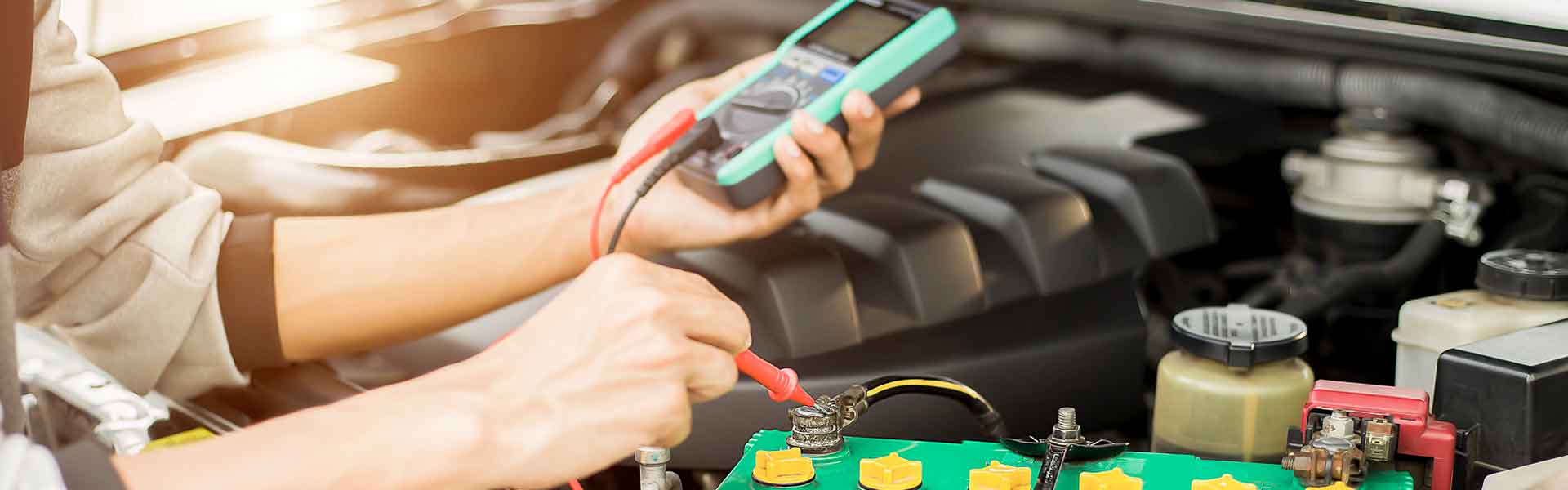
Dodge Battery Repair Replacement at Elevation Auto Repair
Swapping a battery on a modern Dodge is rarely just "disconnect the old, bolt in the new." Miss the registration step and a late-model Charger, Challenger, or Durango will fight you with a flickering dash, disabled auto stop-start, and a battery that dies early because the charging system never learned it's new.
Dodge vehicles with the Totally Integrated Power Module (TIPM) and CAN-bus electrical architecture need the battery type and state-of-charge reported to the body control module. Many Ram and Charger models also run an auxiliary AGM battery for stop-start, and mixing a standard flooded battery into an AGM-spec application shortens life fast.
Our technicians use factory-level scan capability to complete the battery registration and reset the power-management logic – the piece a parts-store swap skips entirely. We also verify the ground straps and check for parasitic draw before handing the keys back.
- Correct AGM or flooded battery matched to your Dodge's stop-start and TIPM requirements
- Battery registration and charging-system reset so the alternator charges to spec
- Parasitic draw test and terminal/ground inspection to catch the real cause of a dead battery
- Honest recommendation – no replacing a battery when an alternator or module is the culprit
Symptoms – How to Know You Need This Service
Dodge electrical gremlins often trace straight back to a weak or failing battery. From the driver's seat you may notice:
- Slow or labored cranking – the starter drags before the engine catches, worse on cold Denver mornings
- Stop-start no longer working – the auto stop-start light shows an amber warning on Charger, Ram, and Durango models
- Flickering interior lights or a jumpy dash when idling or at startup
- Battery, charging-system, or "Service Electronic Throttle" warnings triggered by low voltage confusing the TIPM
- Random no-starts or a clicking sound when you turn the key
- Swollen battery case or a rotten-egg smell from the engine bay – a sign of overheating or overcharging
- Uconnect glitches, power windows resetting, or radio dropping presets from voltage dips
A swollen or leaking battery, or a strong sulfur smell, means stop driving and have it checked right away – overheating batteries can vent acid or fail suddenly. Slow cranking, disabled stop-start, or intermittent warnings are safe to schedule soon before you get stranded.
Common Battery Repair Replacement Issues on Dodge Vehicles
Most shops swap a battery, clear the light, and hand back the keys. On a modern Dodge that misses the step that actually matters – registering the new battery to the power management module. Here's what we see roll through the bay.
- IBS sensor faults on 2011+ Charger/Challenger (LX/LD platform): The Intelligent Battery Sensor on the negative terminal reports state-of-charge to the PCM. Corrosion or a failed sensor throws phantom charging codes and no-start conditions even with a healthy battery.
- Battery registration skipped after replacement: Dodge vehicles with smart charging expect the new battery's age and type to be coded via wiTECH. Skip it and the alternator over- or undercharges, shortening the replacement battery's life.
- Parasitic draw on 2014+ Durango (WD) and RAM 1500 (DT): Uconnect head units and telematics modules that fail to sleep drain batteries overnight – a classic "car sat two days and won't start" complaint.
- AGM vs. flooded mismatch: Many later Dodge models with stop-start or heavy accessory loads spec AGM batteries. Dropping in a standard flooded unit causes early failure and charging faults.
- Terminal corrosion and loose hold-downs on high-mileage Grand Caravan (RT): Vibration and heat under the fender-mounted tray loosen connections, mimicking a dead battery.
- Undersized aftermarket batteries: Wrong group size leaves gaps in the tray, letting the battery shift and stress cables.
Which Dodge Models We See for Battery Repair Replacement
We handle battery service across the current and recent Dodge lineup, including the CAN-bus and stop-start platforms that trip up general shops. Find your vehicle below:
- Charger & Challenger (LX/LD/LA, 2011–present) – 3.6L Pentastar and 5.7/6.4L HEMI; SRT and Hellcat variants often run higher-demand batteries and benefit from AGM upgrades
- Durango (WD, 2011–present) – shares Pentastar/HEMI platform; many later models use auxiliary battery setups
- Ram 1500 (DS/DT, 2013–present) – eTorque mild-hybrid trucks use a 48V system plus dual 12V AGM batteries that require careful, spec-correct replacement
- Grand Caravan (RT, 2008–2020) – classic TIPM-related battery drain complaints we diagnose regularly
- Journey (2009–2020) and Dart (PF, 2013–2016) – straightforward flooded-battery applications
- Durango SRT / Charger & Challenger Hellcat – higher electrical loads make correct AGM selection and registration important
eTorque Ram trucks and stop-start models need the proper AGM battery and a scan-tool registration – we handle both. For older pre-2008 Dodge trucks and Dakotas without integrated power management, the job is simpler but we still test the charging system so you're not back for a repeat. If you're unsure which battery configuration your Dodge uses, bring it by and we'll confirm before ordering anything.
Causes & Risks – What Happens if Ignored
Denver's altitude and temperature swings punish batteries hard. Cold mornings raise cranking demand while summer heat under the hood cooks the electrolyte. Add short around-town trips that never fully recharge the battery, and Dodge charging systems start compensating in ways that mask the real problem.
Ignoring a weak battery or a dashed battery light on an LX-platform Charger for a few weeks often turns a simple replacement into a hunt for a fried alternator or a confused IBS sensor.
- A marginal battery forces the alternator to work harder, accelerating diode and voltage-regulator wear.
- Low system voltage triggers erratic Uconnect behavior, ABS warnings, and stored fault codes that look like electrical gremlins.
- Repeated deep discharges permanently sulfate the plates, so even a recharge won't restore capacity.
- Corroded terminals left unaddressed migrate up the cable, eventually requiring cable replacement.
- A no-sleep parasitic draw left running kills the battery overnight and strands you in a parking lot.
What starts as a quick battery job becomes alternator replacement, cable repair, and module diagnostics if it sits too long. We'd rather catch it early and keep the fix small.
Safety Impact – Why Battery Repair Replacement Matters
Battery voltage feeds far more than the starter. On a modern Dodge, unstable voltage confuses the systems keeping you safe.
- ABS and traction control: Low or spiking voltage sets faults and can disable stability assistance when you need it on icy Denver roads.
- Electronic power steering: Voltage drops cause momentary assist loss or heavier steering.
- Airbag/SRS module: Undervoltage can store faults and compromise crash readiness.
- Electronic shifter and stop-start systems: Erratic behavior when the battery can't hold charge.
Know the difference between "schedule soon" and "stop now":
- Stop driving now: ABS, traction, and airbag warning lights on together; steering assist cutting out; engine stalling at idle.
- Schedule soon: Slow cranking, dimming headlights at idle, occasional battery light flicker, Uconnect resetting.
If a known charging defect goes unaddressed and contributes to a loss of control, that's a liability question you don't want. We'll verify the whole system, not just the battery, and put it in writing.
How Dodge Battery Repair Replacement Actually Works
Newer Dodge vehicles run an intelligent charging strategy. The PCM reads the IBS sensor on the negative terminal to track state-of-charge, temperature, and battery health, then commands the alternator to charge only as needed instead of a constant output. That saves fuel and protects the battery – but it means the system needs to know exactly what battery is installed.
That's why a proper replacement isn't just bolting in a new unit. The battery has to be registered so the charging logic resets its aging calculations.
- Battery registration via wiTECH: The factory scan tool codes the new battery's type and capacity so the PCM charges it correctly.
- AGM vs. flooded matching: Stop-start and high-load models require the specced chemistry and group size.
- IBS sensor verification: We confirm the sensor reads correctly before and after so charging isn't skewed.
- Torque and hold-down specs: Correct terminal torque and tray hardware prevent vibration failures.
- Parasitic draw test: An amp-clamp check confirms modules are sleeping properly.
Doing it the OEM way is what separates a battery that lasts from one that fails early. That's the standard we hold on every Dodge that comes in.
How We Diagnose Battery Repair Replacement Issues on Dodge
A dying Dodge battery rarely dies alone. On late-model Ram 1500, Charger, Challenger, and Durango platforms, parasitic drain from the TIPM (Totally Integrated Power Module), a lazy EGS/BCM staying awake, or a failing alternator decoupler pulley can drag a healthy battery down overnight. We pin down the real cause before we sell you a battery.
- Full state-of-health load test – We measure cold cranking amps against the OEM spec printed on the tray, not just voltage at rest.
- wiTECH scan – Dodge's factory-level tool reads charging system codes, IBS (Intelligent Battery Sensor) data on the negative terminal, and BCM sleep states that a generic OBD reader misses entirely.
- Parasitic draw test – We isolate circuits with an amp clamp to catch the TIPM, radio, or aftermarket accessory keeping modules awake.
- Alternator output check – Charging voltage under load, with attention to the decoupler pulley common on 3.6L Pentastar and 5.7L HEMI setups.
- Visual and terminal inspection – Corrosion, swollen cases, loose hold-downs, and chafed ground straps.
- Road test – We confirm the charging profile behaves under real driving loads.
Once we know whether it's the battery, the sensor, or the charging system, we build a clear repair plan and quote so you approve the work before we touch anything.
Battery Repair Replacement on Dodge: Repair vs. Replacement
Not every battery warning means a new battery. We separate the parts worth saving from the parts that are done.
- Genuine repair – Cleaning corroded terminals, tightening a loose hold-down, replacing a chafed ground strap, or recalibrating the IBS sensor after service. The battery itself is still within spec.
- Partial replacement – Swapping only the failed piece: a bad alternator decoupler pulley, a corroded positive cable end, or a single IBS sensor while the AGM battery tests fine.
- Full replacement – When the AGM battery fails its load test, shows a swollen case, or when a Charger/Challenger with the auto start-stop system needs the correct AGM chemistry. We also replace when repair cost approaches the price of a new battery.
Dodge start-stop vehicles require an AGM battery registered through wiTECH so the charging system adapts to the new unit – a step generic shops skip, which shortens battery life. We show you the test numbers and lay out the options, then let you decide rather than pushing the priciest ticket.
How to Make Your Dodge Battery Repair Replacement Last Longer
A little habit change stretches battery and charging system life, especially in Denver's swing between summer heat and freezing winter mornings.
- Drive long enough to recharge – Short trips on a Ram or Durango never fully replenish the battery. Combine errands or take the highway occasionally.
- Kill parasitic loads – Turn off cabin lights and unplug chargers; the TIPM keeps circuits alive longer than you'd expect.
- Manage temperature swings – Park in the garage when possible. Heat cooks AGM batteries; deep cold saps cranking power.
Things you can safely handle yourself:
- Visually check terminals for white or blue corrosion.
- Listen for slow cranking or dash flicker on startup.
- Watch for battery or charging warning lights and note when they appear.
Leave to us: any battery replacement that needs wiTECH registration, IBS sensor calibration, or work near the TIPM and high-current cables. Getting the wrong chemistry or skipping registration on a start-stop Dodge will kill a new battery early. Stick to Mopar-spec AGM parts and follow Dodge's service intervals, and we'll keep the charging system healthy for the long haul.
What to Expect When You Bring Your Dodge In
A dead Dodge often isn't just a tired battery. On late-model Chargers, Challengers, and Ram 1500s with the IBS (Intelligent Battery Sensor) on the negative terminal, a swapped-in battery that never gets registered will confuse the charging strategy and drain again. We treat every battery job as a charging-system job.
- Drop-off or appointment – Tell us the symptoms: slow crank, dash chimes, random stalls, or a "Service Electronic Throttle" light that flickers with voltage sag.
- Initial inspection – We load-test the battery, check state of charge, measure parasitic draw, and inspect terminals, the IBS sensor, and ground straps for corrosion.
- Written estimate – You get a clear breakdown of what the battery needs versus what the charging system or wiring needs, with nothing added that isn't justified.
- During the work – We reach out before doing anything beyond the approved scope, so surprises stay off the invoice.
- Pickup walkthrough – We show you the old battery, the test results, and confirm what was registered or reprogrammed.
Shuttle and loaner options help you stay moving, and after-hours pickup can be arranged. Clear out personal items you'll need before drop-off. Every Dodge gets a road test and a scan-tool re-check for stored codes before it leaves. If anything feels off afterward, bring it back and we'll re-verify.
Why Choose Elevation Auto Repair for Dodge Battery Repair Replacement
Plenty of shops can bolt in a battery. Fewer know that a new one on many 2011-and-up Dodge and Ram platforms must be registered to the Battery Control Module so the smart charging system stops over- or under-charging it.
- Correct battery registration – We use proper scan tools to write the new battery's spec to the module, not just clamp it down and hope.
- TSB and software awareness – We check for known Dodge bulletins tied to phantom drains, TIPM quirks on older Grand Caravans and Rams, and stop/start charging behavior.
- Full charging-system focus – Alternator output, ground integrity, and parasitic draw all get verified so the replacement actually lasts.
- End-to-end ownership – The same shop diagnoses, repairs, and re-verifies your Dodge, so accountability never gets handed off.
As your Denver dealership alternative, we handle everything from the battery to the drivetrain under one roof, with straight answers about what your Dodge truly needs.
Our Dodge Services
- Air Conditioning AC Repair
- Brake Repair & Brake Fluid Change
- Check Engine Light Diagnostics
- Clutch Repair & Replacement
- Coolant Leak Repair
- Cooling System Repair
- Drive Shaft Repair
- Engine Repair
- Exhaust & Catalytic Converter Repair
- Head Gasket Repair & Replacement
- Oil Change
- Oil Leak Repair
- Scheduled Service Maintenance
- Steering Repair
- Suspension Repair
- Cambelt Timing Belt Replacement
- Transmission Repair
- Tune Up
- Wheel Alignment