
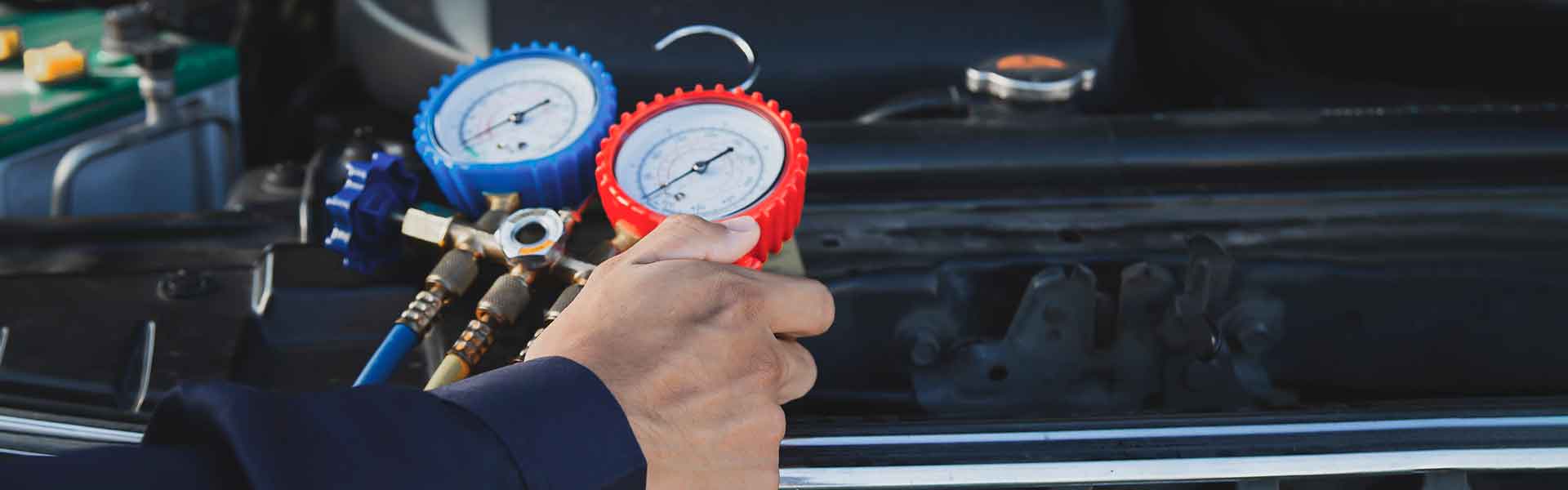
Hyundai Air Conditioning AC Repair at Elevation Auto Repair
A botched AC job on a Hyundai costs more than comfort. Overcharge the system or skip the correct PAG oil charge and you can starve the compressor, turning a simple recharge into a full component replacement.
Hyundai AC systems have their own quirks. Many Sonata, Elantra, and Tucson platforms use variable-displacement compressors and electronically controlled expansion valves, so proper diagnosis means reading data through OEM-level scan tools, not just clamping on a gauge set. On hybrid and Ioniq models, the electric AC compressor requires POE oil and high-voltage-safe service procedures – mix in the wrong lubricant and you damage the unit.
We follow Hyundai's specified refrigerant charge weights and evacuation targets rather than guessing. That precision is what keeps a repair holding up through a Colorado summer instead of failing again in weeks.
Here's what you can expect when you bring your Hyundai to us:
- Accurate diagnosis with factory-level tooling and pressure/temperature verification
- Correct refrigerant type, charge weight, and PAG or POE oil for your exact model
- Honest recommendations – no unnecessary component swaps
- Repairs built for long-term reliability, not a quick top-off
Symptoms – How to Know You Need This Service
Hyundai AC problems usually announce themselves before the system quits entirely. Watch for these signs:
- Air blows warm or only cools at highway speed – often a low charge or a failing compressor clutch
- A grinding or squealing noise when the AC engages, pointing to a worn compressor bearing or clutch
- Musty or mildew smell from the vents, common with clogged evaporator drains and dirty cabin filters
- Weak airflow even on max fan, which can mean a failing blower motor or resistor
- Visible moisture or oily residue near AC lines, condenser, or under the dash
- Clicking cycling that turns cold air on and off repeatedly – a classic low-refrigerant symptom
- Climate control display errors or the AC light flashing on the panel
You can usually keep driving with weak cooling or odors, but schedule service soon before a small leak empties the system. Stop driving and shut the AC off if you hear loud grinding from the compressor – running a seizing unit can send metal debris through the entire loop and force a costly cleanout.
Common Air Conditioning AC Repair Issues on Hyundai Vehicles
Getting Hyundai A/C work wrong gets expensive fast – a misdiagnosed compressor often means replacing a condenser and orifice tube too once metal debris spreads through the loop. These are the failure patterns we see most often on Hyundai platforms across our Denver bays.
- Compressor clutch and internal failure on 2011-2016 Sonata/Elantra (YF/MD platforms): The original Doowon/HCC compressors are prone to internal wear that sheds aluminum through the system, contaminating the receiver-drier and condenser.
- Condenser leaks on 2013-2018 Santa Fe (DM) and Tucson (TL): Front-mounted condensers take road debris and stone strikes, and the thin parallel-flow tubes develop pinhole leaks that bleed refrigerant slowly.
- Blend door actuator failure on 2011-2017 Elantra and Sonata: A clicking sound behind the dash and one-sided temperature output usually points to a stripped plastic actuator gear.
- Evaporator core leaks on older Tiburon/Santa Fe: Corrosion at the evaporator produces weak cooling and an oily film at the drain, a labor-heavy repair buried under the dash.
- Cooling fan and relay faults on Genesis Coupe (BK) and Veloster (FS): A failing radiator/condenser fan drops A/C performance sharply at idle and in stop-and-go traffic.
- Cabin air filter neglect across most models: A clogged filter starves airflow and masks a healthy system as a "weak A/C" complaint.
Which Hyundai Models We See for Air Conditioning AC Repair
We service AC systems across nearly the full Hyundai lineup. These are the models and generations we work on most:
- Sonata (2011–2019, YF/LF) – frequent condenser leaks and compressor clutch wear
- Elantra (2011–2020, MD/AD) – evaporator drain clogs and blower resistor faults
- Tucson (2010–2021, LM/TL/NX4) – expansion valve and low-side line leaks
- Santa Fe (2013–2023, DM/TM) – rear AC line leaks on three-row variants
- Kona and Kona Electric (2018–present) – note the EV uses an electric compressor with different service needs
- Ioniq and Ioniq 5 (hybrid/EV) – high-voltage electric AC compressors requiring POE oil
- Palisade (2020–present) – dual-zone and rear climate diagnostics
- Accent, Veloster, and Genesis Coupe – standard belt-driven systems
Hybrid and EV models call for high-voltage-safe procedures and the correct compressor lubricant – we handle those separately from conventional belt-driven systems. For pre-2010 Hyundais, parts availability varies, so we'll confirm we can source what your car needs before starting.
Causes & Risks – What Happens if Ignored
Denver's altitude, dry heat, and dusty summers push A/C systems harder than most climates. Age, UV exposure on hoses, and the fine grit that coats front-mounted condensers all speed up wear on Hyundai systems.
The biggest cost driver is waiting after the first sign of trouble. A slow leak that could have been a seal or O-ring turns into a full system flush once a starved compressor overheats and grenades internally.
- Low refrigerant left unaddressed: The compressor loses lubrication and seizes, spreading debris that forces condenser and drier replacement.
- Ignored condenser pinhole leaks: Repeated recharges mask the loss until performance collapses in peak heat.
- A clicking blend door actuator: Left alone, the gear strips fully and locks temperature output, sometimes stuck on full heat.
- Failing cooling fan: High-side pressure spikes stress hoses and seals, risking a burst line.
- Moisture in the system from an open leak: Corrosion and acid form inside, attacking every metal component in the loop.
What starts as a simple recharge or O-ring service can become a compressor, condenser, drier, and full evacuation job. We'd rather catch it early and keep the repair small.
Safety Impact – Why Air Conditioning AC Repair Matters
A/C on a Hyundai does more than keep you cool. The system feeds the defrost circuit, and a dead compressor means no fast defog when Denver mornings fog or ice the windshield – that's a visibility hazard. An overheating cooling fan shared with the condenser can also push engine temps up in traffic.
Driver fatigue in a hot cabin dulls reaction time on long I-70 runs, and a stuck full-heat blend door in summer makes the cabin unsafe on extended drives.
- Stop driving soon if: the defrost won't clear the windshield, you smell burning near the compressor, or the engine temp climbs when A/C is on.
- Schedule soon if: cooling is weak but steady, you hear an occasional actuator click, or performance drops only at idle.
If a known refrigerant leak damages the compressor and leaves you without defrost during an incident, it becomes a maintenance-neglect question. Addressing it early keeps you covered and on the road.
How Hyundai Air Conditioning AC Repair Actually Works
Your Hyundai A/C is a sealed loop: the compressor pressurizes R-134a (or R-1234yf on newer models), the condenser sheds heat, and the evaporator absorbs cabin heat while the blower pushes cooled air through the vents. Most later Hyundais use automatic temperature control that relies on blend door actuators and interior sensors talking to the climate module.
That electronic control is what separates proper Hyundai work from a generic recharge. We pull data with factory-level diagnostics to read actuator position, pressure sensor values, and fault codes before touching a wrench.
- Refrigerant type matters: newer Hyundais run R-1234yf, which needs the correct machine and can't be mixed with R-134a.
- Vacuum and charge by weight: we evacuate to remove moisture, then charge to Hyundai's exact refrigerant and oil spec – not by pressure guesswork.
- Actuator recalibration: after replacement, blend doors often need a self-learn cycle so temperature blend reads correctly.
- Leak verification: dye and electronic sniffers confirm the fix instead of a repeat top-off.
Doing it to spec is what makes the repair last – no comebacks, no lingering leaks, just cold air that stays cold.
A botched A/C job on a Hyundai gets expensive fast. Overcharge the system and you spike head pressure, cook the compressor, and turn a simple fix into a full teardown. Get the diagnosis right the first time and your Sonata, Elantra, or Santa Fe cools like new for years.
How We Diagnose Air Conditioning AC Repair Issues on Hyundai
Hyundai climate faults rarely announce themselves clearly. A weak vent temperature can trace back to a leaking condenser, a stuck blend door actuator, or a failing compressor clutch coil. We isolate the real cause before touching a wrench.
- Pull codes and live data through a Hyundai-capable scan tool (GDS/KDS-level access), reading HVAC actuator faults, pressure sensor values, and compressor engagement commands.
- Command the blend door and mode actuators through the module to catch the whining or clicking failures common on Sonata (LF/DN) and Santa Fe dash assemblies.
- Connect manifold gauges to read high and low side pressures against ambient temperature – the fastest way to spot an undercharge, restriction, or failing compressor.
- Visual inspection of the condenser (stone damage is frequent on Elantra and Tucson front-mount condensers), hose fittings, and the parallel-flow evaporator area.
- Electronic leak detection and UV dye tracing when refrigerant loss is suspected, plus a road test with vent-temperature measurement under real load.
Once we know whether the trouble is refrigerant, electrical, or a mechanical component, you get a plain-language explanation and a written repair plan and quote – no surprises, no guessing.
Air Conditioning AC Repair on Hyundai: Repair vs. Replacement
Not every A/C complaint means a big-ticket part. We match the fix to the failure.
- Genuine repair: A slow O-ring leak at a hose fitting, a fouled cabin filter choking airflow, or a single blend door actuator on a Tucson or Santa Fe – clean, adjust, reseal, and recharge.
- Partial replacement: A leaking condenser from road debris while the compressor and evaporator remain healthy, or a worn compressor clutch coil where the compressor body is still sound.
- Full replacement: A compressor that has grenaded and sent metal debris through the loop. On these, we replace the compressor, condenser, orifice/expansion device, drier, and flush the system – anything less invites repeat failure.
When repair cost creeps toward the price of a full assembly, or when contamination threatens the whole circuit, we lay out both paths with the long-term reliability tradeoffs. You decide with full information – we don't default to the most expensive line.
How to Make Your Hyundai Air Conditioning AC Repair Last Longer
Good habits keep a rebuilt or repaired Hyundai A/C system honest for the long haul.
- Run the A/C briefly year-round, even in Denver winters, to keep compressor seals lubricated and prevent them drying out.
- Use recirculation on hot days to reduce compressor load, and let the cabin vent before blasting cold on a heat-soaked car.
- Rinse the front-mount condenser during car washes to clear bugs and grit that block airflow and drive up head pressure.
Owner-friendly checks that catch problems early:
- Replace the cabin air filter on Hyundai's recommended interval – a clogged filter mimics a failing system.
- Listen for new clicking behind the dash (actuator wear) or clutch cycling that's faster than normal.
- Watch for musty odors, weak airflow, or a warm-side temperature creeping up.
Insist on the correct refrigerant charge weight and OEM-spec PAG oil – overfilling is a top cause of premature compressor failure. Keep HVAC-related software current, since Hyundai issues control updates that affect actuator behavior. Filter swaps and visual checks are safe DIY. Leave refrigerant handling, evacuation, and compressor work to us – it's pressurized, moisture-sensitive, and easy to damage without the right tools.
A botched Hyundai A/C job gets expensive fast. Overcharge the system on a Sonata or Elantra and you risk compressor seizure. Skip the leak dye and you're chasing the same problem twice. On Hyundai platforms, getting the diagnosis right the first time protects the compressor, the condenser, and your wallet.
What to Expect When You Bring Your Hyundai In
We keep the process clear from the first phone call to the moment you drive off with cold air flowing.
- Drop-off or scheduled appointment – Tell us the symptoms: weak airflow, warm air, a clutch that won't engage, or that hissing behind the dash. Shuttle service and loaner options are available so you stay on your day.
- Initial inspection – We connect factory-level scan tools to pull HVAC and climate control codes, then check static and low/high-side pressures before touching anything.
- Written estimate – You get a plain-language breakdown of what's failing and why. No surprise add-ons, no repairs you don't need.
- Repair with updates – We text or call as the work moves. If a hidden issue surfaces – say a corroded condenser on a salt-exposed Santa Fe – you approve it before we proceed.
- Pickup walkthrough – We show you the failed parts and explain what we did.
Leave personal items in the glovebox or trunk – we work around them. After-hours pickup is available when your schedule runs late.
Every A/C repair ends with a vent-temperature check, a road test, and a scan-tool re-scan to confirm no lingering HVAC faults. If something still feels off after you leave, bring it back and we'll re-verify it.
Why Choose Elevation Auto Repair for Hyundai Air Conditioning AC Repair
Hyundai A/C problems tend to cluster around known weak points, and we know where to look. Compressor clutch failure and internal seal wear on Sonata and Santa Fe models, condenser leaks from front-end debris, and evaporator core issues that trigger recurring refrigerant loss are all patterns we've traced across Hyundai's recent generations.
- TSB and software awareness – Many climate-control complaints on later Hyundai models trace to control-module behavior or updates, not hardware. We check for applicable bulletins before condemning parts.
- Correct refrigerant handling – We recover, evacuate, and recharge to Hyundai's specified capacity, including R-1234yf systems on newer models, using dedicated equipment rather than guesswork.
- Root-cause diagnosis – Electronic leak detection and UV dye pinpoint the exact failure instead of a top-off that fails again by next summer.
We own the whole job – diagnosis, repair, and post-repair verification under one roof. That's how we build long-term reliability into your Hyundai's cooling system, so cold air stays cold season after season. Straight answers, real fixes, and a Denver dealership alternative that treats your time and your budget with respect.
Our Hyundai Services
- Battery Repair Replacement
- Brake Repair & Brake Fluid Change
- Check Engine Light Diagnostics
- Clutch Repair & Replacement
- Coolant Leak Repair
- Cooling System Repair
- Drive Shaft Repair
- Engine Repair
- Exhaust & Catalytic Converter Repair
- Head Gasket Repair & Replacement
- Oil Change
- Oil Leak Repair
- Scheduled Service Maintenance
- Steering Repair
- Suspension Repair
- Cambelt Timing Belt Replacement
- Transmission Repair
- Tune Up
- Wheel Alignment