
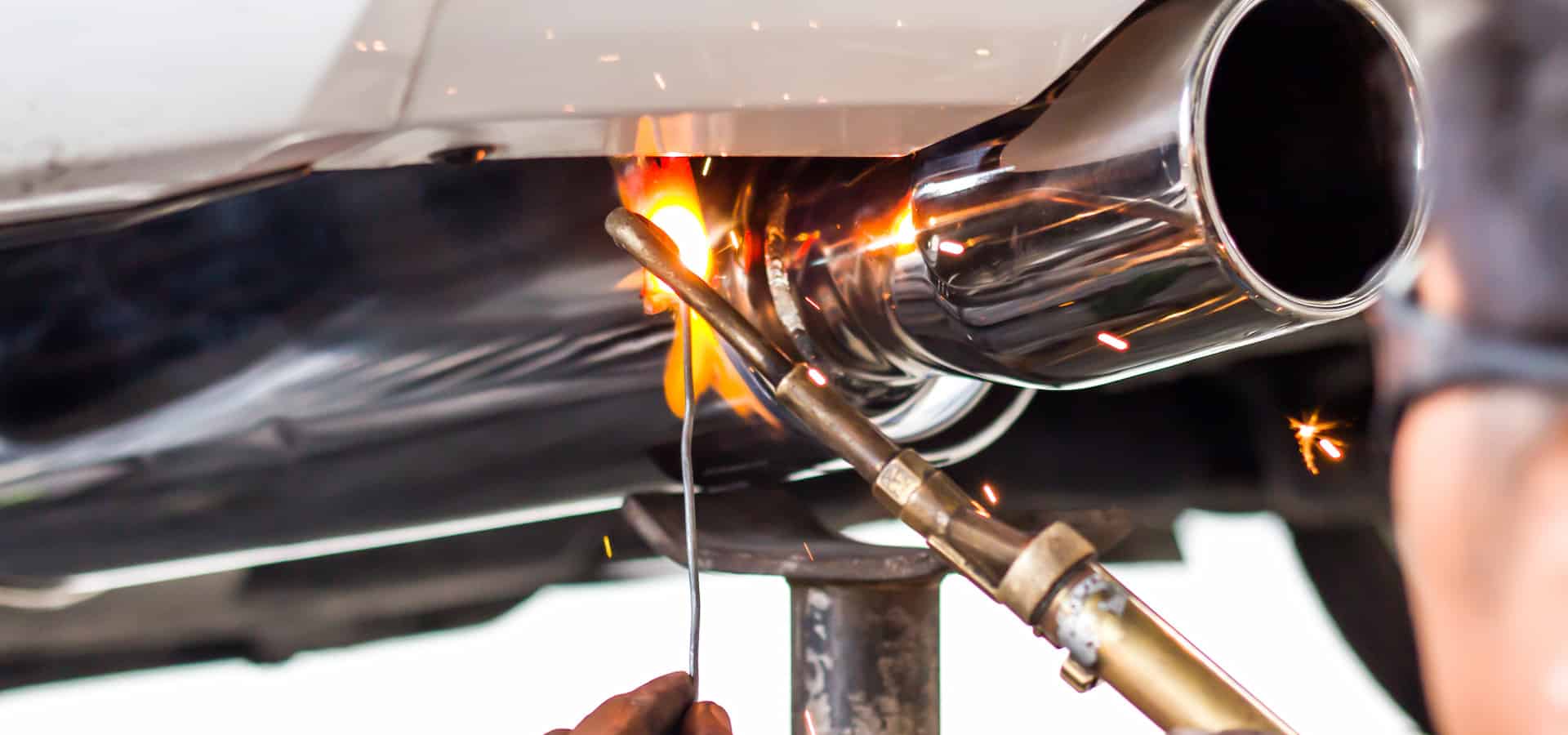
Mazda Exhaust & Catalytic Converter Repair at Elevation Auto Repair
Mazda's SkyActiv engines run some of the leanest air-fuel ratios in the industry, and that high-compression design puts real thermal load on the exhaust and catalytic converter. On the 2.0L and 2.5L SkyActiv-G four-cylinders, the catalytic converter often sits close-coupled to the exhaust manifold, so a misfire or coolant intrusion can cook a cat far faster than on a lazier engine. Getting this repair right on a Mazda takes more than bolting on a universal muffler.
We read live fuel-trim and rear O2 sensor data with factory-level scan tools before condemning any part, because a P0420 on a Mazda is frequently an upstream sensor or fuel-trim problem – not a failed converter. The 3-piece SkyActiv exhaust joints use specific spring-bolt torque values and new gaskets that generic shops routinely skip, which leads to leaks and rattles down the road.
- Data-backed diagnosis that separates a bad converter from a sensor or fuel-trim fault
- OEM or emissions-legal converters matched to your exact SkyActiv or MZR engine
- Proper flange gaskets, spring bolts, and torque specs on reassembly
- Post-repair drive cycle and monitor verification so the light stays off
Symptoms – How to Know You Need This Service
Exhaust trouble on a Mazda tends to announce itself in a few recognizable ways. Here's what you may notice from the driver's seat:
- Check engine light with P0420 or P0430 – the most common trigger, pointing to catalyst efficiency below threshold
- A rotten-egg or sulfur smell from the tailpipe, often signaling a saturated or failing converter
- A rattle or buzz from underneath, worst at idle or light acceleration – frequently a loose heat shield or broken catalyst substrate
- Noticeable loss of power or hesitation on the highway from a clogged, restricted converter
- Louder-than-normal exhaust note or a hissing tick, usually a cracked flange or blown gasket
- Drop in fuel economy paired with rough idle
- Vibration through the floor at certain RPM from a hanging or misaligned pipe
Schedule soon for a check engine light, odor, or minor rattle. Stop driving right away if you smell strong exhaust inside the cabin, see smoke, or feel a sudden power loss with a burning smell – a plugged converter can overheat and become a fire risk.
Common Exhaust & Catalytic Converter Repair Issues on Mazda Vehicles
Mazda's SkyActiv engines run leaner and hotter than many rivals, which puts real stress on catalyst substrates and the tightly packed exhaust manifolds. Here are the failure patterns we see most on Denver Mazdas:
- Header-integrated catalyst cracking on SkyActiv-G 2.0L/2.5L (2012-present Mazda3, CX-5, Mazda6): Mazda mounts the primary catalyst right at the exhaust manifold to light off quickly. The close-coupled design bakes the substrate, and high-mileage units crumble internally, throwing P0420 efficiency codes.
- Rear O2 sensor drift and P0420/P0430: The downstream oxygen sensor connectors near the transmission tunnel corrode in salted winter conditions, mimicking a bad converter when the real fault is signal noise.
- Flex-pipe and mid-pipe rust-through on older Mazda3/Mazda6 (BK/BL/GH chassis): The braided flex joint fatigues, ticks on cold start, then splits open with an exhaust leak ahead of the sensor.
- Rotary exhaust carbon and thermal reactor wear on RX-8 (SE3P): The 13B-MSP's oil-metering strategy loads the catalyst with carbon and unburned fuel, aging the converter far faster than a piston engine.
- Turbo downpipe and gasket leaks on 2.5L Turbo (CX-5, CX-9, Mazda6 Signature): The turbine-side flange gasket weeps under boost heat cycling, producing a whistle and downstream leak.
- Muffler and resonator seam corrosion: Rear silencer seams open up on cars that see short winter trips where condensation never burns off.
Which Mazda Models We See for Exhaust & Catalytic Converter Repair
We handle exhaust and catalytic converter work across the modern Mazda lineup and many older platforms. Find your car below:
- Mazda3 (BK, BL, BM/BN) – 2004 to present, both the older 2.0/2.3 MZR and the SkyActiv-G 2.0/2.5 engines
- Mazda6 (GG, GH, GJ/GL) – 2003 to present; SkyActiv 2.5 and 2.5T turbo models need the correct downstream cat and sensor setup
- CX-5 (KE, KF) – 2013 to present, a frequent visitor for close-coupled converter and rear O2 sensor issues
- CX-30, CX-9 (TB/TC) – SkyActiv turbo and naturally aspirated variants
- MX-5 Miata (NC, ND) – 2006 to present; cat-back and mid-pipe work common on modified cars
- CX-3, Mazda2 – smaller SkyActiv applications
Turbo models like the 2.5T Mazda6, CX-9, and CX-50 route exhaust differently than the naturally aspirated cars, so the converter and piping differ – we match parts to your exact VIN and engine code. We're candid about limits: rotary-powered RX-8 (SE3P) exhaust work is specialized and best discussed case by case, and very early 1990s models may require sourcing hard-to-find parts. Bring us your Mazda and we'll confirm the right approach before any work begins.
Causes & Risks – What Happens if Ignored
Most Mazda exhaust problems trace back to a mix of the close-coupled catalyst design, Colorado's salt-and-cold driving, and normal thermal aging. Short trips and altitude both play a role along the Front Range.
The common drivers we identify:
- Repeated short trips that leave moisture inside the exhaust, rusting flex pipes and muffler seams from the inside out.
- Misfires or an over-rich condition dumping raw fuel into the catalyst, overheating and melting the substrate.
- Winter road salt attacking hangers, clamps, and downstream sensor connectors.
Waiting turns a modest repair into a large one. What gets worse:
- Ignoring a P0420 caused by a misfire lets fuel keep cooking the catalyst until the substrate breaks apart and needs full replacement.
- A small flex-pipe tick left for months becomes a full split, pulling false air across the O2 sensor and corrupting fuel trims.
- Loose catalyst debris can migrate and clog the exhaust, causing power loss and heat soak that damages nearby harnesses.
- An unaddressed exhaust leak lets exhaust gases reach the cabin – a safety issue, not just a comfort one.
Safety Impact – Why Exhaust & Catalytic Converter Repair Matters
A leaking or failing exhaust is more than noise. On Mazdas, upstream leaks skew the air-fuel readings the ECU uses, which can trigger reduced-power modes and unstable idle. Worse, exhaust gas containing carbon monoxide can enter the cabin through a rusted floor pan or open flex joint.
Systems and risks affected:
- Cabin air quality – CO intrusion from upstream leaks poses a direct health risk on longer drives.
- Engine management – bad O2 data disrupts fuel trims, sometimes flagging the check engine light and disabling cruise or throttle response.
- Heat exposure – a fractured close-coupled catalyst radiates extreme heat near wiring and underbody shields.
Use this quick triage:
- Stop driving now: strong exhaust smell inside the cabin, loud roaring with power loss, or a glowing/burning-smell converter.
- Schedule soon: intermittent cold-start ticking, a steady P0420/P0430, or a light exhaust drone.
If a known emissions defect goes unaddressed and contributes to an incident or failed emissions test, that becomes a liability and registration headache – worth resolving before it escalates.
How Mazda Exhaust & Catalytic Converter Repair Actually Works
Your Mazda's exhaust starts at the manifold, routes through one or more catalytic converters that chemically convert harmful gases, and uses oxygen sensors before and after the catalyst so the ECU can grade converter efficiency. On SkyActiv engines, the primary catalyst sits right at the head, so replacement often involves the manifold assembly rather than a bolt-in mid-pipe.
What sets Mazda work apart from a generic exhaust job:
- Close-coupled catalyst design means precise flange torque and gasket sequencing to avoid warping and future leaks.
- SkyActiv fuel-trim logic requires clearing and relearning after sensor or catalyst work, ideally with factory-level Mazda scan tooling rather than a generic code reader.
- Turbo models (2.5T CX-5/CX-9) use downpipe layouts with specific heat-shield and clamp routing that must be reinstalled correctly to prevent boost leaks.
- Rotary RX-8
How We Diagnose Exhaust & Catalytic Converter Repair Issues on Mazda
Mazda's SkyActiv-G engines run unusually high compression ratios, and their catalyst monitors are sensitive to even small upstream leaks – something a generic scan often misses. A P0420 on a 2014-2018 Mazda3 or CX-5 rarely means the converter alone; it frequently traces back to a lazy front air/fuel ratio sensor or a cracked flex pipe near the manifold.
- Pull codes with a Mazda-capable scan tool (MazdaMD or equivalent) to read live catalyst efficiency, front and rear O2/AFR sensor voltages, and long-term fuel trims.
- Compare pre-cat and post-cat sensor switching – a healthy converter shows a steady rear signal while the front oscillates.
- Perform a cold-start visual inspection for cracked welds, rusted flex joints, and loose heat shields common on high-mileage Mazda6 and CX platforms.
- Run a road test to reproduce drone, rattles, or a sluggish throttle response that points toward a restricted or failing catalyst.
- Measure exhaust backpressure and check for internal substrate breakdown when a clog is suspected.
Once the data lines up, we translate it into a plain-language repair plan and an itemized quote – so you see exactly which component is at fault before any work begins. Honest diagnostics mean we won't sell you a converter when the real problem is a $40 sensor.
Exhaust & Catalytic Converter Repair on Mazda: Repair vs. Replacement
Not every exhaust complaint needs a new converter. On many Mazdas the fix is far smaller than owners expect.
- Genuine repair – Replacing a failed AFR/O2 sensor, welding a cracked flex pipe, resealing a manifold gasket, or securing a rattling heat shield on a Mazda3 or CX-5 that still passes catalyst efficiency.
- Partial replacement – Swapping just the mid-pipe or rear muffler section when rust has eaten one segment but the converter reads healthy, common on Colorado-driven Mazda6 and CX-9 models exposed to road salt.
- Full replacement – Warranted when the substrate has broken down, backpressure is high, or repeated P0420 codes persist after upstream repairs. Contaminated converters from an oil-burning or misfiring SkyActiv engine usually require the fault fixed first, then a new unit.
We walk you through each option side by side, showing the cost trade-off and expected lifespan. When a weld-in section saves you money without compromising safety, that's what we recommend – the most expensive path is never the default here.
How to Make Your Mazda Exhaust & Catalytic Converter Repair Last Longer
A converter fails fastest when something upstream is feeding it raw fuel or oil. Protecting the whole exhaust system starts with the engine running clean.
- Let the engine reach operating temperature on cold Denver mornings before hard acceleration – short warm-up trips let condensation and unburned fuel accelerate internal corrosion.
- Address misfires, rough idle, or a check engine light quickly, since a single fouling cylinder can overheat and destroy a healthy converter.
- Avoid repeated heavy loads and aggressive throttle when the exhaust is cold, which stresses flex joints and welds.
Owner-friendly maintenance you can safely do:
- Listen for new rattles, drone, or ticking that signal a loose heat shield or cracked joint.
- Peek under the vehicle for rust streaks or soot at connections.
- Keep up with oil changes using the correct SkyActiv-spec oil so oil consumption stays low and the catalyst stays clean.
Brand-specific habits that matter: use OEM or OEM-equivalent oxygen sensors – aftermarket units often trigger false catalyst codes on Mazda's sensitive monitors – and keep PCM software current per Mazda's service bulletins. Leave sensor replacement, welding, and any work involving the catalytic converter to the shop; these are hot, safety-critical components best handled with proper tooling and torque specs.
What to Expect When You Bring Your Mazda In
Rattling heat shields, a droning cabin, or a P0420 catalyst efficiency code on your Skyactiv-G – we start by pinning down exactly what's failing before touching a wrench. Many Mazda exhaust complaints trace back to flex-pipe cracks near the manifold or a monitor reading that only tells half the story.
- Drop-off or appointment – Schedule ahead or leave it with us; note where the noise or smell shows up so we can replicate it.
- Initial inspection – We put your Mazda on the lift, check the flex pipe, resonator, mid-pipe welds, cat housing, and O2/air-fuel sensors, and pull codes with a scan tool.
- Written estimate – You get a clear breakdown separating a genuine catalyst failure from an upstream cause like a rich condition on a 2.5 Skyactiv or a leaking gasket.
- Approval and updates – Nothing proceeds without your okay, and we check for any relevant Mazda TSBs or software updates tied to the fault.
- Repair and verification – After the work, we road test, re-run the catalyst and O2 monitors, and confirm the readiness flags clear.
Shuttle service and loaner options help you stay mobile, and after-hours pickup keeps things simple. Leave personal items in the cabin if you like – we work around them. If anything feels off after pickup, bring it back and we'll re-scan and re-inspect at no runaround.
Why Choose Elevation Auto Repair for Mazda Exhaust & Catalytic Converter Repair
A P0420 on a Mazda rarely means "just replace the cat." On Skyactiv 2.0 and 2.5 platforms, we've seen efficiency codes driven by aging downstream sensors, exhaust leaks at the manifold flange, or fuel-trim issues that ruin a new converter within weeks. We diagnose the root cause first.
- Mazda-specific knowledge – Familiarity with common flex-pipe and resonator failures on CX-5, Mazda3, and Mazda6, plus applicable TSBs and PCM software updates that affect catalyst monitors.
- Correct sensor and fitment work – Proper O2/air-fuel sensor testing and OEM-grade converters that satisfy Mazda's readiness thresholds instead of tripping a code again.
- End-to-end ownership – The same shop handles diagnosis, repair, and post-repair scan-tool verification, so nothing falls through the cracks.
You get a Denver dealership alternative that fixes the actual problem, communicates clearly, and confirms the repair held with a road test and monitor re-check – not a parts-cannon guess.
Our Mazda Services
- Air Conditioning AC Repair
- Battery Repair Replacement
- Brake Repair & Brake Fluid Change
- Check Engine Light Diagnostics
- Clutch Repair & Replacement
- Coolant Leak Repair
- Cooling System Repair
- Drive Shaft Repair
- Engine Repair
- Head Gasket Repair & Replacement
- Oil Change
- Oil Leak Repair
- Scheduled Service Maintenance
- Steering Repair
- Suspension Repair
- Cambelt Timing Belt Replacement
- Transmission Repair
- Tune Up
- Wheel Alignment