GMC Cooling System Repair at Elevation Auto Repair
Your GMC works hard, whether it's a Sierra hauling trailers up I-70 or an Acadia running daily carpool at Denver altitude. When the cooling system starts slipping, heat builds fast, and the truck's PCM will pull timing and cut power long before things go catastrophic.
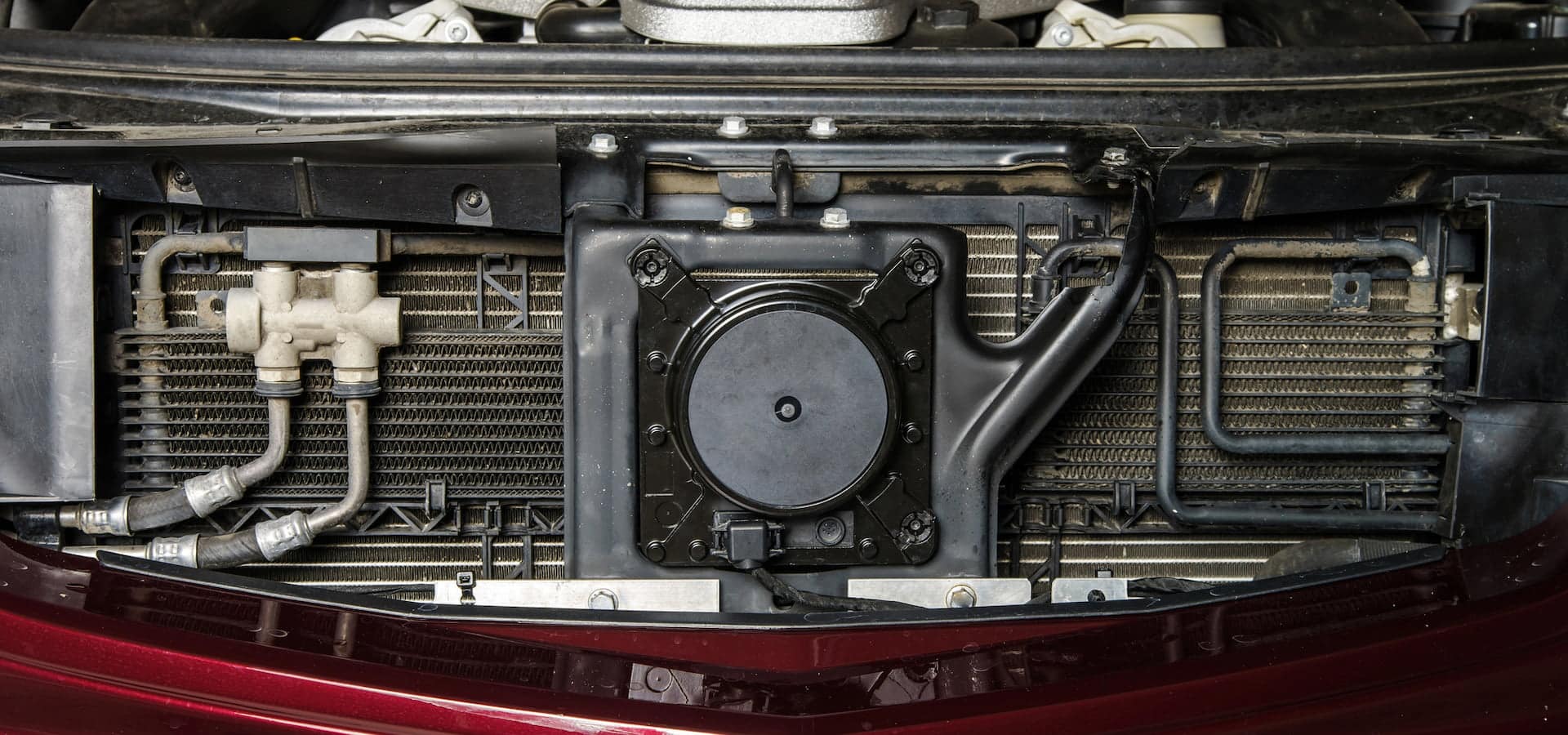
Cooling system repair covers the radiator, water pump, thermostat, cooling fans, hoses, and the coolant itself, all working together to hold engine temperature in a tight window. Doing it right on a GMC is different from a corner shop swapping parts. The 5.3L and 6.2L V8 EcoTec3 engines use an electronically controlled thermostat and a two-stage water pump that require GDS2 or Tech2 scan tools to properly bleed air and verify fan commands. The 3.6L LFX/LGX V6 in Acadia and Terrain is sensitive to the correct DEX-COOL fill and burp procedure, and overfilling or air pockets cause repeat overheating that looks like a bad thermostat.
Here's what you can expect when you bring your GMC to us:
- Pressure testing and coolant analysis before any parts are quoted, so you only pay for what's actually failing
- OEM-correct DEX-COOL fill with a proper vacuum-assisted bleed to eliminate air pockets
- Scan-tool verification of thermostat and fan operation after the repair
- A clear rundown of what we found and what can safely wait
Symptoms – How to Know You Need This Service
Cooling problems rarely announce themselves politely. You may notice one of these before the temperature gauge ever climbs:
- Temperature gauge creeping toward hot in stop-and-go traffic or on a grade – if it hits the red zone, stop driving immediately and let it cool
- Sweet syrup smell from the front of the truck, often DEX-COOL leaking onto hot components
- Orange or green puddle under the front of the vehicle after parking
- Heater blowing cold at idle – a classic sign of low coolant or a failing water pump
- Overflow tank boiling or gurgling after shutdown
- Check engine light with codes like P0128 (coolant below thermostat regulating temperature) or P0217 (engine overtemp)
- Whining or grinding from the water pump area, sometimes with weeping at the weep hole
- Cooling fans running loud and constant even when the engine isn't hot
Steam under the hood or a gauge in the red means shut it down and call us – driving on can warp heads or crack the block. A faint smell or a light stain is your cue to schedule soon before it turns into a roadside event.
Common Cooling System Repair Issues on GMC Vehicles
If your GMC is running hot in Denver traffic, showing a fluctuating temperature gauge, or leaving coolant spots on the driveway, you're seeing patterns we treat every week. GMC trucks and SUVs share powertrain families with Chevrolet, so their cooling weaknesses follow predictable paths tied to specific platforms and engines.
- Plastic radiator end-tank cracks and seam leaks – Common on GMT800/GMT900 Sierra and Yukon models, where the composite tank meets the aluminum core. Age and heat cycling split the seam, often first noticed as a slow coolant drop or sweet smell.
- Water pump failure on 5.3L and 6.2L V8s – The Vortec and later EcoTec3 (L83/L86) engines wear out the water pump bearing and weep from the shaft seal, leaving pink residue near the front cover.
- Intake manifold and gasket coolant leaks – Earlier LS-based 4.8/5.3L engines can seep coolant at the manifold, sometimes contaminating oil if ignored.
- Thermostat housing failures – The 3.6L V6 (LFX/LGX) in Acadia and Canyon uses a plastic housing that warps and cracks, triggering overheating and check-engine codes.
- Electric cooling fan and clutch issues – Fan clutch failure on full-size trucks and cooling fan module faults on newer Acadia/Terrain models cause overheating at idle or low speed.
- Degraded Dex-Cool and clogged heater cores – Neglected long-life coolant turns acidic and forms sludge, blocking heater cores and radiator passages.
Which GMC Models We See for Cooling System Repair
Most GMC platforms share cooling architecture across model years, which helps us diagnose quickly. These are the ones that roll through our bays most often:
- Sierra 1500 (GMT900 and T1 platforms, 2007–present) – 5.3L and 6.2L EcoTec3 V8s, common water pump and electronic thermostat failures
- Sierra 2500/3500 HD – gas 6.0L/6.6L and the 6.6L Duramax diesel, which uses a separate cooling circuit and demands correct fill procedure
- Yukon and Yukon XL (GMT900, K2XX, T1) – heavy cooling loads from towing and A/C strain at altitude
- Acadia (2007–2016 Lambda, 2017+ C1) – 3.6L LFX/LGX V6, sensitive to air pockets and thermostat housing leaks
- Terrain – 2.0T and 2.4L four-cylinders, plus the 1.5T turbo on newer models where cooling and turbo circuits overlap
- Canyon (2015+) – shares the 3.6L V6 and 2.8L Duramax diesel cooling setups
- Envoy (older TrailBlazer-based platform) – 4.2L inline-six, radiator and fan clutch work
The Duramax diesel variants and turbocharged four-cylinders take extra care because of secondary cooling loops, and we handle those regularly. If you have a very early or unusual GMC we don't commonly see, tell us the year and engine and we'll be straight with you about whether it's a good fit before you bring it in.
Causes & Risks – What Happens if Ignored
Most GMC cooling failures trace back to age, Denver's altitude and temperature swings, and the mixed-material designs GM uses to save weight. Plastic housings and end tanks simply don't age as gracefully as the aluminum and cast components around them, and stretched maintenance intervals let Dex-Cool break down.
A small leak rarely stays small. Ignoring a weeping water pump or a hairline tank crack for a few months typically pushes a GMC into a full overheat event, and that's where the expensive damage starts.
- Warped cylinder heads or blown head gaskets – One serious overheat on a 5.3L or 3.6L can turn a simple pump job into major engine work.
- Cracked plastic thermostat housings – A minor seep becomes a sudden coolant dump, stranding you.
- Heater core clogging – Neglected Dex-Cool sludge blocks the core, killing cabin heat and requiring dash-level labor to replace.
- Oil contamination – Internal coolant leaks emulsify oil, accelerating bearing and camshaft wear.
- Transmission overheating – Many GMCs route trans cooling through the radiator, so a failing radiator shortens transmission life too.
We'd rather catch the leaking pump than rebuild the engine behind it. An early inspection keeps the fix affordable and keeps you off the shoulder of I-70.
Safety Impact – Why Cooling System Repair Matters
An overheating GMC is a safety problem, not just a mechanical one. When engine temperature spikes, the powertrain control module can pull power, and a sudden loss of thrust in Denver traffic puts you and everyone around you at risk. Steam and coolant on hot components also create burn and fire hazards.
- Stop driving now: temperature gauge in the red, steam from the hood, coolant smell with a hot engine, or a sudden power-loss "limp mode."
- Stop driving now: coolant pouring from under the vehicle or a heater blowing hot with the gauge climbing.
- Schedule soon: slow coolant loss, occasional temperature swings, weak cabin heat, or minor pink residue at the pump.
Prolonged overheating can also degrade nearby systems – wiring, sensors, and modules that feed stability control and ABS sit in a hot engine bay. If a known coolant leak is left unaddressed and contributes to a breakdown or fire, that neglect can complicate insurance and liability. Handling it early keeps your GMC predictable and safe.
How GMC Cooling System Repair Actually Works
Your GMC's cooling system circulates coolant through the engine, pulls heat into the radiator, and uses a thermostat and fan to hold a target temperature the PCM monitors constantly. On modern GMCs, that temperature data ties directly into engine timing, transmission behavior, and fault detection – so repairs have to respect how the software expects the system to behave.
We diagnose with GM-capable scan tools to read live coolant temperature, fan commands, and thermostat rationality codes rather than guessing at a leak's source.
- Electric cooling fan control – Newer Acadia, Terrain, and Canyon models run PWM fan modules the PCM commands directly, so a fan fault needs proper diagnosis, not just a new fan.
- Integrated thermostat housings – The 3.6L V6 uses a combined housing and sensor assembly that must be torqued to spec to avoid repeat leaks.
- Correct coolant and fill procedure – Dex-Cool systems require the specified coolant and a proper vacuum fill or bleed sequence to avoid air pockets that mimic a bad thermostat.
- Trans cooler interaction
How We Diagnose Cooling System Repair Issues on GMC
If your Sierra or Acadia is creeping toward the red on the temp gauge, dripping green or orange coolant in the driveway, or throwing a P0128 or P0217, the cooling system is telling you something specific. We start by pinning down the exact failure before touching a single part.
- Pull codes with a GM-capable scan tool (GDS2/MDI-level access) to read live ECT sensor data, commanded thermostat duty cycle, and fan operation on models with electronically controlled thermostats.
- Compare the ECT reading against actual coolant temperature to catch a sensor drifting out of spec versus a genuine thermostat problem.
- Run a cooling system pressure test to expose leaks at the radiator, water pump weep hole, plastic end tanks, and the notorious plastic coolant crossover fittings common on 3.6L LFX/LLT V6 platforms.
- Visually inspect hoses, clamps, the surge tank, and the water pump area – GM 5.3L and 6.2L V8s often show seepage at the pump gasket long before failure.
- Perform a road test to confirm fan engagement, heater output, and temperature stability under load and at highway speed.
- Check for combustion gases in the coolant when a head gasket concern is suspected.
Every finding gets documented, and we translate it into a plain repair plan and a clear quote before any work begins – no guesswork, no surprise add-ons.
Cooling System Repair on GMC: Repair vs. Replacement
Not every cooling complaint means a big bill. We size the fix to what your GMC actually needs.
- Genuine repair: A stuck thermostat, a leaking hose, a loose clamp, a failed ECT sensor, or a coolant flush and refill. On a 3.6L V6, a single cracked crossover fitting can often be addressed without touching the rest of the assembly.
- Partial replacement: Swapping a weeping water pump on a 5.3L or 6.2L while keeping a sound radiator and hoses, or replacing one degraded radiator end tank scenario with a new radiator while the surge tank stays.
- Full replacement: When wear cascades – radiator, pump, thermostat, and hoses all aging together on a high-mileage Yukon or Sierra – or when overheating risks head gasket damage. If patchwork repair costs approach a complete refresh, replacement protects you longer.
We lay out both paths with the reasoning behind each, so you decide with full information. The most expensive option is never the default here.
How to Make Your GMC Cooling System Repair Last Longer
A fresh cooling repair holds up best when driving habits and upkeep back it up.
- Let the engine warm up briefly before hard acceleration, especially in cold Denver mornings when coolant is thick and the thermostat is still closed.
- Avoid heavy towing or long grades with a system that's overdue for service – heat load is what kills water pumps and plastic components.
- Watch your temp gauge and the surge tank level between services, and listen for a whining pump or a cooling fan that runs constantly.
Owner-friendly maintenance that pays off:
- Check coolant level in the surge tank when the engine is cold and top off only with the correct GM-spec Dex-Cool if needed.
- Glance under the vehicle for orange residue or wet spots after parking.
- Keep up with GMC's recommended coolant intervals rather than stretching them.
Use OEM or OEM-equivalent Dex-Cool and factory-spec parts – mixing coolant types causes gelling that clogs passages. Keep powertrain software current, since GM updates can refine fan and thermostat control on newer platforms. Simple visual checks are safe to do yourself; pressure testing, thermostat replacement, and any work involving the head gasket or hot coolant should stay with our technicians.
What to Expect When You Bring Your GMC In
If your GMC is running hot, leaking coolant onto the driveway, or throwing a P0128 or P0300 after an overheat event, the goal is to find the real cause and get you back on the road safely. Here's how a cooling system visit moves along:
- Drop-off or appointment: Schedule ahead or come by. Let us know the symptoms you're seeing – temperature spikes, sweet smell, low coolant, or heater blowing cold on a Sierra or Acadia.
- Initial inspection: We pressure-test the system, inspect the radiator, water pump, thermostat housing, and the plastic coolant crossover pipes that crack on many GM 3.6L V6 platforms. A scan-tool pull captures stored codes and live coolant temps.
- Written estimate: You get a clear breakdown of what's failing and what's optional – no surprise line items.
- During the work: We call or text with findings before moving forward. Loaner and shuttle options help you stay mobile, and after-hours pickup is available when your schedule is tight.
- Pickup walkthrough: We show you the old parts and explain what was done.
Before your GMC leaves, we bleed the system fully, run a road test to confirm the thermostat cycles and the fans engage, then re-scan to verify no codes return. Bring valuables home with you – and if anything feels off afterward, bring it back and we'll recheck it directly.
Why Choose Elevation Auto Repair for GMC Cooling System Repair
Cooling problems on GMC trucks and SUVs often trace back to platform-specific weak points, and we know where to look first.
- Platform familiarity: We see the leaking plastic thermostat housings and coolant elbows on 3.6L LFX/LGX engines, water pump failures and Dexos-coolant contamination on 5.3L/6.2L EcoTec3 V8s, and fan clutch and radiator issues on older Sierra and Yukon models.
- TSBs and software: Some overheating and fan-behavior complaints tie to ECM calibration updates, not just hardware. We check for applicable GMC bulletins and thermostat/fan control revisions before condemning parts.
- Correct fill and bleed: These systems trap air easily. We use the proper Dexcool-compatible coolant and OEM bleed procedure so you don't get a false overheat after the repair.
You get one shop handling diagnosis, repair, and post-repair verification – no bouncing between the dealer and a chain store. As your Denver dealership alternative, we back the work with honest diagnostics and straight answers, so the fix addresses the actual cause and holds up for the long run.
Our GMC Services
- Air Conditioning AC Repair
- Battery Repair Replacement
- Brake Repair & Brake Fluid Change
- Check Engine Light Diagnostics
- Clutch Repair & Replacement
- Coolant Leak Repair
- Drive Shaft Repair
- Engine Repair
- Exhaust & Catalytic Converter Repair
- Head Gasket Repair & Replacement
- Oil Change
- Oil Leak Repair
- Scheduled Service Maintenance
- Steering Repair
- Suspension Repair
- Cambelt Timing Belt Replacement
- Transmission Repair
- Tune Up
- Wheel Alignment