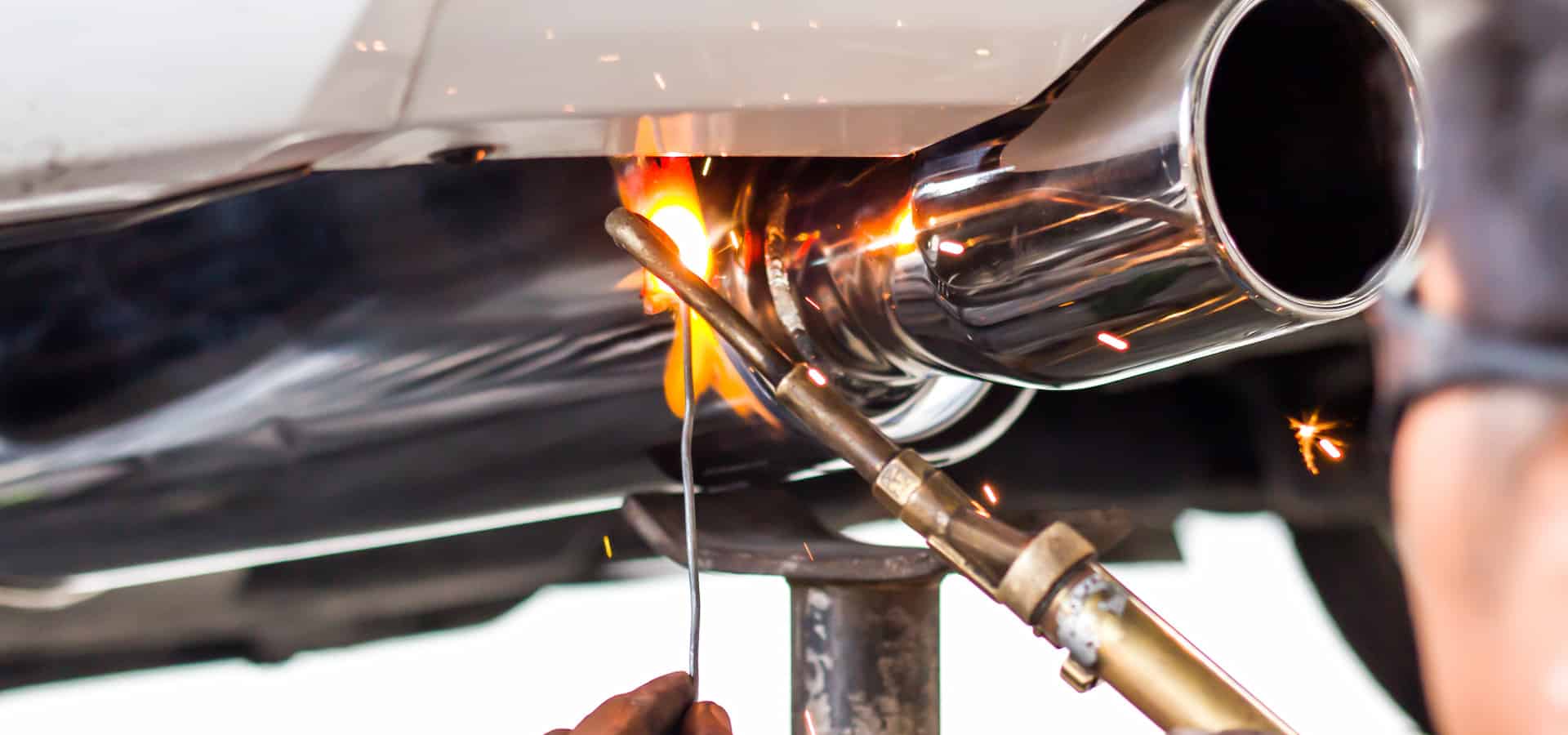
GMC Exhaust & Catalytic Converter Repair at Elevation Auto Repair
A GMC Sierra owner came to us convinced the whole exhaust was shot after a P0420 code lit the dash and a low rumble crept in on the highway. The real culprit was a single downstream oxygen sensor and a cracked flex pipe just behind the manifold. That's the difference specialist diagnosis makes – we fix what's actually failing instead of throwing the entire system at the problem.
GMC trucks and SUVs put their emissions hardware through brutal duty cycles: towing, cold Denver starts, and long idle times that cook the catalyst substrate. The 5.3L and 6.2L V8s (L83/L86, and later L84/L87 with cylinder deactivation) are notorious for premature catalytic converter clogging tied to oil consumption through the AFM/DFM system. Getting this right means reading live data with a factory-capable scan tool, checking fuel trims, and confirming the converter is the real fault before replacement.
When you bring a GMC to us for exhaust and catalytic converter work, you can expect:
- True fault isolation using live O2 sensor and fuel trim data – not guesswork
- OEM-grade or CARB-compliant converters that pass emissions and won't re-trigger codes
- Proper torque on manifold and flange bolts to prevent leaks and rattles
- Honest recommendations with no unnecessary parts added to the bill
Symptoms – How to Know You Need This Service
Exhaust problems on a GMC rarely stay quiet for long. Here's what you may notice from the driver's seat:
- Check engine light with P0420 or P0430 – catalyst efficiency below threshold on one or both banks
- A deep drone or rumble that grows louder under acceleration, often from a cracked flex pipe or failed weld
- Sulfur or rotten-egg smell pointing to a saturated or failing catalytic converter
- Sluggish acceleration and poor fuel economy from a clogged, restricted converter
- Rattling from underneath at idle or over bumps – a broken catalyst substrate coming apart inside the shell
- Ticking near the front of the engine that fades as it warms, hinting at a cracked exhaust manifold
- Hissing or vibration through the floor from a leaking gasket or corroded pipe
Schedule soon for a check engine light, mild drone, or reduced fuel economy. Stop driving and call us right away if you smell strong exhaust inside the cabin, hear loud roaring, or notice excessive heat and burning odors – a severely restricted converter can overheat and become a fire risk.
Common Exhaust & Catalytic Converter Repair Issues on GMC Vehicles
GMC trucks and SUVs share powertrains with Chevrolet across the GMT900 and K2XX platforms, and their exhaust problems tend to follow predictable paths. Here are the patterns we see most often:
- Catalytic converter substrate failure on 5.3L V8 (LC9/LMG/L83) Sierra and Yukon – Active Fuel Management cylinder deactivation and the notorious oil consumption on these engines can foul and overheat cats, breaking the ceramic honeycomb and triggering P0420/P0430 codes.
- Manifold-to-catalyst bolt corrosion on 1999-2013 Sierra/Yukon – Colorado road salt and repeated heat cycling seize the flange bolts, so what should be a simple gasket job becomes a broken-stud extraction.
- Cracked exhaust manifolds on 6.0L and 6.2L (L96/L9H) heavy-duty applications – The cast manifolds warp and crack near the flange, producing a cold-start tick that fades as metal expands.
- Downstream O2 sensor failure on 4.3L V6 (LV3) Canyon – Aging heater circuits set slow-response codes that mimic a bad converter.
- Rusted-through mid-pipes and muffler seams on older Acadia/Terrain – Front-wheel-drive crossovers sit lower and collect road spray, rotting flex pipes and hangers.
- Duramax LML/LGH DPF and EGR clogging on 2011+ Sierra HD – Short-trip driving prevents proper regeneration, loading the diesel particulate filter and setting limp-mode faults.
Which GMC Models We See for Exhaust & Catalytic Converter Repair
We service the full lineup of GMC trucks, SUVs, and crossovers. These are the platforms we most often see for exhaust and catalytic converter work:
- Sierra 1500 (GMT900, K2XX, T1XX) – 2007 to present, with 4.8L/5.3L/6.2L V8s; AFM/DFM-equipped L83/L86/L84/L87 engines are the most common converter cases
- Sierra 2500/3500 HD – 6.0L gas and 6.6L Duramax diesel; diesel work involves DPF, SCR, and DEF system diagnostics beyond a standard cat
- Yukon and Yukon XL (GMT900, K2XX, T1XX) – 2007 to present, sharing the same V8 emissions hardware and oil-consumption concerns
- Acadia (Lambda and C1XX) – 3.6L V6 (LFX/LGX); manifold-integrated converters that require careful diagnosis
- Terrain – 2010 to present, 2.0T/2.4L and 3.6L variants
- Canyon (GMT355, GMT700, 31XX) – 3.6L V6 and 2.8L Duramax diesel models
Duramax diesel emissions repair takes specialized attention – DPF regeneration faults and NOx sensor issues differ sharply from gas converter work, and we diagnose those on their own terms. For pre-1996 GMC models and certain heavily modified emissions setups, availability of compliant parts can be limited, and we'll tell you honestly before starting any work.
A Denver contractor rolled into the shop with his 2011 Sierra 1500 rattling like a coffee can full of bolts every time he hit the gas. He figured it was a heat shield. It was actually a collapsed catalytic converter substrate breaking loose inside the case – the kind of thing that starts as a minor noise and turns into a plugged exhaust that strangles the engine. That truck is exactly why exhaust work deserves a careful eye, not a quick guess.
Causes & Risks – What Happens if Ignored
Most GMC exhaust failures come down to three things: Denver's salted winter roads, the constant heat cycling of a hardworking truck engine, and design quirks like AFM oil consumption that contaminate converters from the inside. Age does the rest.
Waiting rarely makes any of this cheaper. A single P0420 code caught early might mean an O2 sensor or a small upstream repair. Let it ride, and the story changes fast.
- Ignoring a rattling converter for a few months lets loose substrate migrate and plug the exhaust, choking power and spiking fuel use.
- A small exhaust leak near the manifold flange can back-feed carbon and damage downstream O2 sensors, adding parts to the bill.
- Untreated oil consumption on 5.3L AFM engines keeps killing replacement converters until the root cause is addressed.
- Seized flange bolts left in place snap during any future service, turning a gasket into a manifold R&R with drilling and re-tapping.
- A clogged Duramax DPF ignored past its regen threshold forces the truck into limp mode and can require a forced regen or filter replacement.
We'd rather catch it at the rattle stage and keep your GMC on the road affordably.
Safety Impact – Why Exhaust & Catalytic Converter Repair Matters
Exhaust problems are not just a noise nuisance. A leak ahead of the passenger compartment can pull carbon monoxide into the cabin, and a plugged converter can leave you stranded in traffic when the engine loses power. Failed O2 feedback also disrupts fuel trims that other systems rely on for smooth, predictable throttle response.
Here is how we triage symptoms:
- Stop driving now: exhaust fumes or a sulfur smell inside the cabin, sudden severe power loss, or a glowing-hot converter you can smell.
- Schedule soon: a persistent check engine light with P0420/P0430, a cold-start manifold tick, or a low droning rattle under acceleration.
- Monitor and book: a slightly louder exhaust note or a single slow-response O2 code.
There's also a liability angle – a known failed converter that lets a vehicle fail emissions or leak CO can complicate matters if something goes wrong. We document what we find and fix it correctly the first time.
How GMC Exhaust & Catalytic Converter Repair Actually Works
Your GMC's exhaust is a closed feedback loop. Upstream oxygen sensors tell the ECM how to trim fuel, the catalytic converter cleans the exhaust, and downstream sensors confirm the cat is doing its job by comparing oxygen levels before and after. When those readings drift apart, you get a converter efficiency code. On diesel Sierra HD models, add a DPF, EGR cooler, and DEF injection managing soot and NOx.
What makes GMC work different from generic muffler-shop patching:
- Federal emissions rules require CARB-compliant or OEM-grade converters, not the cheap universal cats that quickly re-trigger P0420.
- Replacing a converter often calls for a fuel-trim relearn and clearing readiness monitors with a proper scan tool so the truck passes an emissions retest.
- Duramax DPF service may need a commanded regeneration and soot-mass reset through GM-compatible software, not just a filter swap.
- Manifold and
A Sierra 1500 owner rolls in with a low, droning rumble under acceleration and a P0420 code that keeps coming back after a parts-store converter swap. That kind of story plays out often on GMC trucks and SUVs, where a failing catalytic converter is frequently a symptom of something upstream rather than the root cause. Chasing the code without chasing the cause is how people end up buying the same part twice.
How We Diagnose Exhaust & Catalytic Converter Repair Issues on GMC
The symptom might be a rattle, a sulfur smell, reduced power, or a stubborn check engine light. The problem could live anywhere from the manifold to the tailpipe, so we work through it methodically.
- Full scan with a factory-level tool – Using GDS2 / Tech2Win-style scan capability, we pull stored and pending codes. P0420/P0430 (catalyst efficiency), P0430 bank two, and P0141 (O2 heater) point in very different directions.
- Live data review – We watch upstream and downstream O2 sensor voltages and short/long term fuel trims. A downstream sensor that mirrors the upstream signal usually confirms a spent converter.
- Visual inspection on the lift – We check flex pipes near the manifold on 5.3L and 6.2L V8s, weld seams, hangers, and the notorious cracked exhaust manifold bolts common on older GMT800/GMT900 trucks.
- Physical measurement – Back-pressure testing and, when needed, a temperature check across the converter inlet and outlet to spot internal blockage.
- Road test – We drive the vehicle to reproduce drone, misfire, or power loss under real load.
Once we know what is actually failing, we translate findings into a clear written repair plan and quote – no guesswork, no unnecessary parts.
Exhaust & Catalytic Converter Repair on GMC: Repair vs. Replacement
Not every exhaust complaint means a full converter. We match the fix to the failure.
- Genuine repair – A leaking gasket, a broken hanger, a single seized manifold bolt, or a cracked flex pipe on a Sierra or Yukon can be welded or replaced while the rest of the system stays intact. A false P0420 caused by a lazy downstream O2 sensor is a sensor job, not a converter job.
- Partial replacement – When one converter section or a rusted mid-pipe is gone but the muffler and resonator are solid, we replace only the failed segment. This is common on higher-mileage GMT900 and K2XX platform trucks with regional rust.
- Full replacement – When internal substrate is broken down, contaminating downstream sensors, or when rust has cascaded through hangers and joints, replacing the assembly is safer and more cost-effective than piecing it together.
We lay out the options side by side so you decide with real information – never pushed toward the priciest path.
How to Make Your GMC Exhaust & Catalytic Converter Repair Last Longer
A healthy converter and exhaust system come down to keeping the engine burning clean and catching small problems early.
Driving Habits That Help
- Let the engine reach operating temperature before heavy loads – short cold trips foul converters over time.
- Fix misfires and rich-running conditions promptly; raw fuel destroys catalyst substrate.
- Avoid deep water crossings and hard curb contact that stress hangers and flex pipes.
Owner Maintenance
- Listen for new rattles, ticking, or drone and act before they worsen.
- Glance under the truck for rust bloom, hanging pipes, or dark soot near joints.
- Never ignore a check engine light – misfire and fuel-trim codes shorten converter life fast.
Brand-Specific Care
- Use OEM-spec oxygen sensors and gaskets; off-brand sensors are a frequent cause of repeat P0420 codes.
- Keep engine and emissions software current – GMC updates can refine catalyst monitoring.
- Follow GMC's maintenance intervals for spark plugs and fuel system service.
Visual checks and light listening are safe to do yourself. Welding, converter replacement, and anything on a hot exhaust should be left to our technicians.
What to Expect When You Bring Your GMC In
A Sierra owner rolled in recently with a droning cabin noise and a P0420 code – the classic sign of a catalytic converter losing efficiency on the 5.3L V8. That kind of complaint is where a structured intake pays off, because rattles, sulfur smells, and downstream O2 sensor readings all point in different directions until you separate them.
- Drop-off or appointment – Schedule ahead or leave the vehicle with us; note any symptoms like exhaust drone, a rotten-egg smell, or a check engine light so the tech knows where to start.
- Initial inspection – We put the GMC on the lift, inspect manifold flanges, flex pipes, hangers, and the converter housing, then pull codes and live data with a scan tool to read pre- and post-cat oxygen sensor behavior.
- Written estimate – You get a clear breakdown separating a failed converter from upstream causes like a leaking exhaust manifold gasket or a bad O2 sensor.
- Approval and updates – We call before any additional work and keep you posted as parts and repairs progress.
- Pickup walkthrough – We review what was replaced, show old parts when useful, and explain what to watch for.
Leave personal items in the cabin or take them with you – your call. Shuttle and loaner options and after-hours key drop are available to keep your day moving. Every job ends with a road test and a scan-tool re-check to confirm codes clear and readiness monitors set. If anything feels off afterward, bring it back and we'll re-verify.
Why Choose Elevation Auto Repair for GMC Exhaust & Catalytic Converter Repair
GMC trucks and SUVs have their own exhaust quirks, and we work on them constantly. On the 4.8L, 5.3L, and 6.0L Vortec V8s in Sierra, Yukon, and Savana platforms, we routinely see converter efficiency codes tied to aging sensors, manifold cracks, or oil consumption – not always a bad cat. Chasing the real cause keeps you from paying twice.
- Brand-specific knowledge – We reference applicable GMC TSBs and PCM software updates that affect catalyst monitor thresholds before condemning a converter.
- Correct diagnosis first – We verify P0420/P0430 causes with live O2 data instead of guessing, so you don't replace a good part.
- End-to-end ownership – The same shop handles diagnosis, welding or bolt-in replacement, sensor service, and post-repair verification.
- Proper fitment – Federal-compliant converters and OE-style hangers and gaskets so the repair lasts.
As your Denver dealership alternative, we handle everything from the exhaust back to the check engine light diagnostics that started the whole conversation – one shop, clear communication, no unnecessary parts.
Our GMC Services
- Air Conditioning AC Repair
- Battery Repair Replacement
- Brake Repair & Brake Fluid Change
- Check Engine Light Diagnostics
- Clutch Repair & Replacement
- Coolant Leak Repair
- Cooling System Repair
- Drive Shaft Repair
- Engine Repair
- Head Gasket Repair & Replacement
- Oil Change
- Oil Leak Repair
- Scheduled Service Maintenance
- Steering Repair
- Suspension Repair
- Cambelt Timing Belt Replacement
- Transmission Repair
- Tune Up
- Wheel Alignment