
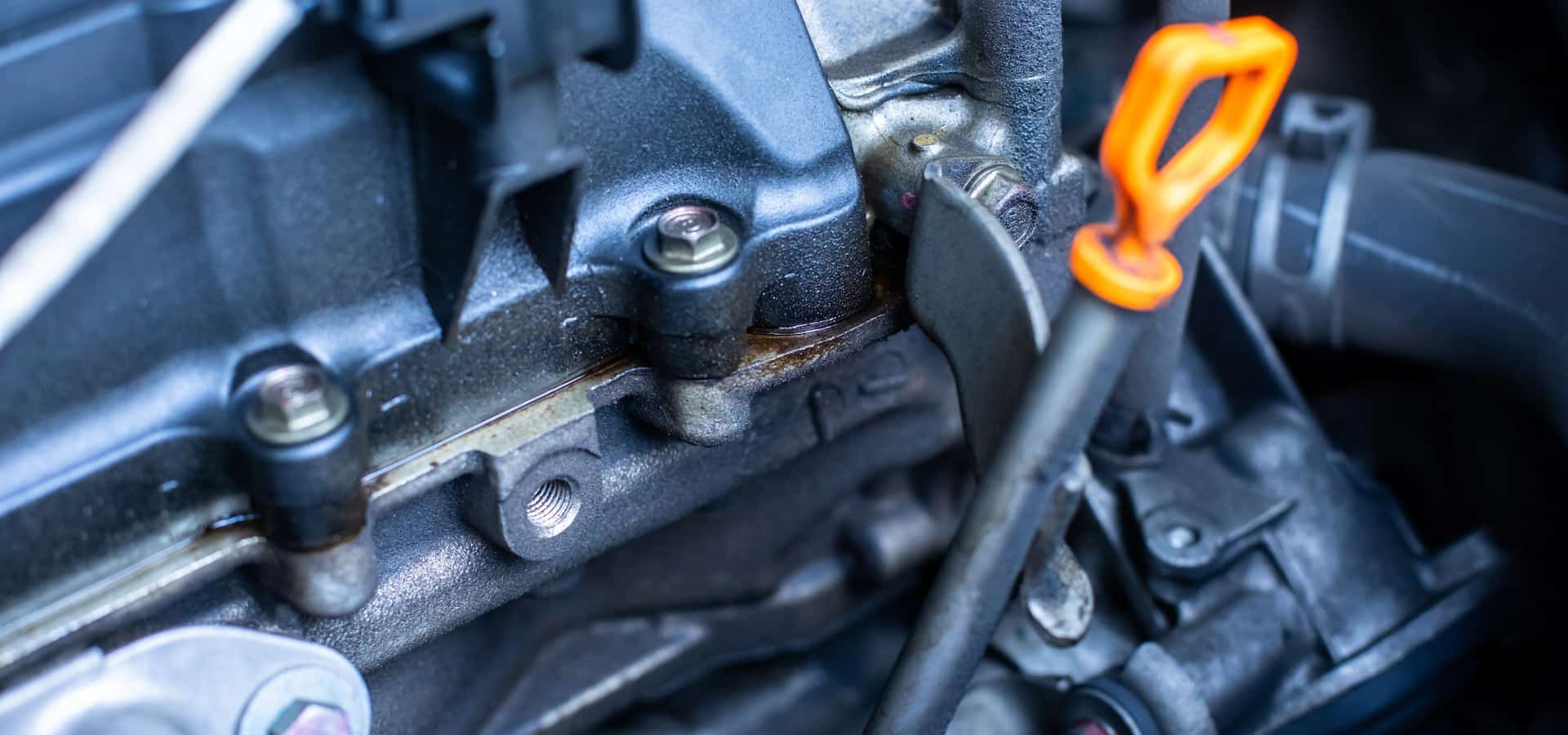
GMC Oil Leak Repair at Elevation Auto Repair
A GMC oil leak is rarely just a puddle on the driveway. On the trucks and SUVs we see most in Denver, leaks trace back to specific gaskets and seals that behave differently under altitude, load, and heat cycling. Finding the true source – not just the lowest wet spot – is what separates a lasting fix from a repeat visit.
GMC platforms carry their own quirks. The 5.3L and 6.2L V8s in Sierra and Yukon (the Gen IV and Gen V small-block families) are known for valve cover gasket seepage, rear main seal weeping, and oil cooler line failures. The 3.6L V6 in Acadia and Canyon commonly leaks at the timing cover and the oil filter housing adapter, where warped seals let oil migrate down the block. Doing this correctly means proper degrease-and-dye tracing, torque-to-spec fasteners on aluminum covers, and the right oil for the engine – not a generic pour.
Here is what you can expect when you bring your GMC to us:
- UV dye tracing and a thorough inspection to pinpoint the actual leak source
- OEM-grade or better gaskets and seals installed to factory torque specs
- Clear explanation of what is leaking and what is not – no padded repairs
- A repair aimed at long-term reliability, verified after a road test and re-check
Symptoms – How to Know You Need This Service
Oil leaks tend to announce themselves gradually, then all at once. Watch for these signs on your GMC:
- You may notice dark spots or a slick sheen under the front or center of the vehicle after parking
- A burning-oil smell through the vents, especially after climbing a grade or idling in traffic
- Faint blue smoke from the engine bay when oil drips onto the exhaust manifold
- Your oil level drops between changes with no obvious cause
- The oil life or low-oil-pressure warning illuminating on the driver information center
- Ticking or lifter noise at cold start, which can point to low oil from a leak
- Visible buildup and grime around valve covers, the oil filter housing, or the timing cover
Schedule soon if you see minor seepage or a slow drop in oil level. Stop driving immediately if the low-oil-pressure light comes on, you smell heavy burning oil, or you find a large fresh puddle – running a GMC engine low on oil risks bearing and camshaft damage far more expensive than the leak itself.
Common Oil Leak Repair Issues on GMC Vehicles
GMC trucks and SUVs share powertrains with the broader GM lineup, but the way these engines age – especially the high-mileage Sierra, Yukon, Acadia, and Canyon – creates a handful of oil leak patterns our techs see again and again. Knowing where a specific platform tends to weep saves diagnostic time and gets you a repair that actually holds.
- Rear main seal seepage on 5.3L and 6.2L Gen IV/Gen V V8s – The LS/LT-family engines in Sierra 1500 and Yukon commonly develop a rear main seal leak that mimics an oil pan drip, often pooling at the bellhousing.
- Valve cover gasket leaks on 3.6L LFX/LGX V6 – The Acadia and Canyon 3.6L tend to weep at the valve covers, dripping onto the exhaust and producing that burning-oil smell at idle.
- Oil pan gasket and front cover leaks on older 4.8L/5.3L trucks – Heat cycling on 2007-2014 GMT900 platform Sierras hardens the pan gasket and RTV, letting oil track down the block.
- Oil cooler line and adapter leaks on Duramax diesels – LML and LMM Duramax Sierra HD trucks often leak at the oil cooler seals and feed lines under sustained load.
- Timing cover leaks on 3.6L high-feature V6 – Aging seals and the front cover RTV joint let oil migrate down toward the crank pulley.
- Camshaft position actuator solenoid and VVT seals – On direct-injected V6 and V8 GMC engines, these seals seep and can throw drivability codes as they age.
Which GMC Models We See for Oil Leak Repair
We handle oil leak repair across the GMC lineup, from daily-driven half-tons to family haulers. The platforms and engines below cover the bulk of what rolls through our bays:
- Sierra 1500 (GMT900, K2XX, T1XX) – 5.3L and 6.2L V8s prone to valve cover and rear main seal leaks; oil cooler line seepage on higher-mileage trucks
- Sierra 2500/3500 HD – 6.6L Duramax diesel front cover and turbo drain-back seal leaks, plus 6.0L gas valve cover gaskets
- Yukon / Yukon XL / Denali – same small-block V8 family; AFM/DFM-equipped engines add lifter and cover considerations
- Acadia (2007–2016 Lambda, 2017+ C1XX) – 3.6L LFX/LGX with timing cover and oil filter housing adapter leaks
- Canyon (2015+) – 3.6L V6 and 2.8L Duramax diesel oil pan and front cover seepage
- Terrain – 2.0L and 2.4L four-cylinders with valve cover and oil filter adapter leaks
Denali trims share drivetrains with their base counterparts, so the repair approach carries over. Diesel Duramax variants take extra care around the front cover and high-pressure fuel system, and we plan those jobs accordingly. If you have an older GMC that falls outside these platforms, reach out – we will tell you honestly whether it is a job we are set up to do right.
Causes & Risks – What Happens if Ignored
Most GMC oil leaks come down to heat, age, and Colorado's dry climate baking gaskets and RTV until they shrink and crack. Frequent towing, long highway pulls up I-70, and stop-and-go city driving all accelerate the cycle. Once a seal starts weeping, the leak rarely stays small.
Waiting turns a straightforward gasket job into a chain of failures. Oil that escapes low creeps onto belts, wiring, and hot exhaust components, and a low crankcase level puts real stress on bearings and the timing system.
- Valve cover leaks left for months typically saturate ignition coils and plug wells, causing misfires and rough running.
- Rear main seal drips can contaminate the clutch or torque converter seal area, pulling the transmission into the repair.
- Oil pan seepage reaches the serpentine belt, degrading it and risking a sudden loss of accessory drive.
- Chronic low oil level starves the VVT solenoids and lifters, leading to the collapsed-lifter and cam-phaser failures common on high-mile GM V8s.
- Duramax oil cooler leaks ignored under load can overheat the engine and compromise the entire lubrication system.
The pattern is consistent: a minor seal today, an engine or transmission tomorrow. We catch it early and keep the repair contained.
Safety Impact – Why Oil Leak Repair Matters
An oil leak isn't just a maintenance nuisance on a GMC – it feeds directly into systems you rely on to control the vehicle. Oil on hot exhaust is a fire risk, and oil-fouled sensors and drive belts affect far more than the engine.
- Power steering assist – A shredded serpentine belt from oil contamination kills your steering assist and water pump drive at speed.
- ABS and stability control – Oil-soaked wiring harnesses near the pan can trigger sensor faults that disable traction control and ABS.
- Braking – Loss of belt drive on many GMC models affects the vacuum or hydraulic assist that supports the brakes.
- Engine protection – Severe low oil can put the engine into reduced-power or shutdown mode on the highway.
Stop driving now if: you smell burning oil with smoke, see the oil pressure light, or hear belt squeal with steering that suddenly stiffens.
Schedule soon if: you spot small driveway spots, notice a faint oil smell at idle, or find oil residue during routine service. Addressing a known leak promptly also protects you on the liability side if a fire or crash ever traces back to a neglected defect.
How GMC Oil Leak Repair Actually Works
Finding a GMC oil leak is about tracing oil to its highest point, since gravity carries it far from the source. Our techs clean the area, run the engine, and often use UV dye and a black light to pinpoint whether it's the valve cover, front cover, rear main, or an oil cooler seal before pulling anything apart.
What sets GMC work apart is the reliance on precise RTV application, torque sequences, and updated OEM seal designs – GM has revised several gaskets and rear main seals over production runs, so using the current part number matters for a leak that stays fixed.
- OEM torque and sequence specs – Valve covers and oil pans on the 3.6L and 5.3L use staged torque patterns; over-tightening warps the cover and causes a repeat leak.
- Correct RTV and cure time – GM specifies particular sealants and bead placement at cover-to-block joints that generic silicone won't match.
- Updated seal part numbers – Rear main and timing seals have superseded revis
GMC trucks and SUVs share the GM small-block and Duramax architecture with their Chevrolet siblings, but the way they get loaded – towing, hauling, and long highway pulls – tends to expose oil leaks faster than lighter-duty vehicles. From the 5.3L and 6.2L EcoTec3 V8s in Sierra and Yukon platforms to the 6.6L Duramax LML/L5P diesels, each engine family has its own leak-prone gaskets and seals. Chasing those leaks correctly takes GMC-specific knowledge, not a guess-and-replace approach.
How We Diagnose Oil Leak Repair Issues on GMC
A wet engine bay rarely tells the whole story. Oil migrates with airflow and gravity, so the visible drip is often far from the actual source. Here's how we track it down on a GMC:
- Full scan with GM-capable tooling – We pull codes and live data through a GDS2/Tech2-compatible platform to check for oil pressure sensor faults, PCV system readings, and any pending codes that hint at crankcase pressure problems on EcoTec3 and Duramax engines.
- Baseline visual inspection – We clean the suspected area, then look at the usual GMC offenders: valve cover gaskets, the rear main seal, oil pan gasket, timing cover, and the oil cooler adapter seals common on 5.3L/6.2L V8s.
- UV dye and pressure verification – When a leak hides behind accessories or the bellhousing, we introduce UV dye and run the engine, then trace the exact origin under black light.
- Road test under load – GMC leaks often appear only at operating temperature or under towing-level load, so we drive the truck the way it's actually used.
- Measure and confirm – We check crankcase ventilation function and confirm the source before quoting a single part.
Once we've isolated the true source, you get a clear written repair plan with the parts and labor spelled out – no upsells, just the fix your GMC needs.
Oil Leak Repair on GMC: Repair vs. Replacement
Not every oil leak calls for tearing an engine apart. We match the fix to the actual condition of the parts.
- Genuine repair – A weeping valve cover gasket on a 5.3L EcoTec3, a loose oil filter housing, or a hardened PCV grommet can often be resealed or replaced as a single component while everything else stays in service.
- Partial replacement – When the oil pan gasket or front timing cover seal fails but the cover and pan are sound, we replace the worn seal and gasket set and reuse the good hardware. Duramax injector return line or oil cooler seal leaks usually fall here too.
- Full replacement – Rear main seal failures with a scored crank hub, or cascading damage where an oil cooler leak has contaminated adjacent components, justify replacing the assembly. If a repair approaches the cost of a reman unit, we tell you plainly.
We lay out every option with the trade-offs – long-term reliability, cost, and how you use the truck – then let you decide. The most expensive path is never the default recommendation.
How to Make Your GMC Oil Leak Repair Last Longer
A proper reseal should hold for years when the engine is treated right afterward. These habits protect the work.
Driving and load habits
- Let the engine reach operating temperature before heavy towing – cold oil pressure spikes stress fresh seals.
- Avoid overloading past your GMC's rated capacity, which raises crankcase pressure on the EcoTec3 and Duramax platforms.
- In Denver's temperature swings, give diesels a brief warm-up in winter to keep seals pliable.
Owner maintenance you can handle
- Do a quick under-hood and driveway check for fresh spots between oil changes.
- Listen for changes and watch the oil pressure gauge and check engine light.
- Keep the oil topped to spec and never run past a change interval.
Brand-specific care that matters
- Use dexos-approved oil and OEM-grade gaskets – GMC seals are engineered for specific fluid formulations.
- Keep PCM and module software current, since GM updates can affect crankcase ventilation behavior.
- Follow GMC's published service intervals rather than stretching them.
Visual checks and fluid top-offs are fine to do yourself. Leave rear main seals, timing covers, and anything requiring engine or transmission separation to us – those repairs demand proper torque specs and sealing procedures to last.
GMC trucks and SUVs share GM's Vortec and EcoTec3 engine families with Chevrolet, but their real-world duty cycle – towing, hauling, and long highway miles – tends to accelerate specific oil leak points. On the 5.3L and 6.2L L83/L86 engines found in Sierra and Yukon models, the rear main seal and oil pan gasket see hard use, while high-mileage 6.0L LS-based trucks are known for valve cover gasket seepage and front cover leaks. Older Duramax 6.6L diesels have their own habits around the front crank seal and turbo drain lines. Diagnosing these correctly takes more than spotting a puddle.
What to Expect When You Bring Your GMC In
We keep the process straightforward so you always know where your GMC stands. Here is how a typical visit flows:
- Drop-off or appointment – Schedule ahead or leave your Sierra, Acadia, Terrain, or Yukon with us. Grab personal items from the cabin; we secure anything left behind.
- Initial inspection – We degrease suspect areas and use UV dye tracing to pinpoint the exact source, whether it's the oil pan gasket, rear main seal, valve covers, or an oil cooler line.
- Written estimate – You get a clear breakdown of what's leaking, what parts we recommend, and why. No guesswork, no padded add-ons.
- Communication during the work – We check in before doing anything beyond the approved scope, so surprises never show up on the final bill.
- Pickup walkthrough – We show you the old gaskets or seals and explain what was done.
Shuttle and loaner options are available to keep you moving, and after-hours pickup can be arranged. Before your GMC leaves, we road test it and run a scan-tool re-check to confirm oil pressure and no related codes. If anything feels off afterward, bring it back and we'll make it right.
Why Choose Elevation Auto Repair for GMC Oil Leak Repair
Oil leaks on GM platforms are often misdiagnosed because gravity carries oil away from the actual source. We trace leaks to their origin rather than replacing the first gasket someone sees.
- Platform-specific knowledge – Familiarity with GMC TSBs, common EcoTec3 AFM-related oil consumption issues, and the leak-prone spots on 5.3L, 6.2L, and Duramax engines.
- Correct sealing procedures – We follow GM torque sequences and use the right RTV and OEM-grade gaskets so repairs hold up under towing loads and Denver temperature swings.
- End-to-end ownership – Diagnosis, repair, and post-repair verification happen under one roof with the same team accountable for the outcome.
Our focus is long-term reliability. When we reseal a rear main or oil pan, we address the surrounding contributors – PCV routing, crankcase pressure, worn cover fasteners – so you're not back for the same leak next season. That's the difference between a quick patch and a repair built to last.
Our GMC Services
- Air Conditioning AC Repair
- Battery Repair Replacement
- Brake Repair & Brake Fluid Change
- Check Engine Light Diagnostics
- Clutch Repair & Replacement
- Coolant Leak Repair
- Cooling System Repair
- Drive Shaft Repair
- Engine Repair
- Exhaust & Catalytic Converter Repair
- Head Gasket Repair & Replacement
- Oil Change
- Scheduled Service Maintenance
- Steering Repair
- Suspension Repair
- Cambelt Timing Belt Replacement
- Transmission Repair
- Tune Up
- Wheel Alignment