
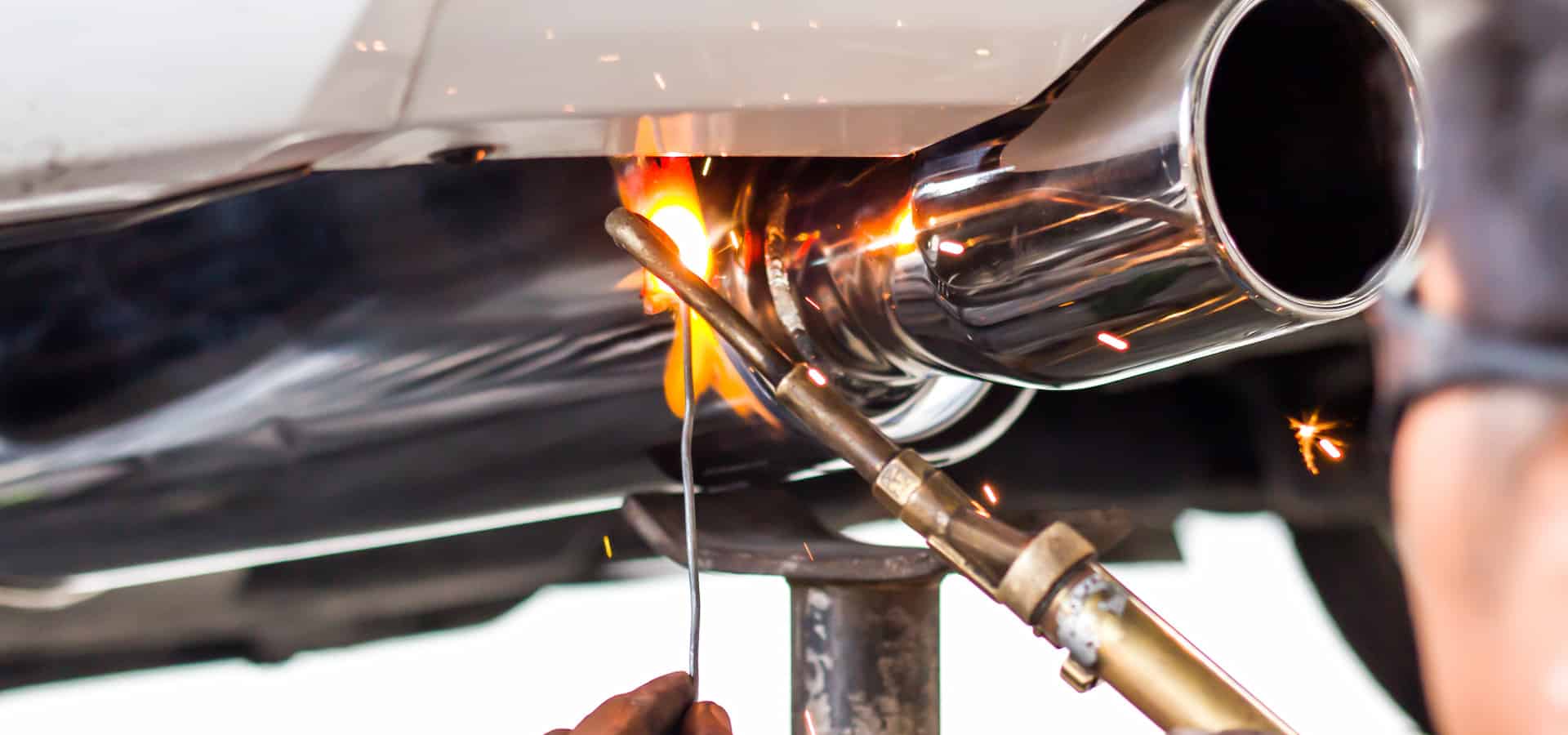
Honda Exhaust & Catalytic Converter Repair at Elevation Auto Repair
That rattle under your Honda when you start cold, or a check engine light flashing a P0420, usually points to something happening in the exhaust and catalytic converter. Honda systems are engineered tightly, and getting them back to factory spec takes more than bolting on a universal cat.
Many Honda catalytic converters are integrated with the exhaust manifold, especially the front bank on 2.4L K-series (Accord, CR-V) and the R18 in Civics. Replacing these correctly means matching the OEM converter to the exact emissions family, using new manifold-to-head gaskets, and torquing fasteners to Honda's staged specs so nothing warps or leaks. On many models we read live catalyst efficiency data through the OBD-II system to confirm the converter is actually failing before recommending replacement – no guessing, no unnecessary parts.
Colorado's altitude and cold starts put extra stress on these systems, so proper repair pays off in long-term reliability. Here's what you can expect:
- Verified diagnosis using live oxygen sensor and catalyst monitor data
- OEM-grade converters that meet your Honda's emissions family for a clean, lasting fix
- New gaskets and hardware, torqued to Honda specifications
- A post-repair drive cycle to confirm all monitors set and no codes return
Symptoms – How to Know You Need This Service
Honda exhaust problems tend to build gradually, then get loud fast. Watch for these signs:
- You may notice a rattling or shaking noise from underneath, often worst on cold startup – frequently a broken internal catalyst substrate or a loose heat shield.
- A rotten-egg or sulfur smell, a strong sign the converter is no longer functioning properly.
- A check engine light with P0420 or P0430 (catalyst efficiency below threshold).
- Noticeably reduced power or sluggish acceleration, especially climbing hills or merging.
- A drop in fuel economy without any change in your driving.
- A louder-than-normal exhaust drone or hissing, pointing to a cracked flex pipe, rusted flange, or leaking gasket.
- A burning smell or discolored heat shield from an overheating converter.
Schedule soon for rattles, smells, and P0420 codes. Stop driving right away if you notice a burning smell with heat coming into the cabin, or a sudden severe loss of power with a glowing converter – a plugged cat can overheat and become a fire risk. We'll get you in quickly and back on the road safely.
Common Exhaust & Catalytic Converter Repair Issues on Honda Vehicles
If your Honda has started droning at highway speed, throwing a P0420, or rattling under the floorpan when you idle at a light, you're dealing with problems Honda owners see regularly. These are the patterns our techs address most often:
- P0420/P0430 catalyst efficiency codes on 2003-2011 Accord and Civic (K-series and R18): The primary catalyst loses efficiency as mileage climbs. Honda's close-coupled cat design runs hot, and worn engines feeding oil past the rings accelerate substrate breakdown.
- Flex pipe cracks on 2006-2011 Civic (FA/FG chassis): The braided flex coupling between the manifold and mid-pipe fatigues and splits, producing an exhaust leak and a loud tick that gets worse under load.
- Rear catalytic converter rattle on 2013-2017 Accord (CR-series, K24W Earth Dreams): The internal ceramic honeycomb crumbles and the loose material rattles inside the housing, often after a misfire event that overheats the cat.
- Manifold-to-cat header cracks on early V6 Odyssey and Pilot (J35): Heat cycling stresses the exhaust manifold and integrated cat, leading to leaks near the flange and a rotten-egg smell.
- Rust-through on muffler and resonator sections: Denver road salt and moisture eat the rear muffler and hangers on higher-mileage CR-V and Civic models, causing drone and dragging pipes.
- Oxygen sensor failure mimicking a bad cat: Aging downstream O2 sensors on many Honda platforms trigger catalyst codes even when the converter is healthy – a distinction that saves you from an unnecessary part.
Which Honda Models We See for Exhaust & Catalytic Converter Repair
We service exhaust and catalytic converter repairs across nearly the entire Honda lineup. The most common visitors:
- Accord – 2003–2017 (K24 2.4L and J-series V6); manifold-integrated front cats are common failure points on the four-cylinders.
- Civic – 2006–2021, including R18, K20, and 1.5L turbo (L15B) engines; the turbo cars have unique downpipe and cat layouts we handle regularly.
- CR-V – 2002–2022 (K24 and 1.5L turbo); front-bank cat and flex-pipe issues show up often.
- Pilot & Odyssey – J-series V6 platforms with dual converters and VCM-related exhaust considerations.
- Fit – L15 engines, prone to rear cat efficiency codes with age.
- Element, Ridgeline, HR-V – full exhaust and converter service available.
Performance variants like the Civic Si and Type R (FK8/FL5) run specific turbo downpipe and catalyst hardware – we match OEM-correct parts so emissions monitors pass. Hybrid Accord and CR-V models have different exhaust routing, and we service those as well. If you're driving an early '90s or older Honda where correct emissions parts have become hard to source, we'll tell you honestly before starting so you can plan the right long-term fix.
Causes & Risks – What Happens if Ignored
Most Honda exhaust failures trace back to a mix of heat cycling, Colorado's salted winter roads, and the engine's own condition. A converter almost never fails on its own – it's usually killed by oil consumption, a lingering misfire, or a rich fuel condition that coats the substrate.
Waiting rarely makes any of this cheaper. A cracked flex pipe you could weld this month becomes a warped mid-pipe next season, and a rattling cat that's already crumbling will eventually plug itself and choke the engine.
- Ignored misfire (P030x) plus a hot cat: unburned fuel torches the substrate, turning a spark-plug job into a full converter replacement.
- Unaddressed exhaust leak near the manifold: skews upstream O2 readings, degrades fuel economy, and can trigger long-term fuel trim faults.
- Continued driving on a clogged cat: builds backpressure, robs power, overheats the exhaust, and stresses valves and the head.
- Rusted hangers left alone: allow the pipe to drop and contact the driveshaft or road, risking a dragging exhaust at speed.
- Rotten-egg sulfur smell inside the cabin: signals a leak forward of the passenger area – a health and safety concern, not just a nuisance.
Our approach is straightforward: verify the actual cause first, fix the root problem, then replace only the components that are truly gone so the repair holds up long-term.
Safety Impact – Why Exhaust & Catalytic Converter Repair Matters
A compromised exhaust does more than make noise. Leaks forward of the cabin can let carbon monoxide reach the interior, and a plugged converter changes how the engine behaves in traffic. False O2 signals from a leak can also confuse the ECU's fueling, which indirectly affects drivability and emissions readiness.
Here's how to tell what needs immediate attention versus what can wait for a scheduled visit:
- Stop driving now: exhaust fumes or a strong sulfur smell inside the cabin, a glowing or overheating converter, or a pipe dragging on the ground.
- Stop driving now: sudden severe power loss with a burning smell – often a fully plugged cat.
- Schedule soon: a steady drone at highway speed, a persistent P0420, or a tick that appears only under acceleration.
- Schedule soon: a check engine light with mild rough idle and no fumes in the cabin.
There's also a liability angle: a known exhaust leak or a failing converter left unrepaired can complicate matters after an incident and will fail Colorado emissions testing. Getting it handled protects both your registration and everyone in the vehicle.
How Honda Exhaust & Catalytic Converter Repair Actually Works
Your Honda's exhaust routes combustion gases through the manifold into a close-coupled catalytic converter, where precious-metal coatings convert harmful gases before they exit the tailpipe. Upstream and downstream oxygen sensors bracket the cat so the ECU can compare readings and confirm the converter is doing its job – that comparison is exactly what sets a P0420.
Honda's implementation has details that shape how we work on it:
- Close-coupled cat placement: Honda mounts the primary cat near the manifold for fast light-off, which means precise torque and gasket sequence at the flange to prevent leaks.
- OEM-grade converter matching: Honda's ECU is sensitive to catalyst efficiency, so a cheap universal cat often re-triggers a code. Correct substrate specs keep the fix permanent.
- Fuel-trim and readiness monitors: after repair, the
How We Diagnose Exhaust & Catalytic Converter Repair Issues on Honda
A droning hum under the floor, a rotten-egg smell, or a check engine light with a P0420 – these are the signs that usually bring a Honda owner to us. We start by reading the whole story before touching a wrench.
- Pull codes with a Honda-capable scan tool (HDS-level access) to read live oxygen sensor and air-fuel ratio data – critical for separating a failed converter from a lazy upstream A/F sensor on K-series and Earth Dreams engines.
- Compare upstream and downstream sensor voltages to confirm whether the catalyst is actually losing efficiency or a sensor is reporting false data, a frequent cause of P0420 on 2006-2011 Civics.
- Perform a cold-start and warmed-up road test to reproduce rattles, exhaust leaks, or the resonance that points to a cracked flex pipe or loose heat shield.
- Visually inspect flanges, gaskets, and the flex coupling behind the exhaust manifold – a known leak point on 2003-2007 Accord and CR-V models.
- Measure back pressure and check for internal converter breakdown or a clogged substrate that starves the engine.
Once we confirm the root cause, we translate the findings into a plain-language repair plan and a clear quote – no guessing, no piling on parts you don't need.
Exhaust & Catalytic Converter Repair on Honda: Repair vs. Replacement
Not every exhaust complaint means a new catalytic converter. We match the fix to the actual failure.
- Genuine repair: Replacing a leaking exhaust gasket, tightening a heat shield, welding a small crack in a flex pipe, or swapping a single downstream O2 sensor that's throwing the efficiency code on a Civic or Fit.
- Partial replacement: Replacing just the converter section or a rusted midpipe while keeping a sound muffler and hangers – common on Colorado-driven CR-V and Pilot models where road salt attacks the mid-section first.
- Full replacement: When the substrate is melted, the shell is rusted through, or multiple sections have cascading corrosion, a complete assembly is the safe, lasting call. We recommend this when patching a converter would cost close to a proper unit.
Honda's factory-integrated manifold converters on some 1.5T and older four-cylinder platforms can drive cost decisions, so we walk you through options – repair, partial, or full – and let you choose with the numbers in front of you rather than pushing the priciest route.
How to Make Your Honda Exhaust & Catalytic Converter Repair Last Longer
A fresh converter or repaired exhaust can serve you for years when the underlying conditions are managed. How you drive and maintain the car matters most.
Driving Habits That Protect the System
- Let the engine reach operating temperature before hard acceleration, especially in cold Denver winters – repeated short trips leave moisture and unburned fuel that shorten catalyst life.
- Avoid frequent very short drives that never fully warm the exhaust and accelerate internal corrosion.
- Address misfires or a rich-running condition quickly – raw fuel is what melts a converter substrate.
Maintenance You Can Do Yourself
- Listen for new rattles, ticks, or drone changes and note when they happen.
- Glance underneath for hanging heat shields, rust streaks, or soot around flanges.
- Never ignore a check engine light – catching a P0420 early often means a sensor fix instead of a converter.
Brand-Specific Care
- Stick to Honda's service intervals and use OEM or OEM-quality oxygen sensors and gaskets that match the correct fitment.
- Keep engine control software current, since Honda updates can refine fuel trims that affect emissions components.
- Use the correct spark plugs and oil grade to prevent oil consumption that contaminates the catalyst.
Visual checks and code awareness are safe for owners. Anything involving lifting the car, exhaust welding, or converter work belongs in the shop – we'll handle the safety-critical parts and keep your Honda reliable for the long haul.
What to Expect When You Bring Your Honda In
If your Honda has developed a droning rasp, a rotten-egg smell, or a P0420 code lighting up the dash, you're likely already worried about a failing catalytic converter or a leaking exhaust joint. Here's how we move from symptom to solution.
- Drop-off or appointment – Tell us what you're hearing, smelling, or seeing. Leave personal items in the cabin if you like; we note and secure anything staged for the tech.
- Initial inspection – We put the car on the lift and trace the system from the header back through the flex pipe, resonator, and muffler, checking for rusted-through spot welds, cracked flex sections, and failed converter substrate.
- Diagnosis and scan – We pull codes and monitor upstream and downstream O2 sensor data to confirm whether the converter is actually spent or a sensor or exhaust leak is fooling the ECM.
- Written estimate – You get a clear breakdown of parts and labor before any work starts. No surprise add-ons.
- Repair updates – We text or call as we go, especially if we uncover something like seized manifold hardware once we're under the car.
- Pickup walkthrough – We show you what was replaced and answer questions.
Loaner and shuttle options and after-hours pickup are available to keep your day moving. Before we hand back the keys, every Honda gets a road test and a scan-tool re-check to confirm readiness monitors set and codes stay clear. If anything feels off afterward, bring it back and we'll re-verify.
Why Choose Elevation Auto Repair for Honda Exhaust & Catalytic Converter Repair
Exhaust work on Hondas rewards experience. A P0420 on a 2006-2011 Civic, an Accord, or a CR-V is often the downstream converter degrading – but rear O2 sensor drift and small exhaust leaks throw the same code, and replacing a good converter fixes nothing. We diagnose the actual cause before quoting parts.
- Honda-specific knowledge – We check for applicable TSBs and PCM/ECM software updates that adjust catalyst efficiency thresholds, so a needless converter swap doesn't happen on your dime.
- Platform awareness – Rusted flex pipes on higher-mileage Odyssey and CR-V units, gasket failures at the manifold-to-cat flange, and heat-shield rattles are patterns we've handled repeatedly.
- Proper parts and fit – We use converters that meet Honda's O2 storage requirements so downstream sensor values stay within spec and monitors set correctly.
We own the whole job – diagnosis, repair, and post-repair verification with a road test and monitor check. That end-to-end approach is what keeps the fix reliable long after you leave, and it's why Denver Honda owners treat us as their dealership alternative for exhaust and catalytic converter work.
Our Honda Services
- Air Conditioning AC Repair
- Battery Repair Replacement
- Brake Repair & Brake Fluid Change
- Check Engine Light Diagnostics
- Clutch Repair & Replacement
- Coolant Leak Repair
- Cooling System Repair
- Drive Shaft Repair
- Engine Repair
- Head Gasket Repair & Replacement
- Oil Change
- Oil Leak Repair
- Scheduled Service Maintenance
- Steering Repair
- Suspension Repair
- Cambelt Timing Belt Replacement
- Transmission Repair
- Tune Up
- Wheel Alignment