
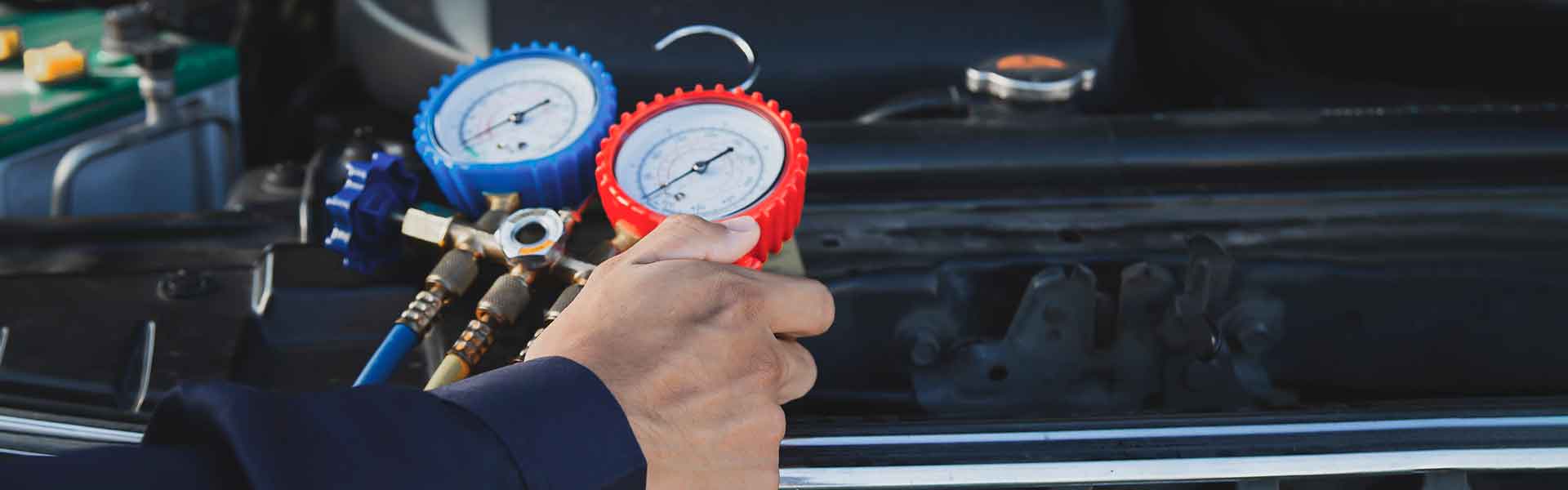
Honda Air Conditioning AC Repair at Elevation Auto Repair
A Denver summer afternoon, stop-and-go traffic on I-25, and vents blowing warm air – that's the moment most Honda owners realize their air conditioning has quit. Honda A/C systems are dependable when maintained, but they hide a few platform-specific quirks that a generic shop tends to miss.
Air conditioning repair covers the compressor, condenser, evaporator, expansion valve, receiver-drier, and the refrigerant charge that ties it all together. Doing it right on a Honda means more than a quick recharge. Many later-model Hondas run R-1234yf refrigerant rather than R-134a, which demands the correct recovery machine and identifier to avoid cross-contamination. Compressor clutch relays and pressure switch logic are read through Honda's system, so proper diagnosis often relies on scan data rather than guessing.
We also see failure patterns Honda drivers share – condensers that leak after road-debris strikes on low-slung front ends, and compressor clutches that stick or grind on higher-mileage units. Getting the charge weight and PAG oil spec exactly to Honda's requirement is what keeps a repair from failing twice.
- Accurate leak and pressure diagnosis using proper gauges and dye, not parts-swapping
- Correct refrigerant type and factory charge weight for your specific Honda
- Honest recommendations – we fix what's failing, not what isn't
- Clear explanation of findings before any work begins
Symptoms – How to Know You Need This Service
Honda A/C trouble usually announces itself gradually, then all at once. Watch for these signs:
- Warm or lukewarm air even with the system set to max cool – often low refrigerant from a slow leak
- Weak airflow from the vents – a failing blower motor or clogged cabin air filter
- A grinding, screeching, or clicking near the front of the engine when A/C engages – a sign of compressor clutch or bearing wear
- Musty or mildew odor when the system starts – bacteria buildup on the evaporator core
- Cooling that comes and goes – pressure switch faults or an intermittent compressor clutch
- Water pooling on the passenger floor – a blocked evaporator drain
- Visible oily residue near A/C fittings or the condenser – a refrigerant leak collecting PAG oil
You can keep driving with warm air or a mild odor, but schedule service soon before a small leak empties the system. Stop and shut the A/C off if you hear loud grinding or smell burning – a seized compressor can shed debris throughout the lines and turn a modest repair into a major one.
Common Air Conditioning AC Repair Issues on Honda Vehicles
Honda climate systems are generally reliable, but certain platforms have well-documented weak points that show up again and again in our bays.
- Compressor clutch and relay failure on 2008-2012 Accord and 2006-2011 Civic – the clutch air gap widens with age, the clutch stops engaging, and you get warm air with a compressor that never spins. Often paired with a failing A/C relay.
- Condenser leaks on 2013-2017 Accord and CR-V – the low-profile parallel-flow condenser sits low in the front and takes rock strikes on Colorado highways, causing slow refrigerant loss.
- Evaporator core leaks on early-2000s to mid-2000s Odyssey and Pilot – a common wear path where the core corrodes internally, showing up as gradual cooling loss and an oily residue at the drain.
- Blend door actuator failure across many Honda platforms – a clicking or knocking sound behind the dash, with temperature stuck on one side or one setting.
- Failing radiator/condenser fan assemblies on 2016+ Civic (10th gen) – weak fan operation means the A/C cools fine at highway speed but goes warm at idle in traffic.
- Cabin air filter neglect and blower motor wear – restricted airflow and a noisy blower are frequently mistaken for refrigerant problems.
Pinning down the real cause matters because "add refrigerant" rarely fixes a Honda A/C for long. We start with the pattern for your specific model and confirm it before touching parts.
Which Honda Models We See for Air Conditioning AC Repair
We service the full Honda lineup, and certain platforms roll through our bays more than others for A/C work.
- Honda Civic – 8th through 11th gen (FA/FG, FB, FC/FK, FE/FL); condenser leaks are common on the lower-mounted units, and later models use R-1234yf
- Honda Accord – 8th through 10th gen (CP/CS, CR, CV); compressor clutch and pressure switch issues show up with mileage
- Honda CR-V – RE, RM, and RW generations; evaporator drain clogs and blower motor complaints are frequent
- Honda Pilot & Odyssey – rear A/C circuits add expansion valves and long lines that leak at connections
- Honda Fit (GD/GE/GK) – compact condensers are vulnerable to stone strikes
- Honda HR-V, Ridgeline, and Passport – newer platforms running R-1234yf that need the correct recovery equipment
Hybrid Accord and CR-V models use an electric A/C compressor with high-voltage components – we handle those with the proper precautions rather than treating them like a belt-driven system. Older Hondas from the 1990s and early 2000s on R-134a are still welcome. If your Honda is a rare import variant we haven't worked on, we'll tell you honestly before booking so you get the right result the first time.
A Denver summer commute up I-25 with a warm cabin and vents blowing lukewarm air is how most Honda owners discover their A/C has quit. One week it's ice cold, the next it's fighting the sun through the windshield. The good news: most Honda climate faults trace back to a handful of predictable parts, and once we know the pattern, the fix is straightforward.
Causes & Risks – What Happens if Ignored
Colorado's altitude, dry heat, and gritty roads work against A/C hardware. Rock chips puncture condensers, UV cooks seals, and the constant thermal cycling of hot-to-cold cabin air fatigues components faster than in milder climates. Age is the other driver – rubber O-rings and hoses harden, and refrigerant seeps out slowly.
Waiting turns cheap repairs into expensive ones. A small refrigerant leak that could be sealed with an O-ring often becomes a compressor replacement once the system runs low on oil.
- Ignoring a slow leak lets the compressor run undercharged and oil-starved, leading to internal metal contamination.
- A failed compressor sheds debris through the entire loop, forcing condenser, orifice tube, and receiver-drier replacement.
- Metal contamination usually means a full system flush – a far larger job than the original leak repair.
- A clogged evaporator drain backs up and soaks carpet, promoting mold and electrical corrosion under the dash.
- A weak cooling fan that also serves the engine radiator can push toward overheating on hot idle days.
Catching a Honda A/C fault early keeps it in the "seal and recharge" category instead of the "replace the whole loop" category.
Safety Impact – Why Air Conditioning AC Repair Matters
A/C isn't only about comfort. The same system defrosts and defogs your windshield, and its fans share cooling duty with engine components on many Honda platforms.
- Defogging failure – a dead A/C compressor cripples defrost performance, leaving fogged glass and reduced visibility in Denver's cold, damp mornings.
- Engine cooling overlap – on Hondas where the condenser fan assists radiator cooling, a failed fan can nudge coolant temps up in stop-and-go traffic.
- Driver fatigue – an overheated cabin on long highway stretches dulls attention and reaction time.
- Electrical corrosion – a leaking evaporator that soaks under-dash wiring can affect body control modules tied to lighting and other systems.
Stop driving soon and schedule promptly if: your defroster can't clear the windshield, you smell mold or coolant in the cabin, or the temperature gauge climbs at idle. Schedule at your convenience if: cooling is simply weaker than it used to be or the air goes warm only after long drives. Our honest diagnostics tell you which category you're in before any parts get ordered.
How Honda Air Conditioning AC Repair Actually Works
Your Honda's A/C is a sealed loop that moves heat out of the cabin. The compressor pressurizes refrigerant, the condenser up front sheds that heat, an expansion valve or orifice tube drops the pressure, and the evaporator behind the dash absorbs cabin heat while a blower pushes cooled air through the vents.
Modern Hondas differ from generic systems in ways that change how the repair has to be done. Many use variable-displacement or electronically controlled compressors, and most current models have moved to R-1234yf refrigerant, which requires different equipment and handling than older R-134a systems.
- Refrigerant type – newer Hondas use R-1234yf, which needs dedicated recovery/recharge machines and identifier testing to avoid cross-contamination.
- Precise charge weight – Honda specs an exact refrigerant charge by weight; overfilling or eyeballing pressures degrades cooling and strains the compressor.
- Actuator calibration –
A Denver summer commute in a Honda Accord with lukewarm air blowing from the vents is a quick way to lose your patience on I-25. The owner often assumes a simple recharge will fix it, but weak cooling on a Honda usually points to something more specific – a compressor clutch that won't engage, a leaking condenser peppered by road debris, or a failed blend door actuator that clicks behind the dash. Getting it right starts with a real diagnosis, not a guess.
How We Diagnose Air Conditioning AC Repair Issues on Honda
Honda A/C faults rarely announce themselves clearly, so we work through a repeatable process that separates refrigerant issues from electrical and airflow problems.
- Scan first with a Honda-capable tool – the HDS (Honda Diagnostic System) or an equivalent bi-directional scanner reads climate control codes, commands the compressor clutch on and off, and pulls live data from the pressure sensor and evaporator temp sensor.
- Verify refrigerant charge by connecting manifold gauges and monitoring high/low side pressures against Honda's spec for the outside temperature.
- Inspect for leaks using UV dye and an electronic sniffer, focusing on the condenser face, compressor shaft seal, and O-rings at the line fittings – common weak points on 2008-2012 Accord and 2006-2011 Civic platforms.
- Test electrical actuation – confirming the compressor relay, clutch coil, and blend/mode door actuators respond correctly, a frequent complaint on CR-V and Odyssey models.
- Road test and vent temperature check to confirm cooling under real load, not just at idle.
Once we know whether it's a charge, leak, electrical, or airflow problem, we turn those findings into a clear written repair plan and quote before any work begins.
Air Conditioning AC Repair on Honda: Repair vs. Replacement
Not every Honda A/C issue calls for a big invoice. The right answer depends on where the failure lives and how much of the system is affected.
- Genuine repair – a single failed blend door actuator, a leaking O-ring, a stuck relay, or a low charge from a minor seep. These are targeted fixes that restore full cooling without touching the rest of the system.
- Partial replacement – a condenser punctured by gravel gets replaced while the compressor and evaporator stay, or a worn compressor clutch is addressed on an otherwise healthy unit. Common on higher-mileage Civics and Accords where one part wears ahead of the others.
- Full replacement – when a compressor fails internally and sheds debris through the system, the condenser, receiver/drier, and orifice components often need replacement too. Reusing contaminated parts risks a repeat failure, so the complete cleanup is the safer long-term call.
We lay out the options side by side – what each fixes, what it leaves alone, and the trade-offs – so you decide with full information instead of being pushed toward the priciest route.
How to Make Your Honda Air Conditioning AC Repair Last Longer
A little routine attention keeps a repaired Honda A/C system cooling strong through Denver's hot, dry summers.
- Run the A/C briefly year-round – even in winter, cycling the compressor keeps seals lubricated and prevents them from drying out and leaking.
- Ease the load by parking in shade and cracking windows before blasting cold air, reducing strain on the compressor.
- Watch and listen for early warning signs – weaker airflow, a musty smell pointing to a clogged evaporator, or a clicking noise from a failing actuator.
- Replace the cabin air filter on Honda's recommended interval to protect airflow and evaporator performance – an easy owner-friendly job on most Civic, Accord, and CR-V models.
Stick with OEM-spec refrigerant and PAG oil at recharge time, and keep up with Honda's service intervals so small issues get caught early. Cabin filter swaps and visual checks are safe to handle yourself. Leave refrigerant handling, compressor work, and any repair touching the sealed system to the shop – that side needs proper recovery equipment and trained hands.
A Denver summer commute turns miserable fast when your Honda's vents blow warm air on I-25. One driver came to us convinced the compressor was toast on a 2013 Accord – the real culprit was a failed condenser leaking at a stone-chip pinhole, a pattern we see often on the ninth-generation Accord and the CR-V after Colorado's gravel-heavy roads. Getting the diagnosis right is where cold air starts.
What to Expect When You Bring Your Honda In
We keep the process straightforward so you always know where your Honda stands and what the A/C system actually needs.
- Drop-off or appointment: Schedule ahead or use after-hours key drop. Grab personal items from the cabin, though a quick glovebox and console are fine left as-is.
- Initial inspection: We check system pressures, inspect the compressor clutch, condenser, and lines, and use UV dye and electronic leak detection to trace refrigerant loss – common at the condenser, the discharge hose O-rings, and the evaporator core.
- Written estimate: You get a clear breakdown of parts and labor before any work begins, with no add-ons you didn't approve.
- Communication during the work: We text or call with findings, especially if a leak-down test reveals a second failure like a weak compressor or clogged expansion valve.
- Pickup walkthrough: We show you what was replaced, verify vent temperatures, and explain any follow-up maintenance.
Shuttle service and loaner arrangements are available when your Honda needs to stay with us. Every repair finishes with a vacuum-and-recharge to spec, a road test to confirm consistent cabin cooling, and a scan-tool re-check of the HVAC and climate control modules. If anything feels off after pickup, bring it back and we'll re-verify at no runaround.
Why Choose Elevation Auto Repair for Honda Air Conditioning AC Repair
Honda A/C problems rarely announce themselves clearly, so we lean on brand-specific knowledge instead of guesswork.
- Platform familiarity: We know the condenser leak trends on 2013-2017 Accord and CR-V models, compressor clutch and relay quirks on older Civics, and blend-door actuator noise that mimics a refrigerant complaint on several Honda platforms.
- TSB and software awareness: Some Honda climate-control faults resolve with updated procedures or actuator recalibration rather than parts, and we check for applicable service bulletins before condemning components.
- Correct refrigerant handling: We charge to Honda's specified capacity by weight – overfilling is a frequent cause of weak cooling and high-side pressure faults.
We own the job from diagnosis through post-repair verification, so the same shop that finds the leak confirms the fix with pressure testing and a temperature-verified road test. That end-to-end accountability is how we keep your Honda cooling reliably through Denver's hottest months and beyond.
Our Honda Services
- Battery Repair Replacement
- Brake Repair & Brake Fluid Change
- Check Engine Light Diagnostics
- Clutch Repair & Replacement
- Coolant Leak Repair
- Cooling System Repair
- Drive Shaft Repair
- Engine Repair
- Exhaust & Catalytic Converter Repair
- Head Gasket Repair & Replacement
- Oil Change
- Oil Leak Repair
- Scheduled Service Maintenance
- Steering Repair
- Suspension Repair
- Cambelt Timing Belt Replacement
- Transmission Repair
- Tune Up
- Wheel Alignment