Ram Drive Shaft Repair at Elevation Auto Repair
A vibration that builds with speed or a clunk when you drop into gear usually traces back to the driveline, and on a Ram truck those parts take a beating. We diagnose and repair Ram drive shafts fast, then get you back to towing, hauling, and daily driving without the guesswork.
Drive shaft work on a Ram is not a one-size-fits-all job. Half-ton 1500s often run aluminum or two-piece shafts with a center support bearing, while heavy-duty 2500/3500 trucks carry stout steel shafts with staked or greaseable U-joints and, on 4x4s, a separate front shaft feeding the transfer case. Getting the phasing right and torquing the flange and pinion hardware to Ram spec matters – a rushed reassembly just recreates the vibration.
We use factory torque and driveline angle specs rather than eyeballing it, and we check pinion angle and transfer case output when a lift or worn suspension is part of the picture. Here is what you can expect from us:
- Straight answers on whether it is a U-joint, center bearing, slip yoke, or the shaft itself
- Balancing and phasing verified so the fix actually holds
- OEM-grade parts matched to your Ram's driveline configuration
- Quick turnaround so your truck is not sitting for days
Symptoms – How to Know You Need This Service
Driveline problems announce themselves early if you know what to listen and feel for. On a Ram, you may notice:
- A vibration that worsens as speed climbs, often felt in the floor or seat
- A distinct clunk when shifting from Park to Drive or letting off and back on the throttle
- Squeaking or chirping at low speed that speeds up with the truck – a classic dry U-joint sign
- A rhythmic knocking or rumble from under the cab, common when a center support bearing fails on two-piece 1500 shafts
- Shuddering during acceleration, especially under load or while towing
- Visible grease slung around the driveshaft tunnel or dark rust dust near a U-joint cap
- A grinding or binding feel in 4x4 mode on 2500/3500 trucks with a worn front shaft
Stop driving immediately if you hear loud metallic banging, feel severe vibration, or the driveshaft feels loose – a failed U-joint can drop the shaft and cause serious damage. Squeaks, mild vibration, and early clunks mean schedule soon before they turn into a roadside failure.
Common Drive Shaft Repair Issues on Ram Vehicles
A vibration through the floor at highway speed or a clunk when you shift into drive usually points straight at the driveline. On Ram trucks – especially the DS/DJ and DT platforms – the driveshaft and its joints take real punishment from towing, off-road use, and Colorado's temperature swings. Here's what we see roll through the bay most often.
- U-joint wear on 2009-2018 DS/DJ 1500-2500: The factory u-joints often lack grease fittings, so once the sealed caps dry out you get a shudder on acceleration and a rust-brown dust ring around the cross. Left alone, the caps seize and the joint fails.
- Center support (carrier) bearing failure on two-piece shafts: Common on Quad Cab and Crew Cab Rams with longer wheelbases. The rubber isolator cracks and the bearing whines or growls, worst around 40-50 mph.
- Slip yoke spline wear and clunk on 4x4 DT 1500 (2019+): A worn slip spline or dry output shaft seal produces a driveline "bang" when transitioning from throttle to coast.
- Rear driveshaft imbalance on lifted or big-tire builds: Aftermarket lifts change pinion angle, accelerating u-joint and CV-style joint wear on the rear shaft.
- Front CV-joint and boot failure on Power Wagon and Rebel packages: Torn boots let grit into the joint, causing a rhythmic click during low-speed turns under load.
- Companion flange and pinion seal seepage on Ram HD (2500/3500) AAM axles: Bolt loosening at the flange creates a repeating driveline vibration that mimics a bad joint.
Which Ram Models We See for Drive Shaft Repair
We service the full modern Ram lineup and the older Dodge Ram trucks that share the same driveline architecture. Find your truck below:
- Ram 1500 (DS/DJ, 2009-2018) and DT (2019-present) – often two-piece shafts with a center support bearing; the 5.7L HEMI and 3.6L Pentastar versions are the most common we see
- Ram 1500 Classic – continued DS platform, frequent center bearing and U-joint wear on higher-mileage trucks
- Ram 2500/3500 Heavy Duty (2010-2018 and 2019-present) – heavy steel shafts; 6.7L Cummins trucks put big torque through the driveline, so U-joints and pinion angle deserve close attention
- Dodge Ram 1500/2500/3500 (2002-2008, third gen) – older two-piece and single-piece shafts, slip yoke and U-joint service
- Ram ProMaster (front-wheel drive) – different driveline layout; we handle CV and half-shaft issues on these vans
The work shifts noticeably on 4x4 and Power Wagon variants, which add a front driveshaft and transfer case output to inspect, and on lifted trucks where pinion angle and slip yoke engagement need correcting. Rear-drive single-cab work-trucks are usually the simplest.
If you have a heavily modified truck with a custom driveshaft or an aftermarket lift kit, bring it in – we will confirm the setup and tell you honestly what fits before we order parts.
Causes & Risks – What Happens if Ignored
Most Ram driveline complaints trace back to a handful of causes: sealed u-joints running out of grease, road grit tearing CV boots, altered pinion angle from lifts, and simple high-mileage fatigue. Denver's grit, salt, and freeze-thaw cycles push all of those along faster.
A driveline problem rarely stays small. What starts as a light shudder becomes a safety issue once metal fatigue sets in.
- Ignoring a dry, chattering u-joint for a few thousand miles typically leads to a seized cross and a snapped joint – which can drop the shaft at speed.
- A whining center support bearing left unaddressed spreads vibration into the transmission tailshaft, damaging the output seal and bushing.
- A torn CV or slip-yoke boot lets grit in, wearing splines until the yoke has to be replaced instead of resealed.
- Chronic imbalance loosens companion flange bolts and can score the pinion seal, adding an axle leak to the repair.
- A dropped rear shaft can strike the fuel tank, brake lines, or fuel lines underneath – turning a joint job into major undercarriage repair.
Catching it early keeps the fix on the shaft itself. We prioritize fast diagnosis so a $200 joint never becomes a transmission or axle repair.
Safety Impact – Why Drive Shaft Repair Matters
The driveshaft sits directly in the path of everything that keeps a Ram controllable. When it fails, the consequences reach well past a rough ride.
- Sudden loss of power delivery: A failed u-joint or separated shaft leaves the truck coasting with no drive – dangerous in traffic or on a grade.
- ABS and stability control interference: Severe driveline vibration can confuse wheel-speed and yaw sensors, triggering false traction or stability events.
- Impact damage on failure: A dropped shaft can gouge brake lines or the fuel tank, creating fire and brake-loss risk.
- Parking-brake and driveline lock hazard: A shaft that binds under load can lock the driveline momentarily, upsetting the truck under braking.
Stop driving now if you notice: a loud metallic bang under acceleration, a shaking that worsens quickly, or a scraping noise from under the truck.
Schedule soon if you notice: a light highway-speed hum, a single clunk when shifting into gear, or a small grease ring near a u-joint. On a known driveline defect, addressing it promptly also protects you from liability if the truck fails and causes an incident.
How Ram Drive Shaft Repair Actually Works
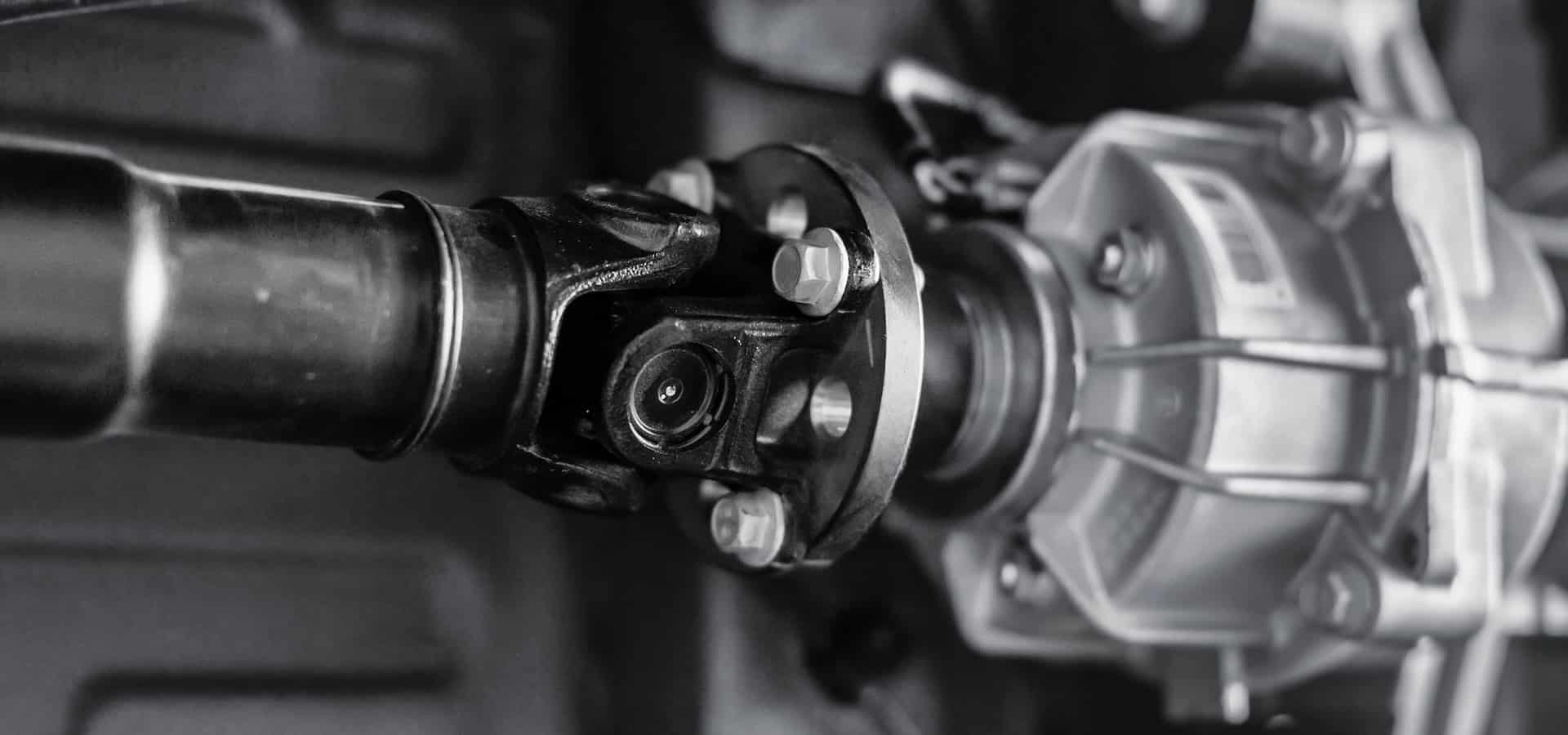
The driveshaft transfers engine torque from the transmission to the axle through joints that flex as the suspension moves. On most Rams that means u-joints on a one- or two-piece steel shaft, with a slip yoke that lets the shaft change length as the axle travels. Two-piece shafts add a center support bearing bolted to the crossmember.
Ram's implementation has details a generic joint swap misses. Getting it right protects the transmission, transfer case, and axle seals.
- Pinion and driveline angle: On lifted or HD trucks, we set working angles to spec so new joints don't wear prematurely.
- Center support and flange torque sequence: AAM axle companion flanges and carrier bearings use specific torque values and thread-locking – under-torqued bolts cause repeat vibration.
- Phasing on two-piece shafts: Front and rear yokes must be reassembled in phase, or the shaft vibrates no matter how good the joints are.
- Balance and runout check: We verify runout and re-index or balance the shaft rather than assuming a new joint fixes it.
How We Diagnose Drive Shaft Repair Issues on Ram
A vibration that builds with speed, a clunk on takeoff, or a droning noise from under the truck usually points at the driveline. On a Ram, we start with a structured process that separates a bad U-joint from a worn carrier bearing or an out-of-balance shaft before any parts come off.
- Interview and scan first – We connect a factory-level scan tool (wiTECH for modern Ram trucks) to pull chassis and drivetrain codes, check ABS/wheel-speed data, and rule out transfer case or transmission faults that mimic driveline noise on 1500/2500/3500 4x4s.
- Road test – We reproduce the symptom under acceleration, deceleration, and coasting to isolate whether it's speed-related (balance) or load-related (joint or slip yoke).
- Lift inspection – With the truck on the rack, we check U-joints for play, inspect the two-piece shaft center support bearing common on longer-wheelbase Rams, and look for a dry or notchy slip yoke spline.
- Measurement – We check driveline angles and runout, and verify pinion/output flange condition on Rear-Axle-heavy 2500/3500 applications.
Once we know exactly what's worn, we build a clear repair plan and quote so you understand the fix, the parts involved, and the turnaround before we start.
Drive Shaft Repair on Ram: Repair vs. Replacement
Not every driveline complaint means a new shaft. We match the fix to the actual wear so you're not paying for parts that still have life left.
- Genuine repair – A dry slip yoke that just needs cleaning and re-greasing, a loose flange bolt set re-torqued to Ram spec, or a shaft that only needs rebalancing after aftermarket work.
- Partial replacement – Replacing failed U-joints while keeping the tube, or swapping the center support (carrier) bearing on a two-piece Ram 1500 shaft when the tube and joints are still sound.
- Full replacement – Cascading wear where the tube is bent, the yokes are worn oval, or the shaft has multiple failed joints. On some late-model Rams the factory shaft uses non-serviceable sealed joints, which makes assembly replacement the sensible call.
Safety-critical wear on a heavy 2500/3500 always gets a straight recommendation. We walk you through each option – what it costs relative to the others and how long it should last – so the decision is yours, not the priciest line on the estimate.
How to Make Your Ram Drive Shaft Repair Last Longer
A driveline repair holds up when the truck is driven and maintained with the assembly in mind, especially on trucks that tow or run gravel and mountain roads around Denver.
Driving Habits That Help
- Ease off the line rather than dumping the clutch or stabbing the throttle, which shock-loads U-joints and the slip yoke.
- Let the drivetrain warm before hard pulls in cold weather so grease flows properly.
- Respect payload and tongue-weight ratings – overloading a 1500 accelerates joint and center-bearing wear.
Owner Maintenance
- Listen for new clunks or vibration changes and note the speed they appear.
- Glance under the truck for slung grease around the joints or a torn center-bearing rubber isolator.
- Keep transfer case and axle fluids fresh using Ram-spec lubricants, and keep wiTECH-based software updates current at service.
Leave This to the Shop
Greasing accessible zerk fittings is fine for the hands-on owner, but U-joint replacement, shaft balancing, and driveline angle correction involve torque specs and rotating safety components – bring those to us. Following Ram's service intervals with OEM parts keeps the repair reliable for the long haul.
What to Expect When You Bring Your Ram In
A vibration that builds with speed, a clunk from under the truck when you shift from park to drive, or a rhythmic droning at highway pace usually points to the driveline. We start by pinning down the source so you're not paying to guess.
- Drop-off or appointment – Tell us what you feel and where in the RPM or speed range it shows up. Grab personal items from the cab; leave the key fob and any wheel lock keys with us.
- Initial inspection – We put the Ram on the lift and check U-joints, the center support bearing on two-piece shafts, slip yoke play, and driveshaft runout. On 1500s with the aluminum shaft we look closely at the welded joints and balance weights.
- Written estimate – You get a clear breakdown of parts and labor before we touch anything. No surprise add-ons.
- Communication during the work – We call or text with findings and confirm before moving forward.
- Pickup walkthrough – We show you what was replaced and explain what caused it.
Loaner and shuttle options are available, and after-hours pickup can be arranged. Every job ends with a road test and a scan-tool re-check for driveline-related codes. If anything feels off afterward, bring it back and we'll make it right.
Why Choose Elevation Auto Repair for Ram Drive Shaft Repair
Ram drivelines have their own patterns, and we work on them often enough to know where to look first. Two-piece shafts on the DS/DJ 1500 and 2500 platforms lean hard on the center support bearing, and worn U-joints on 4x4 models show up as that classic launch clunk. We diagnose the actual failing component instead of throwing a full shaft at every vibration.
- Familiarity with Ram TSBs and driveline software updates, including transfer case and axle-related recalibrations that can mimic mechanical noise
- Proper U-joint and center bearing replacement with attention to phasing and factory torque specs so the fix doesn't come back as a new vibration
- Runout and balance verification – we don't reinstall a shaft that reads out of spec
- Slip yoke and spline inspection on 4x4 EcoDiesel and HEMI trucks that tow heavy
We own the job start to finish – diagnosis, repair, and the road test that confirms it's solved. That's the difference between a parts swap and a real repair, and it's why Denver Ram owners keep bringing their trucks here instead of the dealership.
Our Ram Services
- Air Conditioning AC Repair
- Battery Repair Replacement
- Brake Repair & Brake Fluid Change
- Check Engine Light Diagnostics
- Clutch Repair & Replacement
- Coolant Leak Repair
- Cooling System Repair
- Engine Repair
- Exhaust & Catalytic Converter Repair
- Head Gasket Repair & Replacement
- Oil Change
- Oil Leak Repair
- Scheduled Service Maintenance
- Steering Repair
- Suspension Repair
- Cambelt Timing Belt Replacement
- Transmission Repair
- Tune Up
- Wheel Alignment