
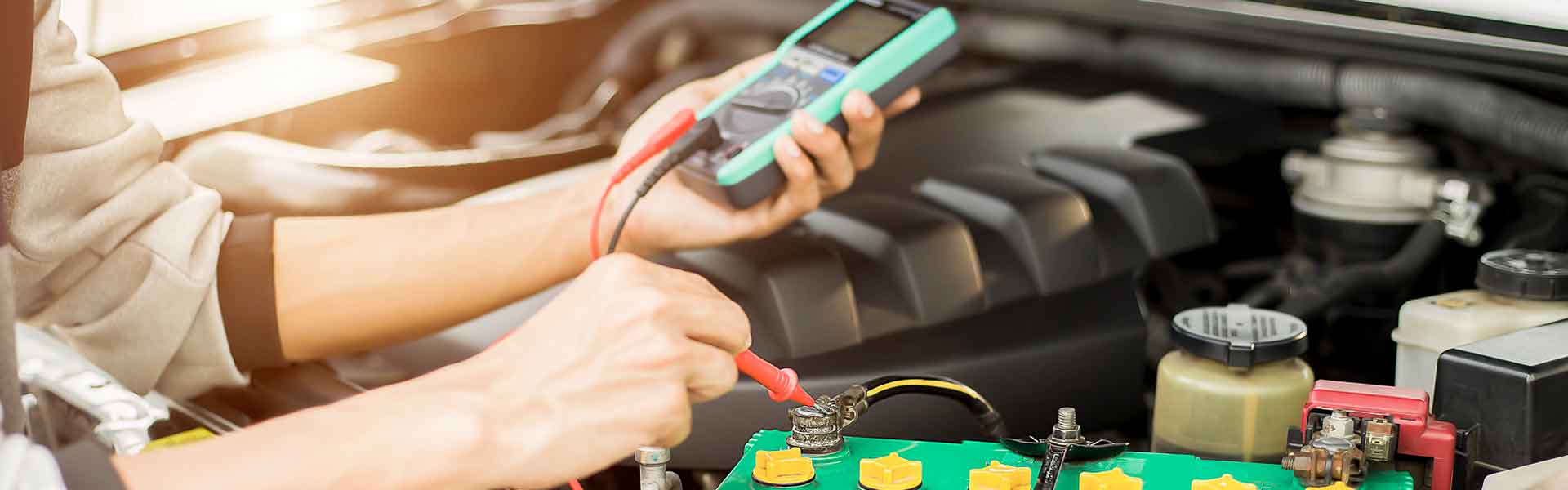
Ram Battery Repair Replacement at Elevation Auto Repair
Modern Ram trucks aren't the simple two-post-battery vehicles they used to be. Late-model 1500 DT and eTorque-equipped trucks run dual batteries, intelligent battery sensors (IBS), and stop/start systems that demand a specific replacement procedure – not just a swap.
A battery on a fourth-gen (DS) or fifth-gen (DT) Ram often needs to be registered to the body control module so the charging system knows the new battery's age and chemistry. Skip that step and the alternator may over- or undercharge, shortening the new battery's life. On eTorque 3.6L Pentastar and 5.7L HEMI trucks, there's also a 48-volt mild-hybrid component and an auxiliary battery to account for.
Colorado's altitude and temperature swings are hard on batteries, so getting the group size, cold-cranking amps, and AGM-versus-flooded spec right matters here more than most places. We use factory-level scan tools to handle registration and verify charging output before you leave.
- Correct OEM group size and CCA matched to your Ram's trim and options
- Battery registration and IBS reset where the platform requires it
- Charging system and parasitic-draw testing, not just a battery swap
- Transparent pricing and clear communication before any work begins
Symptoms – How to Know You Need This Service
Battery trouble on a Ram rarely shows up all at once. Here's what you may notice as things degrade.
- Slow or labored cranking – the starter drags before the engine catches, especially on cold Denver mornings.
- Stop/start disabled – an eTorque or auto-stop truck that stops pausing at lights is often flagging a weak battery.
- Warning messages – "Service Charging System," battery light, or random electronic gremlins on the dash.
- Flickering lights or dim interior displays when idling or with accessories running.
- Uconnect glitches – radio resetting, backup camera dropping out, or memory settings lost overnight.
- Corrosion buildup – white or greenish crust on terminals, sometimes with a faint sulfur smell.
- Clicking with no crank – rapid clicking when you turn the key points to insufficient cranking voltage.
Schedule soon if you see warning messages, disabled stop/start, or slow cranking. Stop driving and get help immediately if you smell rotten eggs, see swelling in the battery case, or notice smoke near the terminals – a leaking or overheating battery is a safety hazard and can damage nearby wiring.
Common Battery Repair Replacement Issues on Ram Vehicles
Ram's electrical architecture varies enough between gas and diesel trucks that the same "dead battery" symptom can point to very different problems. These are the patterns we see most often:
- Dual-battery imbalance on 2013-2023 Cummins 6.7L (2500/3500): The diesel trucks run two batteries in parallel. When one weakens, the healthy battery is overworked and both fail early – replacing only one accelerates the cycle.
- Parasitic drain on the 2019+ 1500 DT: The Uconnect head unit, telematics module, and body control modules can stay awake if a module fails to sleep, draining a healthy battery overnight.
- IBS (Intelligent Battery Sensor) faults: Late-model Rams monitor state-of-charge through a sensor on the negative terminal. A failed IBS or a battery installed without a reset causes erratic charging and false low-voltage warnings.
- Corrosion at the terminals and ground straps: Common on trucks that see Colorado road salt and heavy off-road use, leading to hard starts and voltage drop under load.
- Alternator overcharging on 3.6L Pentastar-equipped 1500s: A weak voltage regulator boils electrolyte and shortens battery life, so the battery keeps failing until the charging fault is found.
- Wrong group-size or non-AGM replacements: Many Rams call for a specific AGM battery. A flooded substitute won't handle the cycling demands and dies prematurely.
Which Ram Models We See for Battery Repair Replacement
We service the full modern Ram lineup, and the procedure changes noticeably by generation. Find your truck below.
- Ram 1500 (DS, 2009–2018) – fourth-gen "Classic" trucks with 3.6L Pentastar or 5.7L HEMI; single-battery layout, IBS on later builds.
- Ram 1500 (DT, 2019–present) – fifth-gen platform; eTorque variants add a 48V mild-hybrid system and require careful handling.
- Ram 1500 Classic (2019–2023) – the DS body sold alongside the DT; different battery spec than the newer truck.
- Ram 2500 / 3500 (2010–present) – Heavy Duty trucks, frequently dual-battery setups, especially 6.7L Cummins diesels needing high CCA.
- Ram ProMaster / ProMaster City – van platforms with their own battery locations and access quirks.
Diesel-equipped 2500/3500 trucks with dual batteries need both units tested together – replacing one and leaving a weak partner is a common cause of repeat failures. eTorque trucks require the most care because of the 48V components. If you're driving something older than the 2009 fourth-gen, we can still help, though we'll confirm parts and procedure up front. Not sure which platform you have? Tell us the year and trim and we'll sort it out.
Ram trucks put heavy demands on their electrical systems that few other vehicles match. Between the diesel-specific dual-battery setups on the Cummins 6.7L, the high-draw accessories on today's 1500 DT platform, and the sensitive body control modules that expect stable voltage, battery work on a Ram is rarely a simple swap. Elevation Auto Repair handles these platforms with the OEM procedures and clear pricing that dealership visits often lack.
Causes & Risks – What Happens if Ignored
Denver's temperature swings are hard on batteries – cold mornings raise cranking demand while summer heat cooks the plates. Add short trips that never fully recharge the battery, aging cells, and Ram's power-hungry electronics, and premature failure becomes common. A weak battery rarely stays a standalone problem.
On the Cummins trucks especially, a single failing battery drags its partner down and stresses the alternator and starter as they compensate. Waiting turns a routine replacement into a chain of failures.
- Ignoring a marginal battery through a cold snap often leaves you stranded with a no-start, usually at the worst moment.
- A failing battery forces the alternator to work harder, wearing out the diode pack and voltage regulator over a few months.
- Low or unstable voltage triggers false fault codes across ABS, Uconnect, and the transmission controller – chasing phantom problems gets expensive.
- On dual-battery diesels, replacing one battery late means the second soon follows, doubling the eventual cost.
- Corroded terminals left unaddressed spread to ground straps and cable ends, adding parts to what began as a simple swap.
Safety Impact – Why Battery Repair Replacement Matters
Modern Rams rely on stable voltage to keep safety systems online. When the battery can't hold charge or delivers erratic voltage, several critical systems can drop out at once.
- ABS and electronic stability control may disable themselves when voltage sags, reducing braking control on wet or icy roads.
- Electric power steering assist on newer 1500s can cut out, making the wheel suddenly heavy at low speed.
- Airbag and restraint modules can log faults and set warning lights when supply voltage is unstable.
- Trailer brake controller function – important for anyone towing – depends on healthy electrical supply.
Know which symptoms mean act now versus schedule soon:
- Stop driving now: multiple safety warning lights on together, steering assist loss, or repeated stalling.
- Schedule soon: slow cranking, dimming headlights at idle, or a battery/charging light that comes and goes.
A documented, known-weak battery left unaddressed before a towing or braking incident can also complicate liability questions – another reason to handle it early.
How Ram Battery Repair Replacement Actually Works
On older trucks, a battery swap was purely mechanical. On today's Rams, the charging system is managed by the body control module using the Intelligent Battery Sensor, so the truck needs to be told a new battery is installed.
After removing and installing the correct AGM or dual-battery configuration, we register the new battery and reset the charging strategy so the alternator charges at the right rate for a fresh cell. Skipping this step is why many self-installed batteries underperform.
- Correct group size and AGM specification matched to your engine and trim.
- Battery registration/reset through OEM-level software so the IBS and BCM recognize the new battery.
- Dual-battery balancing on Cummins trucks – replacing both together and verifying equal charge.
- Torque and terminal prep to spec, with corrosion cleaned from cables and ground straps.
- Charging system verification under load to confirm the alternator and regulator are healthy before you leave.
We walk you through what your Ram actually needs, quote it clearly up front
Ram trucks pull hard on their electrical systems in ways most vehicles never do – integrated trailer brake controllers, dual alternators on diesel HD models, upfitter power circuits, and the 8.4-inch Uconnect that never fully sleeps. The 6.7L Cummins in 2500/3500 trucks runs a dual-battery setup, and the 5th-gen DT platform (2019+) added intelligent battery sensors that change how charging faults show up. That parasitic-draw complexity is exactly why Ram battery work deserves a technician who knows the platform.
How We Diagnose Battery Repair Replacement Issues on Ram
A weak crank or a dash full of warnings doesn't automatically mean a dead battery. We isolate the real cause before quoting anything.
- Full electrical scan – We connect a factory-level scan tool (wiTECH-equivalent) to read the Intelligent Battery Sensor (IBS), body control module, and any stored charging or communication codes across the CAN network.
- Load and conductance testing – We measure cold-cranking capacity and internal resistance on each battery. On Cummins dual-battery trucks, weak cells often hide behind one good battery.
- Charging system check – Alternator output under load, ripple voltage, and ground integrity, since a failing diode or corroded ground mimics a bad battery.
- Parasitic draw test – We check current draw with modules asleep, a frequent culprit on Uconnect-equipped 1500 trucks.
- Visual and physical inspection – Terminal corrosion, swollen cases, loose hold-downs, chafed harnesses, and the negative-cable IBS connection.
- Road test – Verifying voltage stability under real load with lights, HVAC, and accessories running.
Once we know whether the fault is the battery, the charging path, or a draw, we turn the findings into a plain-language repair plan and an upfront quote – no guesswork billed to you.
Battery Repair Replacement on Ram: Repair vs. Replacement
Not every battery concern ends with a new battery. We match the fix to the actual condition.
- Genuine repair – A battery that tests healthy but shows corrosion, a loose hold-down, or a poor IBS ground connection. Cleaning terminals, re-torquing, and restoring the sensor contact often resolves the fault entirely.
- Partial replacement – On dual-battery Cummins trucks, one battery frequently fails before the other. When both test close, we replace the pair to keep them balanced; when one is clearly newer and strong, we replace only the failed unit and re-verify.
- Full replacement – Swollen cases, failed load tests, repeated no-starts, or a battery old enough that repair cost approaches the price of a new AGM. Many 5th-gen DT trucks call for AGM batteries, and substituting flooded units causes charging faults.
After a replacement, we register the new battery to the IBS so the charging strategy adapts correctly. We lay out each option side by side and let you decide – the most expensive path is never the default.
How to Make Your Ram Battery Repair Replacement Last Longer
Ram batteries live a hard life, but a few habits stretch their service life considerably.
- Drive long enough to recharge – Short trips in a diesel that draws heavy startup current never fully replenish the batteries. Longer runs let the alternator catch up.
- Manage cold and heat – Denver winters slow chemistry and thicken diesel oil, raising crank load; summer heat accelerates plate wear. Park inside when you can, and plug in the block heater on cold mornings to ease starting.
- Mind accessory loads – Running upfitter circuits, inverters, or Uconnect for long stretches with the engine off drains capacity fast.
Owner-friendly maintenance you can do safely:
- Check for terminal corrosion and confirm hold-downs are snug.
- Watch the voltage gauge and battery-warning light for early changes.
- Listen for slow cranking as an early warning.
Use OEM-spec AGM batteries on trucks that require them, keep Uconnect and BCM software current, and follow Ram's service intervals. Leave harness repairs, IBS registration, and dual-battery balancing to us – those affect charging safety and are easy to get wrong. Bring it in and we'll handle the rest.
What to Expect When You Bring Your Ram In
Late-model Rams put more electrical demand on the battery than most trucks – the auto start-stop system on 1500 DT trucks, the dual-battery diesel setup on 2500/3500 Cummins, and the sensitive body control modules that throw phantom faults when voltage sags. Here's how a visit works:
- Drop-off or appointment – Schedule ahead or drop in. Grab your personal items from the cab; we'll note anything left inside on the intake sheet.
- Initial inspection – We test the battery under load, check state of charge, and inspect terminals, the IBS (intelligent battery sensor) at the negative post, and grounds prone to corrosion.
- Written estimate – You get a clear breakdown before any work starts, including whether the fix is a battery, a sensor, or a parasitic draw.
- Communication during the work – We reach out with findings and photos, and nothing beyond the approved estimate happens without your okay.
- Pickup walkthrough – We show you what was replaced and explain any register or reset steps performed.
Ask about shuttle service or a loaner if you need to keep moving, and after-hours pickup can be arranged. Before you leave, we road test and run a scan-tool re-check to confirm charging output and clear stored codes. If something feels off afterward, bring it back and we'll re-verify – no runaround.
Why Choose Elevation Auto Repair for Ram Battery Repair Replacement
A battery swap on a modern Ram is more than loosening a clamp. On 1500 DT trucks with start-stop, the new AGM battery has to be registered so the charging strategy matches the correct chemistry – skip that step and you'll see premature failure and stored faults.
- Ram-specific know-how – We handle IBS relearns, dual-battery diesel configurations, and TSB-driven software updates that address voltage and start-stop complaints on EcoDiesel and Hemi platforms.
- Root-cause diagnosis – Parasitic draws from radios, aftermarket accessories, and sticky relays get chased down instead of masked with a fresh battery.
- End-to-end ownership – The same shop diagnoses, replaces, registers, and road-tests, so nothing falls through the cracks.
You get transparent pricing and plain-language explanations at every step. We're your Denver dealership alternative – dealer-level tooling and Ram familiarity, with the personal communication and honest recommendations that keep your truck reliable for the long haul.
Our Ram Services
- Air Conditioning AC Repair
- Brake Repair & Brake Fluid Change
- Check Engine Light Diagnostics
- Clutch Repair & Replacement
- Coolant Leak Repair
- Cooling System Repair
- Drive Shaft Repair
- Engine Repair
- Exhaust & Catalytic Converter Repair
- Head Gasket Repair & Replacement
- Oil Change
- Oil Leak Repair
- Scheduled Service Maintenance
- Steering Repair
- Suspension Repair
- Cambelt Timing Belt Replacement
- Transmission Repair
- Tune Up
- Wheel Alignment