Ford Air Conditioning AC Repair at Elevation Auto Repair
Get an AC repair wrong on a Ford and you pay twice – once for the guess, again for the actual fix. Denver summers punish a weak system, and Ford's electronically controlled climate setups don't respond well to the "just add refrigerant" approach many shops still use.
A proper Ford AC repair starts with reading the HVAC and body control modules, not just hooking up a gauge set. Many late-model Fords run dual-zone electronic actuators and variable-displacement compressors that report faults through the network. Blend door actuators are a known weak point across the platform, and the F-150, Explorer, and Escape lines each have their own quirks.
Ford also uses tight refrigerant charge specifications by system – overcharging a variable-displacement compressor by even a few ounces kills cooling performance. We recover, evacuate, and recharge by weight to Ford's spec, then verify with vent temperature and pressure readings.
Here's what you can expect when you bring your Ford in:
- Module scan for HVAC, blend door, and refrigerant pressure fault codes before any parts talk
- Charge by weight to your model's exact refrigerant spec, not by pressure guesswork
- Straight answers on what actually failed – no unnecessary component swaps
- Clear, upfront pricing before we start the work
Symptoms – How to Know You Need This Service
Ford AC trouble usually announces itself before the system quits entirely. Watch for these signs:
- Air blows warm on one side but cold on the other – classic sign of a failing blend door actuator, common on Escape, Explorer, and F-150
- You hear a clicking or knocking behind the dash when you change temperature settings
- The compressor clutch cycles on and off rapidly, hinting at low charge or a pressure sensor fault
- Weak airflow even at the highest fan setting, pointing to a blower motor or resistor issue
- A musty or sour smell when the AC first kicks on, suggesting evaporator contamination
- Water pooling on the passenger floor from a clogged evaporator drain
- Cooling fades in stop-and-go traffic but returns at highway speed
A grinding or seized compressor means stop driving and schedule immediately – a failed clutch bearing can throw the accessory belt and leave you stranded. Warm air or weak airflow can wait for a scheduled visit, but don't ignore it in Denver heat.
Common Air Conditioning AC Repair Issues on Ford Vehicles
Ford's climate systems have recognizable weak points that vary by platform. Here's what we see most on Denver-area Fords:
- Compressor clutch and coil failure on F-150 (2009-2014, P415 platform) – the clutch cycles hard under load and the coil windings burn open, leaving the compressor dead even though the refrigerant charge is fine.
- Evaporator core leaks on Explorer and Escape (U/CD platforms) – corrosion at the core lets refrigerant weep slowly, so cooling fades over a season rather than all at once. The evaporator lives deep in the dash, which is why diagnosis before teardown matters.
- Blend door actuator failure on F-Series and Explorer – the plastic gear teeth strip, giving you clicking behind the dash and one side blowing hot while the other blows cold.
- Condenser damage on Fusion and Focus – the front-mounted condenser takes rock and debris strikes, opening pinhole leaks along the tube-and-fin junctions.
- Line and O-ring seepage at the manifold on EcoBoost trucks – engine bay heat hardens the rubber seals, and the high-side line fittings begin to weep.
- Electronic HVAC and PATS-related quirks on newer Fords – dual-zone systems that lose calibration after a battery disconnect and need re-learn through Ford diagnostics.
Which Ford Models We See for Air Conditioning AC Repair
We handle AC work across the modern Ford lineup and most recent generations. If your Ford is on this list, we've likely already fixed one:
- F-150 (2009-present, P415/P552 platforms) – blend door actuators and rear-cab evaporator lines are frequent visitors
- Explorer (2011-present, U502 and CD6/U625) – dual-zone actuator faults and front/rear system charge issues
- Escape (2013-present, C520/CX482) – EcoBoost 1.5L and 2.0L variants with variable-displacement compressor concerns
- Focus and Fusion (2012-2018, C346/CD4) – compressor clutch and pressure sensor failures
- Edge (2007-present, CD3/CD4) – blower motor and evaporator drain problems
- Mustang (S197 and S550, 2005-present) – including GT and EcoBoost variants; charge specs differ by engine bay layout
- Super Duty F-250/F-350 (2011-present) – heavy-duty dual AC systems on crew-cab trucks
Diesel Super Duty trucks and Raptor variants share the base AC architecture but add routing and clearance differences we account for. We're less equipped for vintage Ford systems from the R-12 era, so if you own a classic, ask us first and we'll point you the right direction.
Get A/C work wrong on a Ford and the bill climbs fast – a mis-charged system can smoke a compressor, and a compressor failure that spreads debris through the loop turns a simple recharge into a full-loop flush. On Denver's high-altitude summers and dusty spring winds, that difference matters. We diagnose before we quote, so you know exactly what your Ford needs and what it will cost.
Causes & Risks – What Happens if Ignored
Most Ford A/C failures trace back to age, refrigerant loss, and Colorado's heat-plus-dust cycle. Slow leaks starve the system of oil that circulates with the refrigerant, and a system running low on charge overheats its own compressor.
Waiting rarely saves money. A single leaking O-ring is cheap to reseal, but once the compressor runs dry it fails and sends metal shavings through every line.
- Ignoring a slow evaporator leak for a season typically leads to a fully discharged system and a compressor running without lubrication.
- A failing compressor clutch left alone can seize and spread debris, forcing a full-loop flush plus condenser and drier replacement.
- A cracked condenser that keeps losing charge draws moisture in, and moisture in the loop corrodes internal components from the inside.
- Stripped blend door actuators left unaddressed can jam the door in one position, so defrost stops working when you need it most.
- Low refrigerant that keeps the compressor short-cycling wears the clutch bearing early.
The safety side shows up in winter too – a Ford A/C compressor also drives dehumidification for defrost, so a dead system means a fogged windshield you can't clear.
Safety Impact – Why Air Conditioning AC Repair Matters
A/C isn't only about comfort. On Fords, the system ties into defrost performance and driver alertness, both of which affect how safely you operate the vehicle.
- Stop driving soon: windshield won't clear or fogs over quickly – defrost relies on the A/C to pull humidity, and blocked visibility is an immediate hazard.
- Stop driving soon: loud grinding or squealing from the compressor – a seizing clutch can throw or snap the serpentine belt, taking out power steering and charging with it.
- Schedule soon: gradually weaker cooling or an intermittent smell – signals a leak or actuator issue that hasn't cascaded yet.
- Schedule soon: one vent blowing hot while another blows cold – a blend door problem, annoying but not urgent.
Cabin heat also fatigues drivers on long I-70 climbs, dulling reaction time. And if a compressor belt failure knocks out power steering assist at speed, handling changes without warning. Addressing A/C faults early keeps the belt-driven accessories and defrost working the way Ford designed them to.
How Ford Air Conditioning AC Repair Actually Works
Your Ford's A/C moves heat, not cold. The compressor pressurizes refrigerant, the condenser up front dumps that heat to outside air, and the evaporator inside the dash absorbs cabin heat while the blower pushes cooled air past it. An orifice tube or expansion valve controls flow, and a drier or accumulator pulls out moisture.
Ford's newer implementations add layers a generic recharge doesn't handle:
- Electronic dual-zone climate control – blend door actuators are motor-driven and often need a re-learn through Ford IDS/FDRS software after replacement or battery loss.
- System-specific refrigerant and oil charge – many later Fords use R-1234yf, which requires dedicated equipment and exact charge weights, not eyeballed pressures.
- PAG oil specification – the compressor calls for a precise oil type and volume; the wrong oil or amount shortens compressor life.
- Evacuation and vacuum-hold procedure – the loop must be pulled to deep vacuum and verified leak-free before recharge to keep moisture out.
That's why we use OEM-level diagnostics and metered charging equipment rather than a can and a gauge. It's how one honest shop handles everything from a
A misdiagnosed A/C system on a Ford can turn a simple fix into a chain of parts you never needed. Guess wrong on a leaking condenser versus a failing compressor clutch, and you burn money on the wrong repair while the cabin stays warm. Ford systems have their own quirks – and getting the diagnosis right the first time is where we start.
How We Diagnose Air Conditioning AC Repair Issues on Ford
Ford A/C faults rarely announce themselves clearly. A weak-cooling F-150 could be low on refrigerant, or it could be an electronically controlled variable-displacement compressor that stopped varying. Here's how we sort it out:
- Pull codes with Ford-capable tooling – We use FDRS/IDS-level scan capability to read HVAC and PCM data, checking blend door actuator faults, evaporator temperature sensor readings, and pressure switch status that generic readers miss.
- Verify commanded vs. actual operation – We watch the compressor clutch engagement command, cooling fan behavior, and A/C pressure transducer values live to confirm the system is doing what the module tells it.
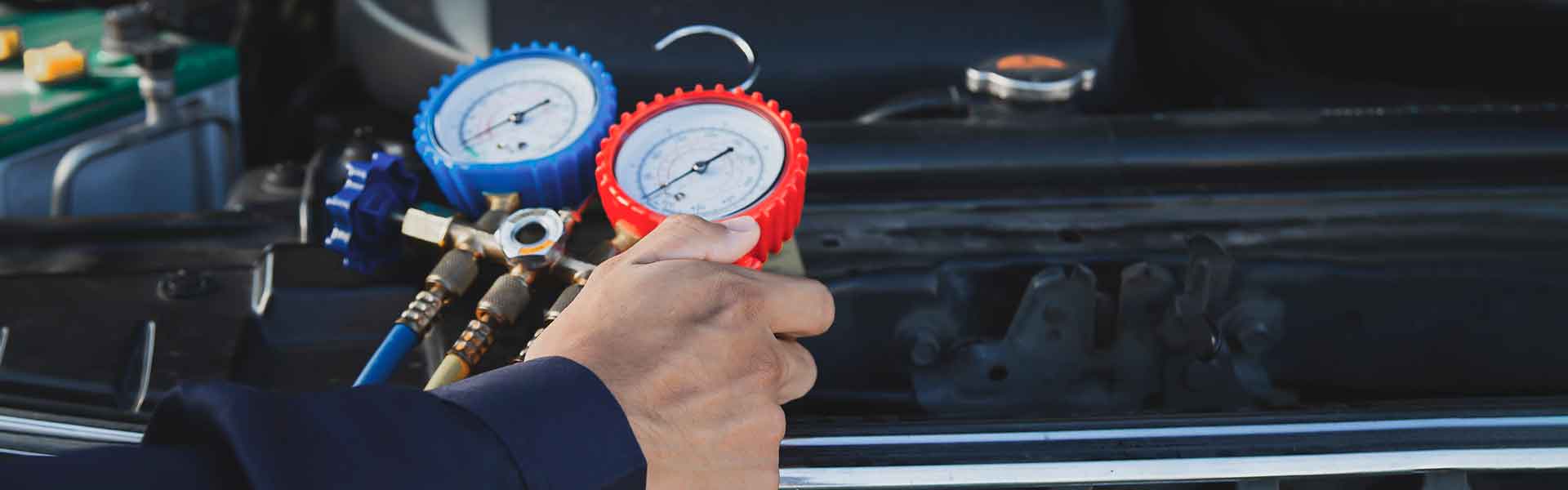
- Attach manifold gauges – High and low side pressures reveal overcharge, undercharge, restrictions, or a compressor not pumping.
- Visual and physical checks – We inspect the condenser for road debris damage (common on Escape and Explorer), look for oil residue at fittings, and check the accumulator/drier and lines.
- Leak detection – UV dye and an electronic sniffer pinpoint slow leaks at O-rings, the condenser, or the notorious evaporator core hidden in the dash.
- Vent temperature and road test – We measure center-vent output and confirm cooling holds under real driving load.
Every finding gets written into a plain-language repair plan with an upfront quote, so you know exactly what needs attention and what doesn't.
Air Conditioning AC Repair on Ford: Repair vs. Replacement
Not every A/C complaint needs a big-ticket compressor. The right call depends on what's actually worn.
- Genuine repair – A leaking O-ring, a stuck blend door actuator (a frequent clicking-dash issue on many Ford trucks and SUVs), a failed pressure switch, or a recharge after a minor leak repair. The core components stay in service.
- Partial replacement – Replacing just the condenser after rock damage, swapping a single failed line, or replacing the clutch and coil rather than the whole compressor when the pump itself is healthy.
- Full replacement – When a compressor grenades and sends metal debris through the system, the correct fix includes the compressor, condenser, accumulator/drier, orifice tube, and a full flush. Skipping the flush on a debris-contaminated Ford system almost guarantees a repeat failure. Evaporator core leaks also justify larger jobs since the part sits deep in the dash.
We lay out each option side by side – what it costs, how long it lasts, and the risk of doing less – then let you choose. No steering you toward the priciest path.
How to Make Your Ford Air Conditioning AC Repair Last Longer
A little attention keeps your Ford A/C cold for years after a repair.
- Run the A/C year-round – Using it briefly in winter keeps seals and the compressor lubricated, preventing the dry-out leaks common on systems that sit idle.
- Pre-cool wisely – Crack the windows for a moment before blasting cold air in Denver summer heat so the compressor isn't fighting a superheated cabin.
- Keep the condenser clear – Rinse road grime and cottonwood fluff off the front of the condenser, a real airflow killer on Explorers and Escapes.
- Replace the cabin air filter – A clogged filter chokes airflow and strains the blower.
- Listen and watch – Note new clicking, weaker cooling, or musty smells early and mention them before they grow.
Leave refrigerant handling, evaporator work, and electrical diagnosis to us – these involve pressurized systems and hidden components. Insisting on the correct refrigerant type and OEM-grade parts matters on Ford, and staying current with HVAC-related module software helps the system regulate properly. Bring it in for seasonal checks and we'll catch small issues before they become expensive ones.
A botched A/C job on a Ford gets expensive fast. Overcharge the system and you spike head pressure; miss a leaking evaporator on a Super Duty and you're back in the dash a second time. On models with the FS-10 or FX-15 compressors, a failed unit can send debris downstream and contaminate the condenser and orifice tube – skip the flush and the new compressor fails again. Getting it right the first time is the whole point.
What to Expect When You Bring Your Ford In
Here's how a typical A/C visit moves from drop-off to pickup:
- Drop-off or appointment – Tell us the symptoms: warm air, weak fan output, cabin odor, or a clutch that won't engage. Leave personal items in the trunk; we'll note anything left in the cabin.
- Initial inspection – We check static and operating pressures, inspect the compressor clutch and cycling, dye-test for leaks, and scan for HVAC and blend-door codes with Ford-capable equipment.
- Written estimate – You get a clear breakdown of parts and labor before any work starts. No surprise add-ons.
- Communication during the work – We call or text before touching anything beyond the approved scope. If a leaking evaporator or blend-door actuator turns up, you decide.
- Pickup walkthrough – We show you what was replaced, vent temps achieved, and any items to watch.
Shuttle and loaner options are available, and after-hours pickup can be arranged. Every job ends with a road test and a scan-tool re-check to confirm proper cycling and vent temperature. If anything feels off after you leave, bring it back and we'll re-verify our work.
Why Choose Elevation Auto Repair for Ford Air Conditioning AC Repair
Ford A/C problems are rarely just "low on refrigerant." We chase the actual cause – blend-door actuators that click or stick on many F-150 and Explorer platforms, evaporator leaks common on Super Duty trucks, and compressor clutch failures that demand a full system flush before the replacement goes in.
What sets our work apart:
- Ford-specific knowledge – We check for relevant TSBs and HVAC software updates that affect climate control operation and dual-zone calibration.
- Correct procedures – Proper vacuum, evacuation, and PAG oil specs for your exact compressor, plus condenser and orifice inspection so a new part isn't installed into a contaminated system.
- End-to-end ownership – The same shop diagnoses, repairs, and verifies the fix, so nothing falls through the cracks.
As your Denver dealership alternative, we handle everything from the A/C to the drivetrain under one roof – with transparent pricing and straight answers at every step.
Our Ford Services
- Battery Repair Replacement
- Brake Repair & Brake Fluid Change
- Check Engine Light Diagnostics
- Clutch Repair & Replacement
- Coolant Leak Repair
- Cooling System Repair
- Drive Shaft Repair
- Engine Repair
- Exhaust & Catalytic Converter Repair
- Head Gasket Repair & Replacement
- Oil Change
- Oil Leak Repair
- Scheduled Service Maintenance
- Steering Repair
- Suspension Repair
- Cambelt Timing Belt Replacement
- Transmission Repair
- Tune Up
- Wheel Alignment