Ford Drive Shaft Repair at Elevation Auto Repair
Ford drive shafts carry a lot of abuse in Colorado – towing at altitude, snow-belt corrosion, and the constant torque swings of turbocharged EcoBoost engines all wear driveline components in ways a generic shop tends to miss. The give-away most quick-lube places overlook is a slip-yoke or center support bearing that's worn just enough to throw a vibration only under load, not at idle.
Getting this right on a Ford is different because these platforms are unforgiving about balance and phasing. A two-piece shaft on a Super Duty or a Transit has to be reinstalled with the U-joints correctly indexed, and the center bearing bracket torqued to spec – guess at that and you'll chase a driveline shudder forever. On IRS Mustangs and AWD Explorers, we watch the half-shaft CV boots and the aluminum shaft balance weights that Ford factory-installs.
We use OEM torque values on flange bolts and pinion nuts, and we check driveline angles rather than eyeballing them. Here's what you can expect:
- An honest inspection of U-joints, center bearings, CV joints, and slip yokes before any parts are quoted
- Proper phasing and balancing so the fix holds up under load and at highway speed
- OEM-spec torque on flange, pinion, and bracket fasteners
- Clear communication on what needs replacing now versus what can wait
Symptoms – How to Know You Need This Service
Driveline problems usually announce themselves before they strand you. On a Ford, you may notice:
- A rhythmic clunk when shifting from Park to Drive or when getting on and off the throttle – often a worn U-joint or slip yoke
- A vibration that builds with speed, typically felt in the floor around 45–65 mph – a sign of an out-of-balance or worn shaft
- A squeak or chirp at low speed that speeds up as you accelerate – a dry U-joint or center support bearing
- A shudder under acceleration, especially while towing or climbing grades
- Grease slung around the underside near the CV boots on AWD Explorers or IRS Mustangs
- A knocking or grinding on tight turns – a failing front half-shaft CV joint
- Metallic rattling that gets louder over rough roads
Schedule soon if you feel a mild vibration or hear an early squeak – those give you time. Stop driving and have it towed if you get a loud metallic banging, a sudden severe vibration, or any grinding that worsens – a U-joint that lets go can drop the shaft and damage the fuel and brake lines underneath.
Common Drive Shaft Repair Issues on Ford Vehicles
Most generic shops hear a driveline vibration and immediately blame tires or balance weights. On a Ford, the driveshaft carrier bearings and center support bushings tell a different story, and knowing the platform saves you from chasing the wrong repair.
- F-150 two-piece driveshaft center support bearing (2004-2014, 11th/12th gen) – The rubber isolator around the center support bearing dries and cracks with age and Colorado heat cycling, producing a clunk on takeoff and a droning vibration between 45-65 mph.
- Super Duty (F-250/F-350) U-joint wear – Non-greaseable factory U-joints on 6.7L Power Stroke trucks fail early under towing loads, showing up as a ratcheting sound during turns and rust-colored dust around the caps.
- Mustang (S197/S550) aluminum driveshaft balance loss – The one-piece aluminum shaft is sensitive to bent flanges after hard launches; owners feel a high-rpm buzz that worsens above 70 mph.
- Explorer/Edge AWD (D4 platform) rear halfshaft and CV joint failure – Torn boots let grease escape and grit in, wearing the outer CV joint and creating clicking under load in turns.
- Ranger (2019+ T6) rear slip-yoke bind – A dry slip yoke on the driveshaft causes a shudder from a stop, often mistaken for transmission issues.
- Transit AWD driveshaft flex disc (guibo) cracking – The rubber coupling splits with age, giving a shudder on acceleration.
Which Ford Models We See for Drive Shaft Repair
We service driveline work across most of the Ford lineup. The models we see most for drive shaft and half-shaft repair include:
- F-150 (P415/P552, 2009–present) – two-piece shafts with center support bearings; EcoBoost trucks stress the driveline harder under boost
- Super Duty F-250/F-350 (2011–present, 6.7L Power Stroke) – heavy two-piece and single-piece shafts, U-joint wear common with towing
- Mustang (S197 2005–2014, S550 2015–2023) – IRS half-shafts on S550 GT and independent rear on later cars; aluminum one-piece shaft balance matters
- Explorer (U502 2011–2019, U625 2020–present) – AWD front and rear half-shafts, CV boot and PTU output issues
- Ranger (2019–present) – center bearing and U-joint wear on 4x4 models
- Transit (2015–present) – two-piece shafts on long-wheelbase and dually vans, center support bearing a common wear point
- Edge, Escape, and Bronco Sport AWD variants – rear half-shaft and driveline coupling service
AWD and 4x4 variants take more time than 2WD models because of the added half-shafts and transfer components, and we'll flag that up front. We're happy to look at older Ford trucks and classic driveline setups too – just note that we focus on Ford drive shaft and half-shaft repair rather than full custom driveline fabrication. If your Ford isn't listed, reach out and we'll tell you honestly whether it's work we handle.
Causes & Risks – What Happens if Ignored
Denver's mix of highway commuting, mountain grades, and wide temperature swings accelerates driveline wear. Heat cycling hardens rubber isolators and boots, road salt from I-70 corrodes U-joint caps, and towing loads on Super Duty and F-150 trucks fatigue the joints faster than flatland driving.
A worn part rarely stays isolated. Ignoring a chirping U-joint for a few months usually lets the caps seize, which then chews the yoke and can drop the shaft entirely.
- A cracked center support bearing left alone lets the front shaft section wobble, damaging the transmission output seal and slip yoke.
- Torn CV boots on an Explorer or Edge dump grease within weeks, and grit destroys the joint – turning a boot replacement into a full halfshaft.
- Seized U-joints on a Super Duty can shear under towing load, letting the driveshaft flail and puncture the fuel or brake lines.
- An out-of-balance Mustang shaft transmits vibration into the transmission tailshaft bushing and rear pinion bearing.
- A failing Transit flex disc eventually separates, stranding an AWD van without power delivery.
What starts as an inexpensive joint or bearing turns into transmission, differential, or fuel-line repair once you wait too long. We'll pin down the actual worn component so you fix the cause, not the symptom.
Safety Impact – Why Drive Shaft Repair Matters
A driveshaft that fails at speed doesn't just leave you stranded – it can disable systems that keep the vehicle controllable.
- Stability and traction control rely on consistent wheel-speed and driveline behavior; a vibrating or binding shaft can trigger false ABS and traction faults.
- A dropped driveshaft on rear-drive Fords can strike the ground, act like a pole vault, and lift the vehicle or lock the rear axle.
- Failed CV joints on AWD Explorers cause sudden power loss to a wheel, unsettling the vehicle mid-corner.
- Debris from a shattered U-joint can sever brake or fuel lines running along the frame.
Stop driving now if you notice:
- A loud metallic clunk when shifting into drive or reverse.
- Severe vibration that intensifies with speed.
- A scraping or banging from under the floor.
Schedule soon if you notice: a light chirp at low speed, a slight shudder from a stop, or grease slung around a boot. Addressing a known driveline fault before an incident also protects you from liability questions if a failure contributes to a collision.
How Ford Drive Shaft Repair Actually Works
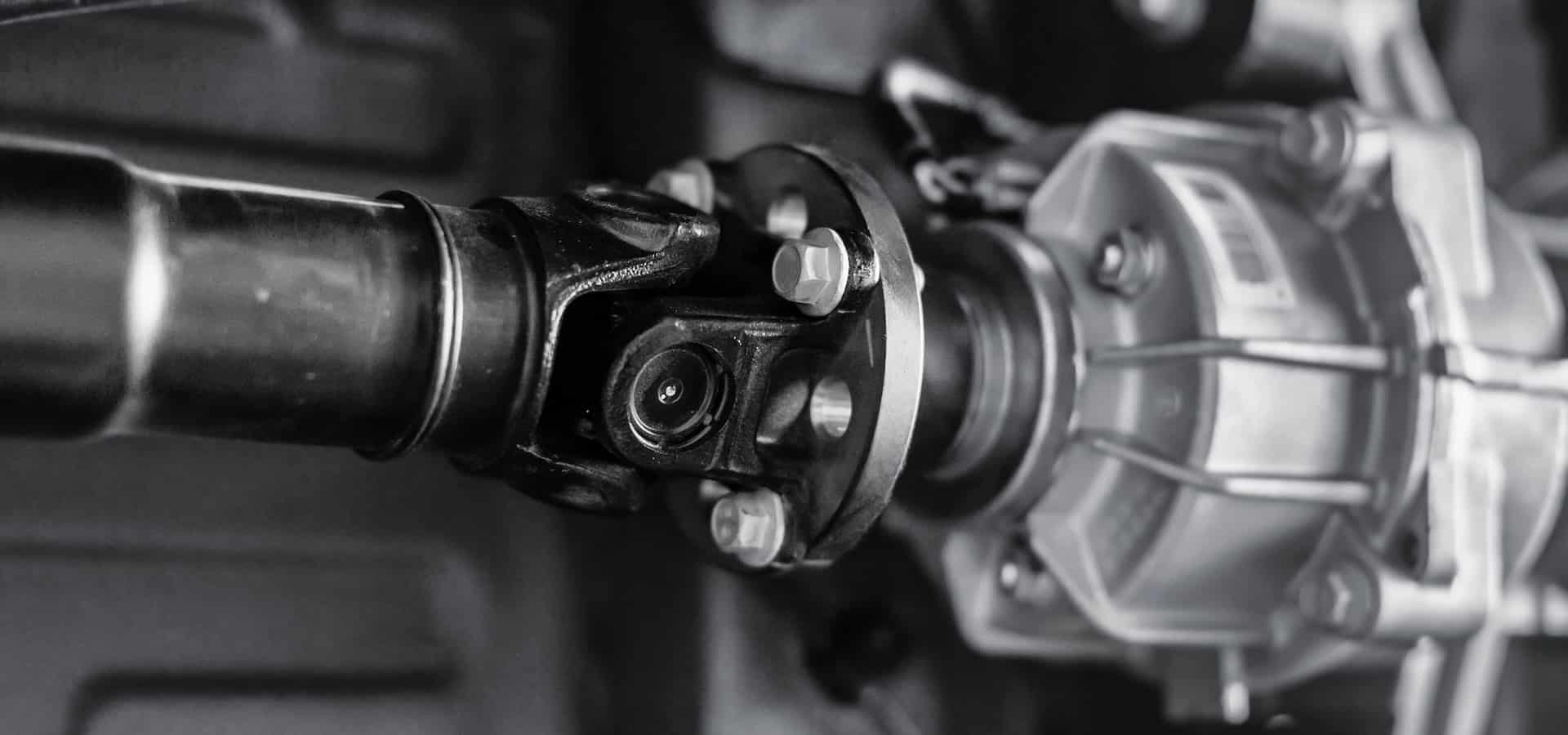
The driveshaft carries torque from the transmission or transfer case to the axle through U-joints or CV joints, with slip yokes allowing length changes as the suspension moves. On Ford trucks and rear-drive cars, the shaft has to be balanced and phased correctly, or you'll feel it in the seat.
Ford's implementation adds steps a generic shop often skips:
- Two-piece shafts on F-150s must have the center support bearing aligned and the U-joints phased identically, or vibration returns immediately.
- Aluminum one-piece shafts (Mustang S550) require balancing after any flange work and correct yoke indexing.
- AWD halfshafts on Explorer/Edge need proper axle nut torque and often a new hub seal to keep the joint clean.
- Newer Fords with electronic parking brakes and 10R80 transmissions may need the EPB retracted and system re-initialized with Ford IDS/FDRS software before rear driveline work.
- Factory torque and phasing specs on flange bolts and pinion nuts matter – over- or under
How We Diagnose Drive Shaft Repair Issues on Ford
A shuddering F-150 SuperCrew under acceleration or a rhythmic clunk from a Mustang's one-piece aluminum shaft usually points to worn U-joints, a failing center support bearing, or a slip-yoke problem – not a mysterious transmission fault. Ford's driveline layouts vary widely between the 4WD Super Duty two-piece shafts and the AWD Explorer and Edge units, so the diagnosis has to match the platform.
- Pull the customer's history and any stored codes with Ford's FDRS/IDS scan platform, watching for PTU and driveline-related PIDs on AWD Explorers and Edges.
- Road test to reproduce the symptom – vibration frequency that rises with vehicle speed points to shaft balance or U-joints; vibration tied to engine RPM points elsewhere.
- Lift the vehicle and check runout on the shaft, along with U-joint play, center bearing rubber condition, and CV boot integrity on independent-suspension Fords.
- Inspect the slip yoke and pinion flange for wear, rust jacking, and missing balance weights.
- Measure driveline angles on two-piece Super Duty shafts, since incorrect pinion angle drives premature U-joint failure.
Those findings – scan data plus hands-on measurement – become a written repair plan and quote before any work starts, so you see exactly what's worn and what isn't.
Drive Shaft Repair on Ford: Repair vs. Replacement
Not every driveline complaint needs a new shaft. We match the fix to the actual wear.
- Genuine repair: Re-greasing a serviceable U-joint, tightening a loose pinion flange, or rebalancing a shaft with a lost weight. Older F-250 and F-350 shafts with replaceable U-joints often just need fresh cross-and-bearing kits.
- Partial replacement: Swapping a single failed U-joint or center support bearing on a two-piece Super Duty shaft while keeping the tubes and yokes. On many trucks this restores the shaft fully without buying the whole assembly.
- Full replacement: Required when the aluminum one-piece shafts on Mustangs and half-ton F-150s have staked, non-serviceable U-joints, or when tube damage, cascading bearing wear, or a bent shaft makes piecemeal repair unsafe or uneconomical.
We lay out both paths – cost, longevity, and safety – and let you choose. When a partial repair genuinely lasts, that's what we recommend, not the priciest option on the shelf.
How to Make Your Ford Drive Shaft Repair Last Longer
A driveline repair holds up far longer when driving and maintenance habits back it up.
- Ease into acceleration under heavy load or when towing with an F-250 or F-350 – shock loading is what tears up U-joints and center bearings first.
- Avoid dropping into 4WD on dry pavement, which stresses the front driveshaft and CV joints on 4WD trucks and AWD crossovers.
- In Denver's road-salt and freeze-thaw winters, rinse undercarriage grime off to slow rust jacking on slip yokes and flanges.
Owner-friendly checks you can safely do:
- Listen for new clunks on shifting between drive and reverse, and vibrations that build with speed.
- Peek underneath for torn CV boots, weeping grease, or missing balance weights.
- Keep the PTU and transfer case fluids on Ford's service intervals, using OEM-spec fluid – the wrong viscosity accelerates AWD driveline wear.
- Stay current on Ford software updates that affect AWD torque management.
Leave U-joint pressing, driveline-angle setting, and shaft balancing to the shop – these are safety-critical and need proper tooling. Bring it in at the first hint of a change, and we'll catch it before it becomes a bigger repair.
What to Expect When You Bring Your Ford In
A driveline vibration on an F-150 or a clunk from an Explorer's rear axle rarely has one cause. On Ford trucks and SUVs, a worn center support bearing, a collapsed slip yoke, or a failed U-joint can each mimic the others, so the first thing we do is separate real symptoms from parts-cannon guesses.
- Drop-off or appointment – Schedule ahead or leave the vehicle. Clear personal items from the cabin and cargo area, though we handle everything left inside with care.
- Initial inspection – We put the Ford on the lift, check runout on the two-piece shaft found on Super Duty and Expedition models, and inspect U-joints, the center bearing, and the flange bolts for the telltale fretting seen on higher-mileage units.
- Written estimate – You get a clear breakdown of what's worn versus what's fine. No padded line items for parts that still measure in spec.
- Communication during the work – We reach out before any additional repair, so nothing happens without your say-so. Loaner and shuttle options are available to keep you moving.
- Pickup walkthrough – We show you the replaced components and explain what we found. After-hours pickup can be arranged when your schedule is tight.
Every drive shaft repair ends with a road test to confirm the vibration is gone across the speed range, plus a scan-tool re-check where AdvanceTrac or driveline sensors are involved. If anything feels off afterward, bring it back and we'll make it right.
Why Choose Elevation Auto Repair for Ford Drive Shaft Repair
Drive shaft work on Ford platforms rewards experience. A two-piece shaft on a Super Duty needs the center bearing preload and flange phasing set correctly, or the fix lasts weeks instead of years. We index and balance driveshafts the way the factory procedure calls for, not by eyeballing it.
- Ford-specific knowledge – We track Ford TSBs and software updates that address driveline shudder, including the well-documented vibration complaints on transverse-mounted and 4WD applications.
- Correct diagnosis first – We confirm whether the source is the shaft, the U-joints, worn transfer case output, or a mount before replacing anything.
- Proper torque and phasing – Flange bolts, center support bearing, and slip yoke assembled to Ford specs to keep the driveline balanced.
We own the job start to finish – diagnosis, repair, and post-repair verification under one roof. That means no handoffs, no finger-pointing, and a Ford that leaves smooth and stays that way.
Our Ford Services
- Air Conditioning AC Repair
- Battery Repair Replacement
- Brake Repair & Brake Fluid Change
- Check Engine Light Diagnostics
- Clutch Repair & Replacement
- Coolant Leak Repair
- Cooling System Repair
- Engine Repair
- Exhaust & Catalytic Converter Repair
- Head Gasket Repair & Replacement
- Oil Change
- Oil Leak Repair
- Scheduled Service Maintenance
- Steering Repair
- Suspension Repair
- Cambelt Timing Belt Replacement
- Transmission Repair
- Tune Up
- Wheel Alignment