Ford Wheel Alignment at Elevation Auto Repair
Ford builds everything from compact front-drive hatchbacks to body-on-frame trucks and independent-rear-suspension performance cars, and each platform demands a different alignment approach. A generic four-wheel print-and-park won't cut it when your F-150 rides on an aluminum body over a fully-boxed frame, or when your Mustang runs Ford's integral-link independent rear suspension.
Getting a Ford alignment right means understanding where the adjustments actually live. Many Fords need cam bolts, aftermarket eccentric kits, or specific torque sequences to correct camber and caster that aren't adjustable from the factory. On trucks like the Super Duty, ride height and worn radius arm bushings skew your numbers before the heads ever touch the wheels. We set toe, camber, and caster to Ford's published specs on Hunter equipment, then road-test to confirm the steering wheel sits centered.
Elevation Auto Repair keeps Denver drivers out of the dealership line without giving up factory-level precision. Here's what you can expect:
- Alignment measured and corrected to Ford OEM specifications for your exact trim
- A pre-alignment suspension and steering inspection so we don't align worn parts
- Fast diagnosis and turnaround that gets you back on the road same day when possible
- Clear before-and-after readouts with no upselling on repairs you don't need
Symptoms – How to Know You Need This Service
Ford alignment issues usually announce themselves through the steering wheel and your tires. You may notice:
- Pulling to one side on a straight, level road even with light hands on the wheel
- An off-center steering wheel that sits crooked when driving straight ahead
- Uneven tire wear – inner-edge feathering on Fusions and Escapes, or outer-shoulder wear on lifted trucks
- A steering wheel vibration that grows with speed, often paired with a wandering feel
- Squealing or scrubbing tires during normal cornering
- A loose, darty feel where the truck or car follows road grooves and ruts
- A lit steering or stability warning after a curb strike or pothole hit
Schedule soon if you feel a mild pull or spot early edge wear – catching it protects your tires. Stop driving and call us right away if the steering feels suddenly loose, you hear clunking over bumps, or the wheel shakes violently, since those point to worn tie rods, ball joints, or control arm bushings that make alignment unsafe until repaired.
Common Wheel Alignment Issues on Ford Vehicles
Certain Ford platforms show alignment-related wear in predictable places. Here are the patterns we see most often across the Denver fleet:
- F-150 (2015-2020, P552) inner tire wear – Aggressive factory toe and camber settings combined with heavy tow loads chew through inner edges on the front tires long before the tread wears evenly.
- Super Duty (F-250/F-350) death wobble and toe drift – The solid front axle with radius-arm design is sensitive to worn track bar bushings and ball joints, which pull toe out of spec and trigger the harsh steering shimmy owners call "death wobble."
- Explorer (2011-2019, U502) rear camber wear – Independent rear suspension on these unibody SUVs develops negative camber wear as rear control-arm bushings age, showing as feathered inside-rear tread.
- Focus and Fiesta (2012-2018) uneven front wear – Struts and lower control-arm bushings soften with Colorado's freeze-thaw cycles, letting camber and toe drift and scrubbing the front tires.
- Edge and Fusion pull after pothole strikes – Denver's rough winter roads bend lower control arms and knock caster out, producing a steady pull and an off-center wheel.
- Ranger (2019+) post-lift geometry – Leveling kits and aftermarket tires on the current Ranger throw factory caster and camber off, accelerating wear if not corrected.
Which Ford Models We See for Wheel Alignment
We align the full Ford lineup, from daily commuters to work trucks and performance cars. The platforms we see most often:
- F-150 (P415 / P552, 2009–present) – aluminum-body trucks where caster and camber shift with lift kits and leveling spacers
- Super Duty F-250/F-350 (2011–present) – solid front axle trucks needing caster shims and radius-arm bushing checks
- Mustang (S197 2005–2014, S550 2015–2023) – IRS on S550 GT and GT350/GT500 variants call for careful rear toe and camber setup
- Focus & Fiesta (2012–2018, including ST and RS) – performance variants benefit from aggressive-but-legal camber tuning
- Fusion (2013–2020) – prone to inner-edge tire wear when rear camber drifts
- Escape (2013–present) and Explorer (U502/U625, 2011–present) – unibody crossovers with adjustable rear settings
- Ranger (2019–present) and Bronco (2021–present) – off-road setups where oversized tires and lifts change the geometry
Performance models like the ST, RS, GT350, and GT500 often run staggered wheels and tighter spec windows, so we treat those with extra care. We're glad to look at classic and pre-2000 Fords, though parts availability for adjustment hardware can vary – give us a call and we'll tell you honestly what we can do before you bring it in.
Ford builds across a huge spread of platforms – unibody sedans, body-on-frame trucks, and independent rear suspension setups that all behave differently on an alignment rack. A precise wheel alignment on a Super Duty with a solid front axle demands a different approach than a Fusion or an Explorer with fully independent suspension. Getting it right the first time is what keeps your tires wearing evenly and your steering wheel centered, and that's exactly where a specialist beats a quick-lube guess.
Causes & Risks – What Happens if Ignored
Most Ford alignment problems trace back to a mix of road conditions and worn suspension components. Denver's potholes, curb strikes, and constant temperature swings harden bushings and stress ball joints, while towing and hauling on trucks amplifies every small deviation. Age does the rest – tie-rod ends and control-arm bushings simply wear.
Waiting turns a quick correction into a parts-and-labor problem. A little toe error becomes ruined tires, then a bent component, then a safety concern.
- Ignoring inner-edge wear on an F-150 for a few thousand miles usually means replacing tires that still look fine on the outside.
- Delaying track bar and ball joint service on a Super Duty lets minor toe drift progress into full death wobble at highway speed.
- Driving on a worn Explorer rear bushing allows camber to keep sliding, ruining rear tires and eventually loading the wheel bearing.
- Leaving a pull uncorrected after a pothole hides a bent control arm that grows into steering-knuckle or strut damage.
- Skipping alignment after a lift on a Ranger scrubs new tires quickly and stresses CV joints.
A simple alignment protects tires and suspension parts. Put it off and you're paying for both plus the alignment anyway.
Safety Impact – Why Wheel Alignment Matters
Alignment isn't only about tire life – it feeds directly into the systems that keep a Ford controllable. Bad geometry undermines braking balance, steering response, and the sensors that stability and traction control rely on.
- Stop driving now – violent steering shimmy at speed (Super Duty death wobble), a sudden strong pull, or a steering wheel that fights back all point to failing components that can lose control.
- Schedule soon – a mild drift, slightly off-center wheel, or uneven tire wear you can feel with your hand.
When toe and camber are off, AdvanceTrac stability control and ABS work harder to keep the vehicle straight, and worn tires reduce grip in exactly the wet and icy conditions Denver drivers face. Uneven braking from mismatched tire wear extends stopping distances. There's also a liability angle: if a known worn ball joint or tie-rod contributes to a crash, that neglected repair can complicate an insurance claim. Correct alignment keeps every one of those systems reading true.
How Ford Wheel Alignment Actually Works
A wheel alignment sets three angles – camber, caster, and toe – so the tires meet the road the way Ford engineered them to. On our alignment rack we measure all four wheels, then adjust to the exact factory spec for your platform, because a Super Duty solid axle, an Explorer IRS, and an F-150 all use different targets and different adjustment points.
Modern Fords add steps a generic shop often skips:
- Steering angle sensor calibration – Many 2015-and-newer Fords require resetting the steering angle sensor after alignment so AdvanceTrac and lane-keeping read center correctly, done with Ford-capable software.
- Platform-specific adjustment methods – Trucks use cam bolts and eccentrics, while some unibody models need control-arm or rear-shim adjustments to bring camber into range.
- Torque and sequence specs – Tie-rod jam nuts and cam bolts must be torqued to Ford values in the correct order to hold the setting.
- Post-lift geometry targets – Lifted or leveled Rangers and
Ford's alignment behavior varies wildly across its lineup, and that's exactly why a one-size-fits-all rack setting misses the mark. A body-on-frame F-150 with twin I-beam heritage tracks differently than a strut-based Focus or Escape, and Super Duty trucks running heavy front axles chew through toe settings under load. Getting a Ford aligned right means knowing where each platform likes to sit – and catching the worn parts that pull it out of spec before they cost you a set of tires.
How We Diagnose Wheel Alignment Issues on Ford
We move fast because we start with the right sequence, not guesswork. Here's how a Ford alignment diagnosis runs on our rack:
- Road test first – we drive it to feel pull, wander, and steering-wheel offset, noting whether a 2015-2020 F-150 drifts under braking or an Escape darts over expansion joints.
- Scan the modules – with Ford-capable diagnostics we check for steering angle sensor faults, EPAS (electric power steering) codes, and any DTCs that would throw off centering on models with lane-keeping and pre-collision assist.
- Visual and hands-on inspection – we check tie rod ends, ball joints, control arm bushings, wheel bearings, and radius arm bushings common on Super Duty front ends for play and cracking.
- Tire wear reading – feathering points to toe, inner/outer shoulder wear points to camber, and cupping flags worn dampers.
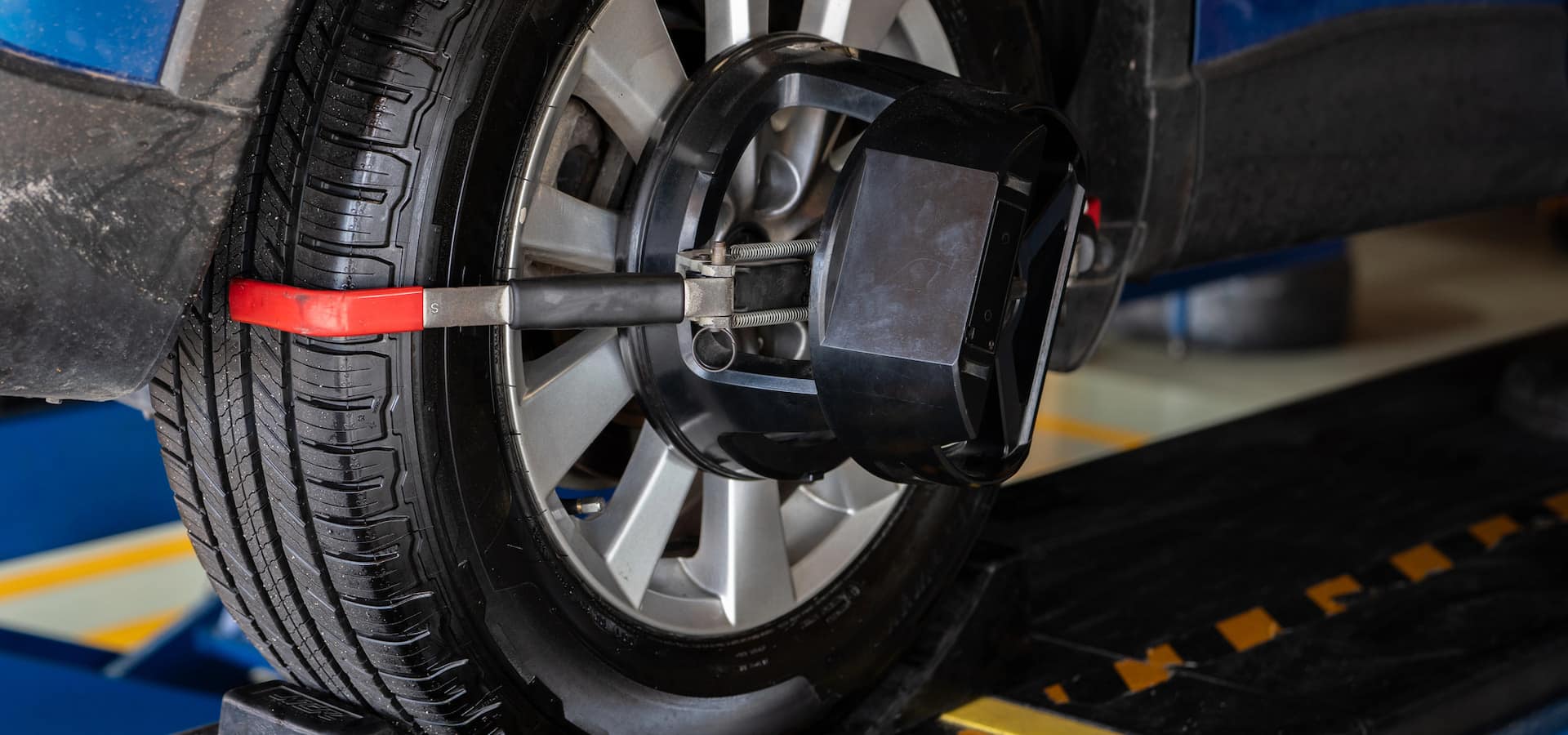
- Mount and measure – laser/imaging heads capture live camber, caster, toe, and thrust angle against Ford's factory spec for that VIN.
Once we have real numbers next to worn parts, we build a clear plan – what needs adjusting, what needs replacing, and a straight quote before any work starts. After alignment on models with driver-assist systems, we recalibrate the steering angle sensor so the safety features read center correctly.
Wheel Alignment on Ford: Repair vs. Replacement
Not every out-of-spec Ford needs new parts. We sort it into three honest buckets.
- Adjustment only (true repair) – suspension components are tight and serviceable, so we simply reset toe, camber, and caster. Common on Fusions and Focus models that drifted out of spec after curb contact or a tire rotation.
- Partial replacement – one worn piece is the culprit while the rest of the assembly is fine. Outer tie rod ends on high-mileage F-150s, sagging radius arm bushings on Super Duty, or a single worn control arm bushing on an Escape – replace that part, then align.
- Full replacement – cascading wear or a safety-critical failure. A collapsed ball joint, multiple worn joints across a front end, or bent steering knuckles from impact make piecemeal repair pointless when the labor stacks up near replacing the assembly.
We lay out each option with the numbers behind it and let you decide. Our job is to show you what's actually worn and what it costs – not to steer you toward the biggest invoice.
How to Make Your Ford Wheel Alignment Last Longer
A good alignment holds up when the parts and habits behind it cooperate. A few things go a long way on any Ford.
- Ease off curbs and potholes – hard impacts knock toe and camber out fast, especially on strut-based Focus, Fusion, and Escape platforms.
- Watch your load – overloading a Super Duty or F-150 bed constantly stresses front geometry and bushings.
- Rotate tires on Ford's schedule and keep pressures at the door-jamb spec to spread wear evenly.
- Listen for changes – new clunks over bumps or a steering wheel that no longer sits straight are early flags worth a look.
DIY-safe habits: check tire tread and pressure, glance at tire shoulders for uneven wear, and note any warning lights. Use OEM-grade or Ford-spec parts when suspension work is done, and keep steering and driver-assist software current so calibrations stay accurate.
Leave the hands-on work – ball joints, tie rods, bushings, and the alignment itself – to the shop. These are safety-critical systems that need proper torque specs and post-repair sensor recalibration. Bring it in early and we'll catch small issues before they eat your tires.
What to Expect When You Bring Your Ford In
Ford steering and suspension setups vary widely – from the electric power steering on an Escape or Focus to the twin I-beam and solid rear axle geometry on F-150 and Super Duty trucks. Each demands its own alignment approach, and here's how a visit flows:
- Drop-off or appointment – Schedule ahead or drop the vehicle when it works for you. Leave the key and let us know how you use the truck or car (towing, off-road, daily commuting), since that shapes the alignment spec we target.
- Initial inspection – We check tire wear patterns, ball joints, tie rod ends, control arm bushings, and wheel bearings before touching the rack. On F-Series and Explorer platforms, worn radius arm bushings and sagging leaf packs often masquerade as alignment problems.
- Written estimate – You get a clear breakdown of any worn parts found and what the alignment itself requires. No surprise add-ons.
- Communication during the work – We call or text before doing anything beyond the agreed scope. Personal items can stay in the vehicle; just remove valuables.
- Pickup walkthrough – We show you the before-and-after alignment readout and explain what changed.
Shuttle and loaner options are available, and after-hours pickup can be arranged when your schedule is tight. Every alignment ends with a road test and a scan-tool re-check on models with steering angle sensor calibration. If anything feels off – a pull, an off-center wheel, a returning wear pattern – bring it back and we'll recheck it.
Why Choose Elevation Auto Repair for Ford Wheel Alignment
Ford alignments go sideways when a shop ignores the platform. We calibrate to Ford's published specs and account for the quirks that generic shops miss.
- Steering angle sensor and ADAS awareness – Many 2015-and-newer Ford models require a steering angle sensor reset or lane-keeping camera check after alignment. We handle that recalibration rather than sending you elsewhere.
- Platform-specific setup – Twin I-beam caster/camber shims on older F-Series, cam-bolt adjustment on independent front suspension Explorers and Edges, and rear toe correction on car platforms like Focus and Fusion.
- TSB and software familiarity – We cross-reference Ford technical service bulletins for known pull complaints and drive-mode-related steering behavior before assuming the geometry is at fault.
We own the job end to end – diagnosis, any needed suspension repair, the alignment itself, and post-repair verification on the road and with the scan tool. That means one shop finds the worn tie rod, replaces it, corrects the toe, and confirms the fix, so tire life and handling actually improve. It's honest work with no unnecessary repairs, backed by clear communication at every step.
Our Ford Services
- Air Conditioning AC Repair
- Battery Repair Replacement
- Brake Repair & Brake Fluid Change
- Check Engine Light Diagnostics
- Clutch Repair & Replacement
- Coolant Leak Repair
- Cooling System Repair
- Drive Shaft Repair
- Engine Repair
- Exhaust & Catalytic Converter Repair
- Head Gasket Repair & Replacement
- Oil Change
- Oil Leak Repair
- Scheduled Service Maintenance
- Steering Repair
- Suspension Repair
- Cambelt Timing Belt Replacement
- Transmission Repair
- Tune Up