Toyota Wheel Alignment at Elevation Auto Repair
Get an alignment wrong on a Toyota and you pay for it twice – once in feathered tire edges that scrub out thousands of miles early, and again in a steering wheel that never quite sits straight. Denver drivers put serious miles on their Camrys, Tacomas, and RAV4s, and pothole season on I-25 knocks toe and camber out of spec fast.
A proper alignment sets toe, camber, and caster back to Toyota's factory values, then verifies the steering angle sensor reads center. That last step matters more than most shops admit. Newer Toyotas with Toyota Safety Sense route lane-keep and pre-collision data through that sensor, so a mechanical alignment without a steering angle reset can leave lane-centering pulling to one side. We calibrate to OEM specs using precision alignment equipment, not eyeballed guesses.
Truck and SUV platforms bring their own quirks. Tacoma and 4Runner front ends adjust through cam bolts at the lower control arm, and rear-wheel-drive setups need the thrust angle checked so the rear axle tracks true behind the front.
- Full four-wheel alignment measured against Toyota factory specifications
- Steering angle sensor verification and reset where the platform requires it
- Suspension and tire inspection to catch worn parts before we align
- Clear before-and-after readouts so you see exactly what changed
Symptoms – How to Know You Need This Service
Your Toyota usually tells you when the alignment has drifted. Here's what you may notice from the driver's seat:
- Steering pull – the car drifts left or right on a flat, straight road even when you let off the wheel
- Off-center steering wheel – you're holding the wheel slightly turned to drive straight
- Uneven tire wear – inner or outer edges wearing faster, or a scalloped, feathered pattern you can feel by hand
- Vibration through the wheel – often shows up alongside a pull after hitting a curb or deep pothole
- Squealing tires on turns – a sign toe is fighting the road surface
- Lane-keep warnings or false corrections – Toyota Safety Sense nudging when you're centered in your lane
- Loose or wandering feel – the truck follows road grooves or feels twitchy at highway speed
Most of these mean schedule soon – you'll save your tires the longer you don't wait. But a sudden hard pull, clunking, or wandering after an impact can point to a bent component or damaged tie rod. If steering feels unstable or you hear knocking over bumps, stop driving and have it inspected right away.
Common Wheel Alignment Issues on Toyota Vehicles
Toyota's lineup spans body-on-frame trucks, unibody crossovers, and low-slung sedans, and each platform drifts out of alignment in its own way. Here's what we see roll through the bay most often:
- Rear camber and inner-edge tire wear on Corolla and Camry (2012-present): The independent rear suspension on these unibody sedans holds a slight negative camber that scrubs the inside tire edges as bushings age – easy to miss until the cords show.
- Tacoma (2005-2015 and 2016+) front toe drift: Frequent off-road use and loaded beds shift front toe quickly. These trucks are also sensitive to lift kits that need caster correction to keep the steering returning to center.
- 4Runner and GX470/460 caster loss with age: Sagging front coils and worn upper control arm bushings pull caster out, producing wandering at highway speed and uneven front-tire feathering.
- Prius (Gen 3/Gen 4) inner-edge wear: Low-rolling-resistance tires and the rear beam geometry make these hypersensitive to toe – small misalignment shows up fast in fuel economy and tread.
- Highlander and Sienna clock-spring and steering-angle sensor faults: After suspension work, an uncalibrated steering angle sensor throws the wheel off-center and can trip stability control lights.
- Pothole-induced thrust angle problems: Denver's freeze-thaw roads knock rear alignment out on any Toyota, causing the vehicle to "dog-track" and pull under braking.
Which Toyota Models We See for Wheel Alignment
We align nearly the full Toyota lineup, from daily commuters to lifted trucks. Find your platform below:
- Camry (XV50 2012-2017, XV70 2018+) – common toe drift on high-mileage front struts; TNGA-K cars need steering angle attention
- Corolla (E170 2014-2019, E210 2020+) – frequent inner tire wear when toe goes out
- RAV4 (XA40 2013-2018, XA50 2019+) – AWD models benefit from a true four-wheel alignment and thrust-angle check
- Tacoma (2nd gen 2005-2015, 3rd gen 2016-2023) – lower control arm cam bolt adjustment; lifted trucks need caster and camber reset after suspension work
- 4Runner (N280 2010+) – body-on-frame front end that drifts after off-road use or larger tires
- Tundra (2007-2021, 2022+) – heavy front ends that pull camber out over time and with load
- Highlander, Sienna, Prius, and Avalon – routine four-wheel alignments and post-repair corrections
Lifted or leveled Tacomas and 4Runners need extra attention – aftermarket kits change caster and often require adjustable UCAs to bring specs back into range, and we'll tell you honestly if your setup needs those parts. We handle classic and older RWD Toyotas too, though very early models may need a straightforward toe-and-caster setting rather than a full four-wheel readout.
A botched alignment on a Toyota costs more than a set of tires. Get the caster, camber, and thrust angle wrong on a Tacoma or 4Runner and you'll chew through pricey all-terrains in a few thousand miles, pull the steering off-center, and mask a worn suspension component that keeps eating your money. Toyota's precise factory geometry rewards a shop that follows OEM specs and dials the numbers in correctly the first time.
Causes & Risks – What Happens if Ignored
Most Toyota alignment problems start with Colorado's rough winter roads, curb strikes, and the slow wear of control-arm and sway-bar bushings. Add a lift kit, heavier tires, or a sagging spring, and factory geometry walks out of spec without a single warning light.
Waiting rarely saves money. A cheap toe adjustment ignored for a few thousand miles turns into a new set of tires, and the underlying loose tie-rod end or worn ball joint keeps stressing steering components until something bigger fails.
- Ignoring inner-edge wear on a Camry or Corolla for a season typically means replacing tires that still had half their life.
- A Tacoma driven with excessive toe wears the outer edges and hides a failing tie-rod end that then loads the steering rack.
- Unaddressed caster loss on a 4Runner leads to constant steering correction, fatiguing the driver and accelerating rack and pump wear.
- Rear thrust-angle problems left alone cause pull under braking and premature wear on wheel bearings and rear bushings.
- Alignment issues masking a bad ball joint can escalate to a sudden loss of steering control – the point where a minor repair becomes a major, expensive one.
Once handling feels unpredictable under braking or over bumps, the safe move is to stop and have it inspected rather than push the miles.
Safety Impact – Why Wheel Alignment Matters
Alignment isn't just tire economy – it feeds the sensors and systems that keep a Toyota planted. When geometry drifts, the steering angle sensor, Vehicle Stability Control (VSC), traction control, and ABS all work with bad reference data, and on newer models with Toyota Safety Sense, lane-keep and pre-collision braking can misjudge your path.
Worn alignment-related parts also mean longer stopping distances, uneven brake loading, and unpredictable behavior in an emergency swerve.
- Stop driving now: steering that suddenly pulls hard, a wheel that shimmies violently, clunking over bumps, or a loose/vague steering feel – these can signal a failing ball joint or tie-rod.
- Schedule soon: gradual off-center steering wheel, mild pull, uneven tire wear, or a slight wander at highway speed.
If a Toyota Safety Sense warning appears after curb or pothole damage, the camera and radar calibration may be affected too. From a liability standpoint, driving on known steering or suspension faults after they've been flagged can complicate an insurance claim if a collision follows – another reason to address alignment promptly.
How Toyota Wheel Alignment Actually Works
A proper Toyota alignment sets three angles – camber, caster, and toe – on each wheel, plus the rear thrust angle, so all four tires track straight and the steering returns to center. On modern Toyotas it's not just turning tie-rods; the steering angle sensor and driver-assist systems have to agree with the mechanical numbers.
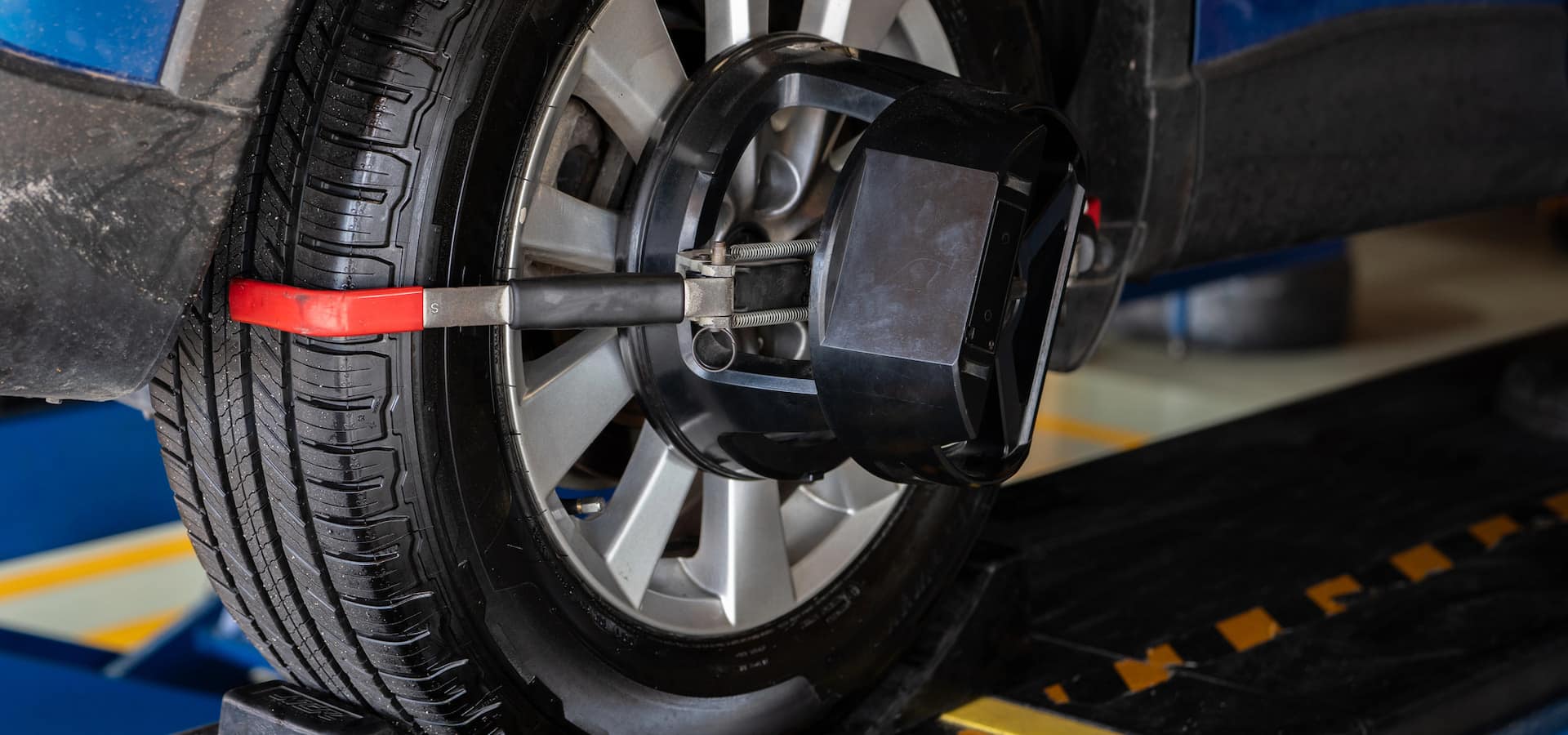
We put the vehicle on a precision alignment rack, measure against Toyota's factory specs for that exact platform and trim, adjust to target, then handle the electronic side.
- Steering angle sensor reset: After adjustment or suspension work, Toyota requires a zero-point calibration so VSC and power steering read a true center.
- Toyota Safety Sense calibration: Models with the forward camera and radar may need OEM-level calibration when ride height or geometry changes.
- Platform-specific targets: A lifted Tacoma or 4Runner need
A sloppy alignment on a Toyota costs more than uneven tire wear – it undermines the predictable handling these vehicles are built around, and on models with electric power steering and Toyota Safety Sense, it can throw off lane-keep and pre-collision calibration. Getting the geometry right the first time protects your tires, your steering feel, and the driver-assist systems that depend on a centered wheel.
How We Diagnose Wheel Alignment Issues on Toyota
An accurate alignment starts long before the car goes on the rack. Here is how we work through a Toyota:
- Scan first: We pull codes with a Toyota-capable scan tool and check the steering angle sensor, zero-point calibration, and any Toyota Safety Sense faults – a common trigger for pull complaints on Corolla, Camry, and RAV4 after curb strikes.
- Road test: We drive the vehicle to feel pull direction, wander, and off-center steering wheel behavior at highway speed.
- Visual inspection: We check tie rod ends, lower ball joints, control arm bushings, and strut mounts – rear lower control arm bushing wear is a known cause of shifting toe on older Camry and Avalon platforms.
- Tire read: Feathering, inner-edge wear, and camber wear each point to a different geometry problem.
- Rack measurement: We put the Toyota on the alignment rack and compare caster, camber, and toe against factory specs for that chassis and year.
Those readings show whether you need a straightforward adjustment or a worn part addressed first. We turn the numbers into a clear repair plan and quote before any work begins, so nothing is a surprise.
Wheel Alignment on Toyota: Repair vs. Replacement
Many Toyota alignments are genuinely just an adjustment – but not all. Here is how we sort it out:
- Adjustment only: If tie rods, ball joints, and bushings are tight, we set toe (and camber where the platform allows) back to spec. Front toe is adjustable on nearly every Toyota; rear toe is adjustable on many independent-rear models like RAV4 and Highlander.
- Partial replacement: A single worn outer tie rod end or a torn control arm bushing gets replaced, then aligned. This restores geometry without touching the rest of a healthy assembly – often the case on higher-mileage Corolla and Prius suspensions.
- Full replacement: When wear cascades – loose ball joint, collapsed bushing, and a bent lower arm from a pothole – replacing the complete control arm assembly is safer and more durable than piecing it together.
We walk you through what the rack numbers and inspection actually show, explain which parts are safety-critical, and let you decide with full information. We do not default to the biggest invoice.
How to Make Your Toyota Wheel Alignment Last Longer
A good alignment holds up when the suspension underneath it stays healthy. A few habits go a long way on any Toyota.
- Drive gently over hazards: Slow for potholes and avoid curbs – a single hard hit can knock toe out and bend a lower arm.
- Watch your load: Chronic overloading on Tacoma, Tundra, and Highlander accelerates bushing and ball joint wear.
- Rotate on schedule: Follow Toyota's tire rotation interval and keep pressures at the door-jamb spec, especially through Denver's temperature swings.
- Listen and look: Note new clunks, a steering wheel that drifts off-center, or uneven tread edges – all early signs worth an inspection.
Owner-friendly tasks include checking tire pressure, eyeballing tread wear, and keeping an eye on warning lights. Leave ball joint, tie rod, and steering work – plus steering angle sensor calibration – to the shop, since these affect braking stability and driver-assist accuracy. Using OEM-grade suspension parts and keeping Toyota Safety Sense software current help the alignment stay true for the long haul.
A sloppy alignment on a Toyota costs more than a set of tires. Set the toe wrong on a RAV4 or Camry and you'll scrub the inner shoulders off a fresh set of Michelins, throw off the steering angle sensor, and trigger lane-keep and pre-collision faults that a generic four-wheel print job won't catch. Getting it right the first time is what protects your investment and keeps the electronic safety systems reading true.
What to Expect When You Bring Your Toyota In
We keep the process straightforward so you always know where your Toyota stands.
- Drop-off or appointment – Schedule ahead or drop the keys. Shuttle service and loaner options are available so you're not stranded, and after-hours key pickup can be arranged.
- Initial inspection – Before any adjustment, we check tie rod ends, lower ball joints, control arm bushings, and wheel bearings, since worn parts on higher-mileage Corollas and Highlanders make an alignment impossible to hold.
- Written estimate – You get a clear breakdown of what the alignment needs and any suspension parts that should be addressed first. No surprise add-ons.
- Communication during the work – We call or text before doing anything beyond the approved scope. Leave personal items in the cabin if you like – we work around them.
- Pickup walkthrough – We show you before-and-after alignment readings and explain what changed.
Every alignment finishes with a road test to confirm the wheel sits centered and the vehicle tracks straight. On Toyotas with driver-assist hardware, we scan-tool re-check for steering angle and camera calibration faults. If anything feels off after you leave, bring it back and we'll recheck it.
Why Choose Elevation Auto Repair for Toyota Wheel Alignment
Toyota alignments aren't just about numbers on a screen. Many models tie their safety systems directly to steering geometry, and we account for that.
- TSS-aware procedures – On Toyota Safety Sense-equipped Camry, RAV4, and Tacoma models, we handle the steering angle sensor reset and forward-camera considerations that a standard alignment overlooks.
- Platform familiarity – We know the rear camber and toe adjustment quirks on the TNGA-K and TNGA-C platforms, and where older truck platforms need cam bolts to bring specs back in range.
- TSB and software awareness – We check for relevant Toyota service bulletins and calibration updates that affect how the vehicle should be set.
We own the whole job – diagnosis of worn suspension components, the alignment itself, and the post-repair verification that confirms it holds. That end-to-end approach is what makes an alignment last through Denver's rough roads instead of drifting back out in a few thousand miles. Your Toyota leaves handling the way it should, with even tire wear and safety systems reading accurately for the long haul.
Our Toyota Services
- Air Conditioning AC Repair
- Battery Repair Replacement
- Brake Repair & Brake Fluid Change
- Check Engine Light Diagnostics
- Clutch Repair & Replacement
- Coolant Leak Repair
- Cooling System Repair
- Drive Shaft Repair
- Engine Repair
- Exhaust & Catalytic Converter Repair
- Head Gasket Repair & Replacement
- Oil Change
- Oil Leak Repair
- Scheduled Service Maintenance
- Steering Repair
- Suspension Repair
- Cambelt Timing Belt Replacement
- Transmission Repair
- Tune Up