Toyota Suspension Repair at Elevation Auto Repair
Toyota built its reputation on chassis that shrug off high mileage, but even Camry struts and Tacoma leaf springs wear out – and Colorado roads, potholes, and mountain grades accelerate the process. Suspension work on a Toyota rewards knowing the platform, not just swapping the loudest part.
Doing it right means matching components to the exact generation and drivetrain. A double-wishbone front on a Tacoma or 4Runner loads the lower ball joints and upper control arm bushings differently than the MacPherson struts on a Corolla or Prius. We follow OEM torque sequences and, critically, torque control-arm and sway-bar bushing hardware at ride height – tightening a rubber bushing while the arm hangs pre-loads it and shortens its life. Trucks with the KDSS (Kinetic Dynamic Suspension System) on Land Cruiser and 4Runner platforms require bleeding and cross-linking procedures a generic shop often skips.
Precision here protects your investment and keeps factory ride quality intact. Here's what you can expect:
- Honest inspection that separates worn parts from parts with life left
- OEM-grade struts, ball joints, and bushings installed to Toyota torque specs
- Post-repair alignment to protect tire wear and handling
- Clear communication before any work begins – no surprise add-ons
Symptoms – How to Know You Need This Service
Toyota suspension issues usually announce themselves gradually. Watch for these from the driver's seat:
- Clunking or knocking over bumps – often worn sway-bar end links or control-arm bushings, common on higher-mileage Tacoma and 4Runner platforms.
- Nose dive under braking or excessive bounce – tired struts or shocks; schedule soon.
- Uneven or feathered tire wear – worn ball joints or misalignment eating your tread.
- Steering wander or a car that pulls to one side – alignment or worn tie-rod ends.
- Creaking when turning at low speed – dry or cracked bushings and strut mounts.
- Vibration through the steering wheel at highway speed.
- Popping from the front end during turns on 4WD models – often CV or worn front components.
Most of these mean schedule soon before secondary damage sets in. If you feel a sudden loss of steering control, hear a loud metallic bang followed by the corner dropping, or notice a wheel visibly leaning, stop driving immediately – a failed ball joint or broken coil spring can be dangerous. We'll pinpoint the source instead of guessing.
Common Suspension Repair Issues on Toyota Vehicles
Toyota builds suspensions that last, but the miles and Colorado roads catch up with every platform eventually. Certain models wear in predictable patterns, and knowing where to look saves time and money.
- Lower ball joint wear on Tacoma (2005-2015, second-gen) – The front lower ball joints on these trucks develop play that shows up as clunking over bumps and uneven inner tire wear. Toyota's press-in design means the joint is serviced as part of the lower control arm on many builds.
- Rear coil sag and strut fatigue on Highlander and RAV4 – Higher-mileage crossovers on the K-platform often lose ride height and bottom out over dips, with tired KYB struts leaking oil down the strut body.
- Upper control arm bushings on 4Runner (2003-2009, N210) and FJ Cruiser – The double-wishbone front end wears the upper arm bushings, causing a squeak on turn-in and alignment drift.
- Sway bar end links on Camry and Corolla – A very common source of a rattling or knocking noise at low speed over rough pavement, especially on higher-mileage front-drive sedans.
- Rear leaf spring shackle wear on Tundra (2007-2021) – Loaded work trucks develop worn shackle bushings and sagging leaf packs that hurt ride quality and towing stability.
- Strut mount bearing failure across the fleet – A groaning noise while turning at parking-lot speeds points to a failing upper strut mount bearing, common on Prius and Sienna as they age.
Which Toyota Models We See for Suspension Repair
We service suspension across the Toyota lineup. Find your platform below:
- Tacoma – 2nd gen (2005–2015) and 3rd gen (2016–2023); upper ball joints and leaf-spring wear are frequent on off-road-driven trucks.
- 4Runner – 4th gen (2003–2009) and 5th gen (N280, 2010–2024); KDSS-equipped models need proper cross-link service.
- Tundra – 2nd gen (2007–2021) and 3rd gen; front lower control arms and shocks under load.
- Camry – XV40/XV50/XV70 generations; front strut mounts and rear shocks.
- Corolla – E140 through E210; MacPherson struts and sway-bar links.
- RAV4 – 3rd, 4th, and 5th gen (XA30/XA40/XA50); rear trailing-arm bushings and struts.
- Highlander – XU40/XU50/XU70; front lower control-arm bushings.
- Prius – XW20/XW30/XW50; strut and rear shock replacement.
- Land Cruiser – 200 series with KDSS.
TRD Off-Road and TRD Pro variants often carry Bilstein or Fox components that call for model-specific parts, and we source accordingly. For heavily modified lift setups with aftermarket long-travel kits, we'll assess fit case by case and tell you honestly if it's outside our usual scope before booking work.
Causes & Risks – What Happens if Ignored
Most Toyota suspension wear traces back to age, mileage, and the pothole-and-gravel reality of Front Range driving. Salt and freeze-thaw cycles accelerate corrosion on fasteners and strut bodies, while heavy loads and towing punish leaf springs and control arm bushings faster than gentle commuting.
A worn part rarely stays isolated. A loose sway bar end link left alone starts working the bar mounts loose, and a leaking strut lets the tire scallop until the whole set needs replacing.
- Ignoring a clunking ball joint on a Tacoma can lead to accelerated tie-rod and wheel bearing wear, and in worst cases separation that puts the wheel at an angle.
- Driving on a leaking strut for months typically ruins the tire with cupped wear and stresses the strut mount bearing.
- Worn control arm bushings throw off alignment, which chews through fresh tires and drags the vehicle out of factory spec.
- Sagging rear springs on a Tundra shift braking balance and overload the rear shocks.
- A neglected strut mount can seize, transferring harsh impacts into the chassis and steering.
What starts as a single end link often turns into struts, mounts, and an alignment. Addressing it early keeps the repair small and protects your factory ride quality.
Safety Impact – Why Suspension Repair Matters
Suspension isn't just about comfort – it keeps the tires planted so your brakes, steering, and stability systems can do their jobs. When components wear out, the safety systems Toyota engineered around them lose their footing.
- Braking – Worn struts let the front end dive and unload the rear, lengthening stopping distances and confusing ABS wheel-speed readings.
- Stability and traction control – Vehicle Stability Control (VSC) relies on predictable tire contact. Bad shocks and loose joints make the system intervene late or unexpectedly.
- Steering – Failing ball joints and control arm bushings introduce play and wander, so the truck feels vague and darts on grooved pavement.
Know the difference between urgent and soon:
- Stop driving now – Severe clunk with visible wheel lean, a ball joint with obvious play, or a strut that has fully collapsed.
- Schedule soon – Groaning strut mounts, minor end-link rattle, a slow ride-height drop, or a light pull.
There's also a liability angle: a known worn component that fails and contributes to a collision can complicate an insurance claim. Getting it documented and repaired protects you on more than one front.
How Toyota Suspension Repair Actually Works
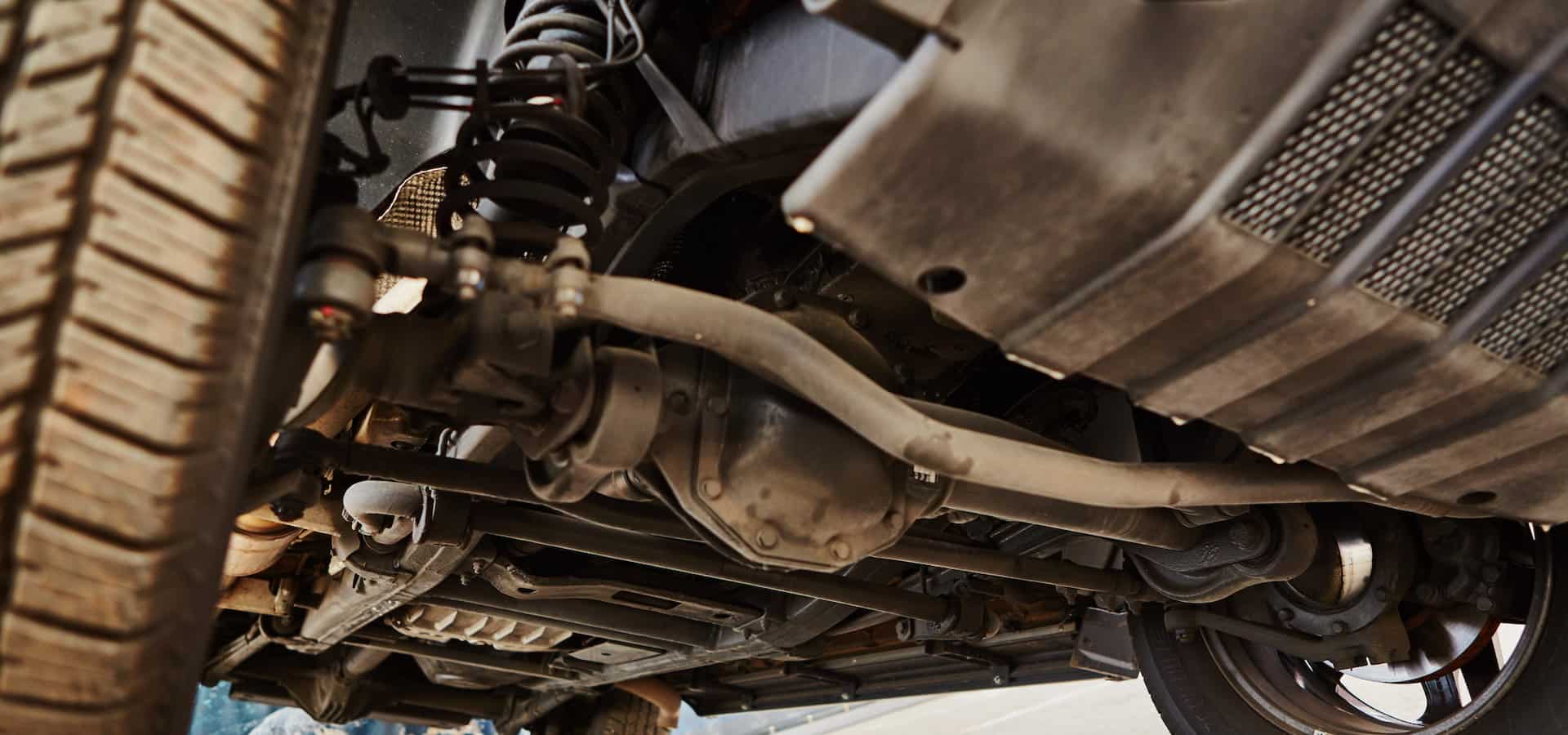
Most Toyota cars and crossovers use MacPherson struts up front, while trucks and body-on-frame SUVs like the 4Runner and Tacoma run double-wishbone front ends with independent upper and lower arms. The rear varies from multi-link setups on cars to leaf springs on Tundra and Tacoma. Each design has its own torque sequence and alignment requirements that generic work often skips.
Getting a Toyota back to factory feel takes more than bolting on parts. We follow OEM procedures so the repair holds up and your alignment stays true.
- Torque-to-yield and staged fasteners – Control arm and ball joint bolts have specific torque values that must be set with the suspension loaded at ride height, not hanging.
- Alignment after every suspension job – Replacing arms, struts, or bushings shifts camber and toe, so a precision alignment brings it back to Toyota spec and protects tire life.
- OEM-grade parts – Matching the original KYB or factory-equivalent components preserves the tuned ride and helps protect warranty and resale value.
- Steering angle sensor and VSC calibration – Newer models may need the steering angle reset so stability control reads center correctly after the work.
As your Denver d
How We Diagnose Suspension Repair Issues on Toyota
Toyota builds most of its lineup on well-understood platforms – the Camry and Avalon on the K-platform, the Tacoma and 4Runner on body-on-frame chassis, and the RAV4 on the TNGA-K architecture. Each has its own wear patterns, and our diagnosis starts with knowing what to look for on your specific model.
- We connect Techstream, Toyota's factory scan software, to pull chassis and stability control codes – ABS wheel-speed faults, steering-angle sensor data, and yaw-rate readings that often point to worn suspension geometry.
- We road test the vehicle to reproduce the complaint: clunks over expansion joints, wander at highway speed, or a rear-end sway that signals tired struts or bushings.
- We put the Toyota on the lift for a visual inspection – checking for cracked lower control arm bushings on Camrys, worn upper strut mounts, sagging coil springs, and leaking struts common on higher-mileage 4Runners and Highlanders.
- We perform a dry-park test to isolate play in ball joints, tie rod ends, and sway bar links.
- We measure ride height and take alignment readings, since caster and camber drift often reveals bent or worn components.
Once we know which parts are actually failing versus which are still serviceable, we build a clear repair plan and quote so you see exactly what's needed and why – no padded lists, no guesswork.
Suspension Repair on Toyota: Repair vs. Replacement
Not every suspension complaint means a full corner rebuild. We match the fix to the actual wear.
- Genuine repair: A single worn sway bar link, a seized bushing that responds to cleaning and re-torque, or an alignment correction after new tires. On many Corollas and Camrys, replacing one tie rod end restores tight steering without touching the rest.
- Partial replacement: Swapping a leaking strut cartridge while the top mount and spring stay in service, or replacing only the failed lower control arm bushing set. Common on TNGA RAV4s where the ball joint outlasts the bushing.
- Full replacement: Cascading wear justifies loaded strut assemblies – when the strut, spring, and mount are all fatigued on a high-mileage 4Runner or Sienna. Once repair cost approaches replacement, or the component is safety-critical like a cracked control arm, we recommend the complete unit.
We walk you through each option with the trade-offs laid out. Choosing OEM-equivalent parts protects your warranty coverage and keeps resale value intact – and we'll never steer you toward the most expensive path when a targeted repair does the job.
How to Make Your Toyota Suspension Repair Last Longer
How you drive and maintain your Toyota has a direct effect on how long new suspension parts hold up.
- Ease off railroad crossings, potholes, and steep driveways – impact loads are what crack bushings and bend control arms.
- Avoid overloading beyond your Toyota's rated payload; a heavily loaded Tacoma or Sienna accelerates spring sag and strut wear.
- Denver's road salt and temperature swings corrode fasteners and mounts, so periodic undercarriage rinses help.
Owner habits that catch problems early:
- Listen for new clunks, squeaks, or a change in ride feel after bumps.
- Watch for uneven tire wear – feathering or inside-edge scrubbing signals alignment or worn components.
- Do quick visual checks for fluid streaks on struts or torn rubber boots.
Stick with Toyota's factory service intervals and insist on OEM or OEM-equivalent parts where fitment and durability matter. Keep alignments current – a proper alignment after any suspension work is the single biggest factor in tire and component life. Rotating tires and topping fluids are safe to handle yourself. Ball joints, control arms, struts, and alignment are safety-critical – leave those to our technicians so the repair stays reliable for the long haul.
What to Expect When You Bring Your Toyota In
Toyota suspensions age in predictable ways – sagging rear coils on Highlander and Sienna, worn lower ball joints on Tacoma and 4Runner, and clunking sway bar links on Camry and Corolla. We build the visit around confirming the real cause before touching a wrench.
- Drop-off or appointment: Tell us what you hear and when – a clunk over speed bumps, a pull under braking, uneven tire wear. Leave the key; grab valuables from the console and glovebox.
- Initial inspection: We lift the vehicle and check struts, control arm bushings, ball joints, tie rods, and rear coils, plus ride-height measurements on load-carrying models like the Sequoia and Sienna.
- Written estimate: You get an itemized breakdown separating what's failed from what's simply wearing, so nothing unnecessary sneaks in.
- Communication during the work: We call or text with findings and wait for your go-ahead before proceeding.
- Pickup walkthrough: We show you the replaced parts and explain what changed.
Shuttle and loaner options help you stay on schedule, and after-hours pickup is available when your day runs long. Every suspension job ends with a road test to confirm the noise or pull is gone, plus a scan-tool re-check where steering angle or ride-height sensors are involved. If anything feels off afterward, bring it back and we'll re-inspect.
Why Choose Elevation Auto Repair for Toyota Suspension Repair
Toyota suspension work rewards knowing the platform quirks. We track TSBs on issues like rear coil sag on early-2000s Highlanders, front strut mount noise on the XV40/XV50 Camry, and premature lower ball joint wear on the Tacoma and 4Runner.
- Platform-aware diagnosis: We measure factory ride height and torque bushings to Toyota specs at load rather than in the air, which prevents bushing bind and squeaks.
- Software and sensor calibration: On models with steering angle sensors and stability control, we reset and verify with scan-tool procedures so the system reads correctly after the repair.
- End-to-end ownership: The same shop diagnoses, repairs, aligns, and road-tests – no handoffs, no finger-pointing.
Using quality parts and correct torque values protects your warranty coverage and keeps resale value intact when it's time to sell or trade. You get dealership-level knowledge with clear communication and no upsell pressure – one shop that handles the whole job right the first time.
Our Toyota Services
- Air Conditioning AC Repair
- Battery Repair Replacement
- Brake Repair & Brake Fluid Change
- Check Engine Light Diagnostics
- Clutch Repair & Replacement
- Coolant Leak Repair
- Cooling System Repair
- Drive Shaft Repair
- Engine Repair
- Exhaust & Catalytic Converter Repair
- Head Gasket Repair & Replacement
- Oil Change
- Oil Leak Repair
- Scheduled Service Maintenance
- Steering Repair
- Cambelt Timing Belt Replacement
- Transmission Repair
- Tune Up
- Wheel Alignment