Kia Oil Leak Repair at Elevation Auto Repair
That fresh oil spot on your garage floor or the burnt smell drifting through the vents usually means a seal or gasket has given up somewhere on your Kia. Oil leaks look simple until you're tracing them across a Theta II or Nu engine, where the source is rarely where the drips land.
Kia oil leak repair rewards a shop that knows the platforms. The Nu 1.8L and 2.0L fours and Theta II 2.4L GDI engines are known for valve cover gasket seepage and oil control ring issues that push oil past seals, while many Lambda V6 Sorento and Sedona builds develop leaks around the timing cover and rear main. Getting these sealed correctly means following Kia's torque sequences on aluminum covers, using the right RTV where the OEM specifies it, and cleaning mating surfaces properly so the repair actually holds.
We work the leak from the top down, confirm the true source with UV dye when needed, and only replace what's actually failing.
- Honest diagnosis that pinpoints the real leak source, not a guess
- OEM-spec gaskets, seals, and sealants installed to Kia torque values
- Fast turnaround so you're back on Denver roads quickly
- A clear explanation of what we found and what we recommend
Symptoms – How to Know You Need This Service
Kia oil leaks tend to announce themselves gradually, then get worse under heat and load. Here's what you may notice from the driver's seat.
- Oil spots under the front of the car – brown or amber puddles where you park point to a valve cover or oil pan gasket.
- Burning oil smell – oil dripping onto the exhaust manifold produces that hot, acrid odor, often strongest at stoplights.
- Blue-tinged smoke – oil reaching hot components or the combustion chamber can show as light smoke.
- Low oil warning light – recurring low-level alerts between changes signal oil escaping faster than normal.
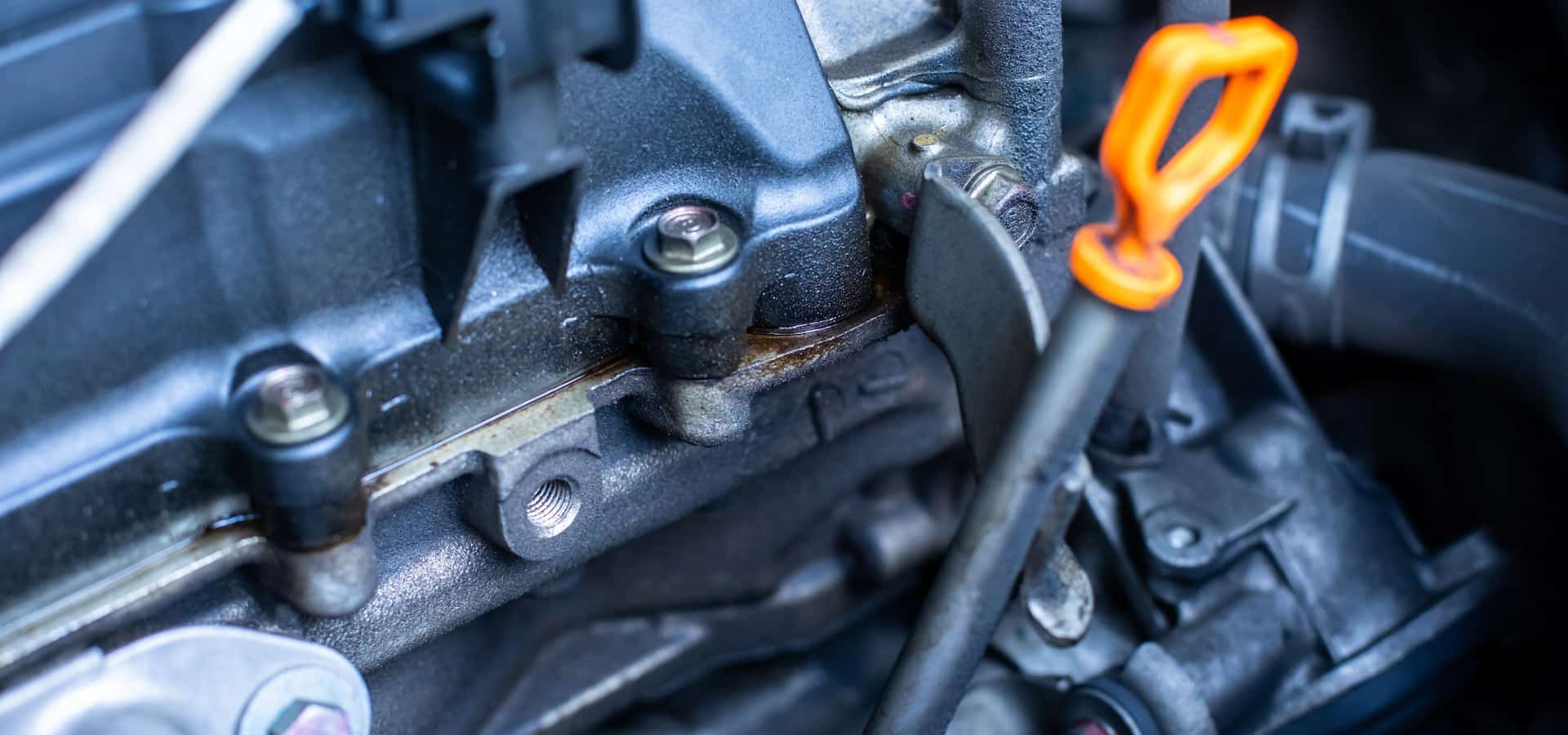
- Visible seepage or crusty residue – dark, grimy buildup around the valve cover, timing cover, or filter housing.
- Ticking or lifter noise on startup – dropping oil pressure from a significant leak can cause momentary valvetrain noise.
- Dashboard oil pressure light – this is the serious one.
Schedule soon if you see minor spots, faint burning smells, or crusty residue. Stop driving immediately if the oil pressure warning light comes on, if you see heavy smoke, or if you find a large fresh puddle – running a Kia engine low on oil risks bearing and timing damage that costs far more than the seal.
Common Oil Leak Repair Issues on Kia Vehicles
If you're spotting fresh spots on the driveway or catching a burnt-oil smell after parking, you're not alone. Kia platforms tend to leak from a handful of predictable places, and pinning down the source quickly is the first step to a clean fix.
- Valve cover gasket seepage on 2.4L Theta II and 2.0L Nu engines – The rubber gasket hardens with heat cycling, letting oil weep down the block and onto the exhaust manifold. Common on 2011-2019 Optima, Sorento, and Sportage.
- Rear main seal leaks on Theta II GDI motors – Higher combustion pressure and known engine wear on 2.4L Theta II units accelerate seal fatigue, leaving a film on the bellhousing.
- Oil pan gasket and drain plug leaks on 3.3L/3.8L Lambda V6 – Telluride, Sorento, and Cadenza owners often see slow pan seepage, sometimes worsened by an over-torqued or stripped drain plug from prior quick-lube visits.
- Timing cover leaks on 1.6L Gamma turbo (Soul, Forte, Seltos) – The front cover sealant breaks down, and the leak sits close to accessory belts and the turbo feed line.
- Camshaft and crankshaft seal weeping on Smartstream 2.5L platforms – Newer engines still develop front-seal seepage as mileage climbs.
- Turbo oil supply/return line leaks on GDI turbo models – Fittings and gaskets on the 1.6T and 2.0T loosen with heat cycling.
Which Kia Models We See for Oil Leak Repair
We handle oil leak repair across the modern Kia lineup, with certain platforms showing up more than others. Find your car below.
- Optima (TF/JF, 2011–2020) – Theta II 2.4L GDI and 2.0T builds with valve cover and oil filter housing seepage.
- Sorento (XM/UM/MQ4) – Lambda 3.3L/3.5L V6 timing cover and rear main leaks; Theta II fours with valve cover gasket wear.
- Sportage (SL/QL/NQ5, 2011–present) – Nu 2.0L and Theta 2.4L leaks around the valve cover and oil pan.
- Soul (PS/SK3, 2014–present) – Nu 1.6L and 2.0L engines with common valve cover gasket seepage.
- Forte (YD/BD) – Nu and Gamma engines; valve cover and crankshaft seal leaks with mileage.
- Sedona/Carnival – Lambda V6 timing cover and oil pan gasket work.
- Stinger (CK) – Lambda 3.3L twin-turbo, where turbo oil feed and drain line leaks need careful attention.
Turbocharged 2.0T and 3.3T variants involve extra oil lines and heat cycling, so we inspect turbo seals and feed lines alongside the usual gaskets. We also service the Telluride's Lambda V6 and older Rio and Rondo models when parts availability allows. If you're driving a much older or imported-spec Kia we don't commonly see, tell us the VIN and we'll confirm we can source the right seals before you come in.
Causes & Risks – What Happens if Ignored
Colorado's temperature swings and elevation are hard on gaskets and seals. The constant expansion and contraction, combined with GDI engine heat and normal aging, is what drives most Kia oil leaks. Age, high mileage, and skipped oil changes accelerate everything.
A small weep rarely stays small. Waiting turns a straightforward gasket job into a much larger repair.
- Ignoring a valve cover leak lets oil drip onto the exhaust manifold, creating smoke, odor, and a genuine fire risk over time.
- A neglected rear main seal on a Theta II engine can drop oil level low enough to accelerate bearing wear – a known weak point on that platform.
- Turbo oil line leaks starve the turbocharger, and a failed turbo is far costlier than a fitting or gasket.
- Low oil from an unaddressed leak triggers the low-pressure warning and can cause internal engine damage on GDI motors.
- Oil contamination of the accessory belt or serpentine belt leads to slipping, squeal, and eventual belt failure.
Catching it early keeps the fix simple. We diagnose the source fast, show you exactly where it's coming from, and repair only what's leaking.
Safety Impact – Why Oil Leak Repair Matters
An oil leak is not just a maintenance annoyance. Depending on where it lands, it can affect the systems you rely on to stay in control.
- Fire hazard – Oil on a hot exhaust manifold or turbo housing can ignite.
- Engine failure – Chronic low oil damages bearings and can lead to sudden stalling in traffic.
- Belt-driven systems – Oil-soaked belts affect power steering assist and charging, making the vehicle harder to control.
- Slick surfaces – Dripped oil under the car creates hazards where you park and pull out.
Stop driving now if you see: smoke from under the hood, an illuminated oil pressure light, or a rapidly dropping oil level.
Schedule soon if you notice: a faint burnt smell, small spots on the driveway, or slight seepage on a dipstick check.
There's also a liability angle. On platforms with known concerns, an unaddressed leak that contributes to an engine fire or breakdown can complicate an insurance claim. Documenting the repair protects you.
How Kia Oil Leak Repair Actually Works
Finding a Kia oil leak means confirming the true source before touching a wrench, since oil travels and the highest wet spot is not always the origin. We clean the area, apply UV dye when needed, and pressure-check to isolate the exact seal or gasket.
Kia's GDI and Smartstream engines use specific sealing methods and torque sequences that generic guesswork gets wrong. Timing cover reseals, for example, require the correct OEM RTV, proper cure time, and a precise bolt sequence to avoid a repeat leak.
- OEM-spec gaskets and sealant – Theta II and Nu valve cover work uses updated gasket designs that outperform generic replacements.
- Correct torque and sequence – Oil pans and covers on Lambda V6 and Gamma turbo engines have staged torque specs to seal evenly.
- Turbo line service – GDI turbo supply and return fittings need new crush washers and precise torque to prevent re-leaks.
- Post-repair verification – We run the engine to temperature and re-inspect so you leave with a confirmed dry seal.
As your Denver dealership alternative, we handle everything from a simple oil pan gasket to a rear main seal on one Kia under one roof, with honest diagnostics and clear updates the whole way through.
How We Diagnose Oil Leak Repair Issues on Kia
Spotting fresh oil spots on your driveway or catching a burning smell after a drive usually means something is weeping where it shouldn't. Kia leaks tend to hide behind covers and shields, so we track the source rather than guess.
- Verify the complaint – confirm whether you're seeing engine oil, transmission fluid, or power steering fluid by color, viscosity, and location under the vehicle.
- Scan for related codes – we connect Kia GDS/KDS to check for low oil pressure flags, PCV/crankcase faults, and any stored data on Theta II 2.0T/2.4L and Gamma engines that point to seal or gasket wear.
- UV dye and clean-and-observe – we degrease the suspect area, add fluorescent dye, and road test so the leak reveals itself under a UV lamp instead of pooling and spreading.
- Inspect known Kia leak points – valve cover gaskets on Nu 2.0L and Lambda V6 engines, rear main seals, oil filter housing gaskets, and the timing cover on Theta engines.
- Confirm with measurement – oil pressure and PCV function checks rule out a pressurized leak versus a simple seep.
Once we pinpoint the source, we translate the findings into a clear repair plan and up-front quote – no guesswork, no piling on parts you don't need.
Oil Leak Repair on Kia: Repair vs. Replacement
Not every Kia leak calls for the same fix. We match the repair to the actual condition of the part.
- True repair – a weeping valve cover gasket on a Nu or Gamma engine, a loose oil filter housing, or a seeping drain plug often just needs a fresh OEM gasket, correct torque, and a proper cleanup.
- Partial replacement – when the rear main seal or camshaft/crankshaft seals fail but the surrounding assembly is sound, we replace just the worn seal and reseal the timing cover on Theta II engines rather than tearing down more than necessary.
- Full replacement – cascading damage, like oil contaminating the timing chain area or a leak feeding an oil-starvation condition on higher-mileage Theta II 2.4L engines, may justify replacing the full assembly when repair cost approaches the value of the component.
We walk you through each option with the trade-offs laid out plainly, so you decide based on your car's mileage and your plans for it – not on whichever job costs the most.
How to Make Your Kia Oil Leak Repair Last Longer
A fresh gasket or seal holds up far better when the surrounding conditions stay healthy. A few habits protect the repair.
- Let it warm up – give the engine a short idle before hard driving in cold Denver mornings so oil reaches full pressure gradually and seals aren't shocked.
- Avoid overfilling oil – excess crankcase pressure pushes past fresh gaskets; stick to the correct level on the dipstick.
- Watch for early signs – peek under the car for new spots, note oil smell after driving, and respond to any oil pressure or check engine light promptly.
Brand-specific care matters on Kia platforms:
- Use OEM-spec oil viscosity and Kia-approved filters – wrong-spec oil accelerates seal wear on Theta and Nu engines.
- Follow Kia's published service intervals and keep PCV components clean, since a clogged PCV drives crankcase pressure into gaskets.
- Stay current on Kia software and recall updates that affect engine management.
Checking fluid levels and glancing under the car are safe to do yourself. Reseal work, timing cover jobs, and anything involving oil pressure or engine internals should stay with our technicians so it's done right the first time.
What to Expect When You Bring Your Kia In
Maybe you spotted dark spots on the driveway, caught a burning smell after a highway run, or noticed the oil level dropping between changes. Whatever brought you in, here's how we track down where the oil is escaping and get you back on the road.
- Drop-off or scheduled appointment – Let us know what you've seen: puddle color, where it pools, any smoke from the exhaust or engine bay.
- Initial inspection – We clean the affected area and often use UV dye to pinpoint the true source, since Kia leaks frequently migrate from valve cover gaskets, the oil filter housing, or the front timing cover before dripping lower.
- Written estimate – You get a clear breakdown of the failed component, parts, and labor before any work starts.
- During the repair – We text or call with updates, and we ask before adding anything we discover along the way.
- Pickup walkthrough – We show you the old gaskets or seals and explain what caused the failure.
Loaner and shuttle options are available so you're not stranded, and after-hours pickup can be arranged. Leave personal items in the cabin – we work only in the engine compartment. Before you leave, we road test the vehicle and run a scan-tool re-check to confirm no leftover codes. If anything feels off afterward, bring it back and we'll re-inspect the same area.
Why Choose Elevation Auto Repair for Kia Oil Leak Repair
Kia oil leaks aren't one-size-fits-all, and chasing them takes real platform knowledge. We see recurring patterns across the lineup and repair the actual source instead of throwing parts at a symptom.
- Platform-specific experience – Valve cover and timing cover seepage on Theta II 2.0T and 2.4L engines, rear main seal weeping on Lambda V6 Sorento and Sedona models, and oil filter housing gasket leaks on GDI four-cylinders.
- TSB and software awareness – We check for applicable Kia service bulletins and updated gasket revisions so a repair sticks rather than reappearing after a few thousand miles.
- End-to-end ownership – The same shop diagnoses the leak, performs the repair to factory torque and sealant specs, and verifies the fix with a road test and scan-tool check.
As your Denver dealership alternative, we give you honest diagnostics without padding the bill with repairs your Kia doesn't need. You get one shop handling everything from the oil change to the gasket work, with clear communication at every step.
Our Kia Services
- Air Conditioning AC Repair
- Battery Repair Replacement
- Brake Repair & Brake Fluid Change
- Check Engine Light Diagnostics
- Clutch Repair & Replacement
- Coolant Leak Repair
- Cooling System Repair
- Drive Shaft Repair
- Engine Repair
- Exhaust & Catalytic Converter Repair
- Head Gasket Repair & Replacement
- Oil Change
- Scheduled Service Maintenance
- Steering Repair
- Suspension Repair
- Cambelt Timing Belt Replacement
- Transmission Repair
- Tune Up
- Wheel Alignment