Lincoln Oil Leak Repair at Elevation Auto Repair
A misdiagnosed oil leak on a Lincoln gets expensive fast. Chase the wrong seal and you tear into an engine twice, throwing away parts and labor while the real source keeps dripping onto hot exhaust. On modern Lincolns – with their tight EcoBoost packaging and shared Ford platform architecture – the leak you see on the driveway rarely starts where the oil pools.
Oil leak repair means finding the true origin, replacing the failed gasket or seal to OEM spec, and confirming the fix holds under pressure and heat. That work looks different on a Lincoln than on a generic domestic.
- Platform quirks: The 2.7L and 3.5L EcoBoost V6 engines run turbo oil feed and return lines that harden and weep – valve cover gaskets, timing cover seals, and turbo drain gaskets all mimic each other.
- OEM procedure: Torque-to-yield fasteners on cam covers and oil pans have specific sequences and one-time-use bolts; guessing distorts the seal.
- Software touch: Later Lincolns log oil pressure and level data we read with proper scan tools before and after the repair.
What you can expect from us:
- Dye-and-UV or pressure tracing to pinpoint the actual source before any parts come off
- OEM-grade gaskets and one-time-use hardware installed to factory torque specs
- Honest findings – we won't sell you a reseal you don't need
- A post-repair verification drive and re-inspection to confirm the leak is gone
Symptoms – How to Know You Need This Service
Oil leaks announce themselves in several ways before they turn into real damage. On a Lincoln, watch for these:
- You may notice dark spots or puddles under the front or center of the vehicle after parking overnight.
- A burning oil smell through the vents, especially after highway driving – often oil hitting the exhaust manifold or turbo housing.
- Blue-tinged smoke from under the hood or the tailpipe at idle.
- The oil level dropping between changes without obvious cause.
- An oil pressure or low-oil warning light on the dash.
- Ticking or lifter noise at cold start that fades as pressure builds.
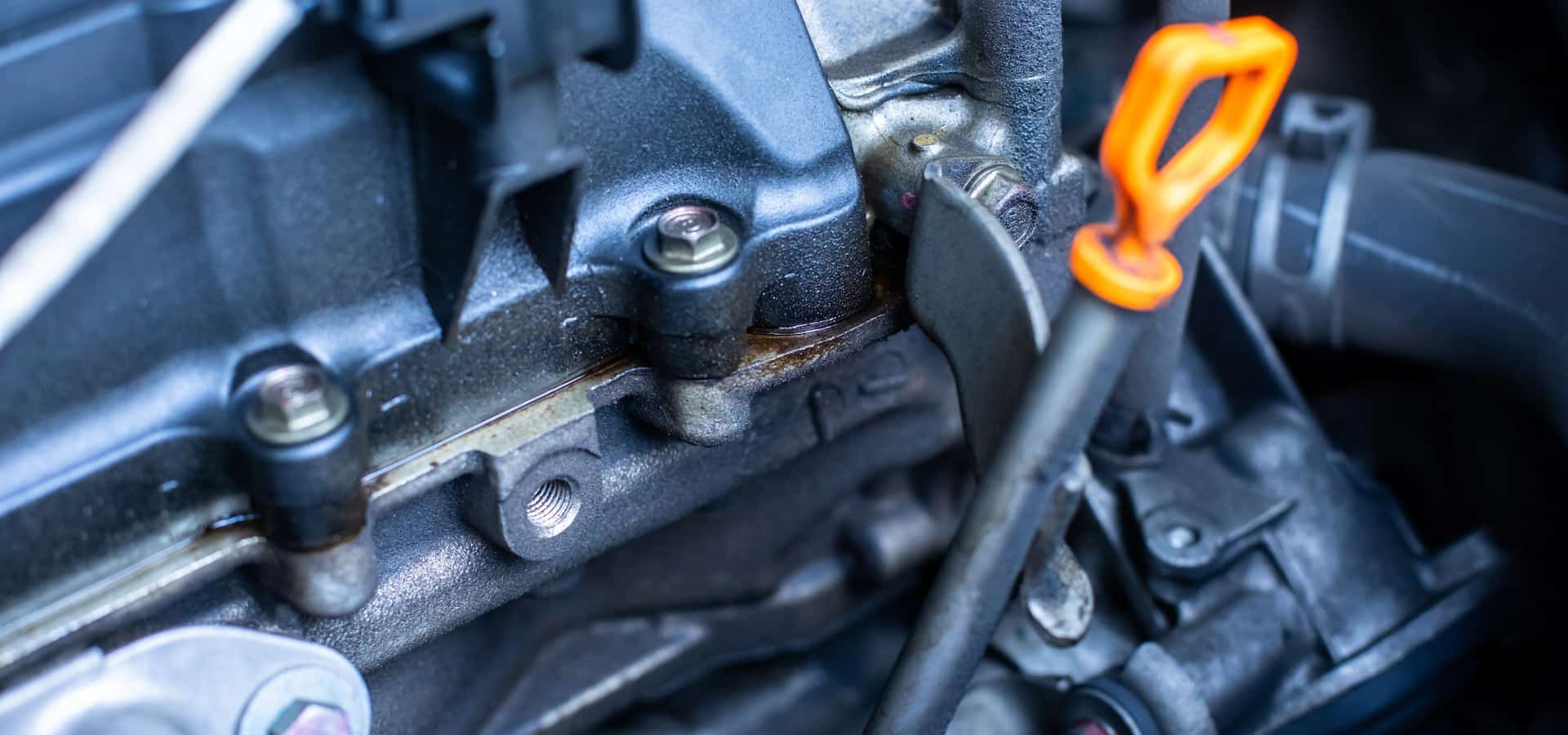
- Oil residue or grime visible around the valve covers, oil pan rail, or timing cover.
Schedule soon for minor weeping, damp gaskets, or slow drips. Stop driving immediately if the oil pressure light stays on, you smell heavy burning oil, or you see smoke – running low on oil pressure can destroy bearings and turbos in minutes.
Common Oil Leak Repair Issues on Lincoln Vehicles
Lincoln oil leaks tend to follow predictable paths tied to specific engines and body platforms. Here are the patterns we see most on Denver-area Lincolns:
- 3.5L EcoBoost valve cover and cam cover leaks – Common on 2015-2020 Navigator and MKT/MKX with the twin-turbo V6. Heat cycling from the turbos hardens the cover gaskets and PCV seals, letting oil weep onto the exhaust.
- Rear main seal seepage on 3.7L/3.5L Ti-VCT platforms – Seen on MKZ and MKX. Age and crank end-play let the seal harden, dripping at the bellhousing and often mistaken for a transmission leak.
- Oil pan gasket and RTV failures on 2.0L/2.3L EcoBoost MKC/Corsair – The stamped pan and aluminum ladder rely on precise RTV bead work; sloppy prior repairs are a frequent repeat-leak source.
- Turbocharger oil feed and return line seepage – 3.5L EcoBoost Navigators develop leaks at the banjo fittings and return line O-rings under sustained load.
- Cam phaser and front cover leaks – The variable cam timing hardware on Ti-VCT V6s adds seams and solenoid seals that seep as mileage climbs.
- Older Town Car / 4.6L V8 valve cover and oil pan leaks – Classic body-on-frame Lincolns show cork-style and PCV-driven leaks after years of Colorado temperature swings.
Which Lincoln Models We See for Oil Leak Repair
We service oil leaks across the current and recent Lincoln lineup. Find your vehicle below:
- Lincoln MKZ (2013-2020): 2.0L and 3.7L Cyclone V6 – valve cover and oil pan gasket seepage is common with age.
- Lincoln MKC / Corsair (2015-present): 2.0L and 2.3L EcoBoost – turbo oil feed/return lines and cam cover seals are frequent sources.
- Lincoln Nautilus / MKX (2016-present): 2.7L EcoBoost and 3.7L V6 – front timing cover and oil cooler adapter leaks show up here.
- Lincoln Aviator (2020-present): 3.0L EcoBoost twin-turbo – turbo drain gaskets and rear main seal weeping on higher-mileage units.
- Lincoln Navigator (2015-present, U554/U554e): 3.5L EcoBoost V6 – valve cover, oil pan, and turbo line leaks common on towing-duty trucks.
- Lincoln Continental (2017-2020): 2.7L and 3.0L EcoBoost variants – timing cover and oil filter housing seals.
EcoBoost twin-turbo variants take extra care – the turbo oil lines and drains complicate access and demand correct routing on reassembly. Older body-on-frame Navigators with the 5.4L Triton and pre-2010 Town Cars fall outside what we routinely stock parts for, though we're glad to look and point you the right direction if we can't do the job in-house.
A misdiagnosed oil leak on a Lincoln costs far more than the gasket that started it. These platforms share DNA with Ford truck and EcoBoost engines, but the packaging is tighter, the accessory layouts are busier, and a wrong torque spec on an aluminum cover can turn a routine reseal into a warped surface that leaks again in weeks. Getting it right the first time protects the engine and your wallet.
Causes & Risks – What Happens if Ignored
Most Lincoln oil leaks start with heat, age, and Denver's dry, high-altitude climate drying out elastomer seals faster than sea-level environments. Turbocharged EcoBoost engines run hotter underhood, which accelerates gasket hardening. Add stop-and-go city driving and repeated cold starts, and seepage becomes an active drip.
Waiting rarely saves money. A weeping valve cover on a 3.5L EcoBoost that drips onto a turbo can carbonize, smoke, and eventually damage wiring or the turbo itself. What starts as a gasket becomes a chain of failures.
- Valve cover seepage onto turbos – progresses to burning smell, smoke, and heat-damaged harness connectors.
- Ignored rear main seal drips – low oil level risking bearing and crank damage on high-mileage V6s.
- Oil pan leaks left unaddressed – contaminated subframe bushings and a slick that reaches the exhaust.
- Turbo oil return line seepage – oil starvation risk to the turbo cartridge, a far costlier repair.
- Cam phaser seal leaks – dropping oil pressure to VCT solenoids, triggering timing faults and rough running.
Driving becomes unsafe once oil reaches hot exhaust components or drips onto tires and brake areas. At that point, schedule immediately rather than waiting for the next service interval.
Safety Impact – Why Oil Leak Repair Matters
Oil leaks touch more than the engine. On a Lincoln, an unchecked leak can compromise systems drivers rely on without warning.
- Fire risk – Oil on hot turbos or exhaust manifolds is the leading under-hood fire hazard on EcoBoost Navigators.
- Braking and traction – Oil migrating onto the underbody can reach brake components and tires, reducing grip and stopping power.
- Engine protection systems – Low oil from a chronic leak triggers oil-pressure warnings and can force limp mode, affecting drivability in traffic.
- Electronics and sensors – Oil-soaked connectors near cam and crank sensors can cause erratic readings that ripple into stability and traction control behavior.
Stop driving now if: you see smoke from under the hood, smell burning oil, or the oil-pressure light comes on.
Schedule soon if: you notice small driveway spots, a faint oil smell after highway drives, or slow-dropping oil levels between changes. Addressing a documented leak early also protects you on the liability side if a known issue contributes to an incident.
How Lincoln Oil Leak Repair Actually Works
An oil leak repair is only as good as the diagnosis and the resealing procedure. Oil travels along the block before it drips, so the visible spot rarely marks the source. We pinpoint the origin with UV dye, controlled cleaning, and pressure testing before touching a wrench.
Lincoln's EcoBoost and Ti-VCT engines use aluminum covers, precise RTV bead patterns, and torque-to-sequence fasteners that a generic reseal often gets wrong. Overtightening warps the sealing surface; the wrong RTV cures poorly against hot aluminum.
- OEM-aligned diagnostics – Ford IDS/FDRS scan data confirms whether low oil pressure faults tie back to a leak or a phaser issue.
- Correct sealing materials – O
Chasing an oil leak on a Lincoln the wrong way gets expensive fast. Misread a weeping cam cover as a rear main seal on a 3.5L EcoBoost V6, and you've pulled a transmission for nothing. Confuse valve cover seepage with a timing cover leak on a 3.7L Duratec, and the labor bill doubles while the real source keeps dripping. Getting the source right the first time is where good diagnostics pay for themselves.
How We Diagnose Oil Leak Repair Issues on Lincoln
Precise source identification comes first, because oil migrates downstream and rarely leaks where it lands. Our process on Lincoln platforms:
- Pull codes and live data with a factory-aligned scan tool (IDS/FDRS-level access) to check oil pressure sensor readings, PCV operation, and any related fault history.
- Degrease the suspected areas, then run the engine and complete a short road test to load the seals under real conditions.
- Apply UV dye and inspect with a black light – this separates a leaking valve cover gasket from a cam phaser cover leak on EcoBoost V6 engines, or a front crank seal from an oil pan gasket on the 3.7L.
- Inspect common Lincoln failure points: turbo oil feed and return lines on 3.5L/2.7L EcoBoost, PCV-related crankcase pressure driving seal seepage, and oil cooler adapter seals on V8-equipped Navigators.
- Verify with pressure and level measurement to confirm the leak rate matches the symptom.
Findings translate into a written repair plan and quote that names the exact gasket or seal, the labor involved, and any related wear worth addressing while the area is open – no vague estimates.
Oil Leak Repair on Lincoln: Repair vs. Replacement
Not every Lincoln oil leak needs major parts. The right call depends on what's actually worn.
- Genuine repair: Reseating a loose valve cover, replacing a single PCV valve, or re-torquing a fastener to spec often stops early seepage on 3.7L Duratec and 3.5L EcoBoost engines without deeper teardown.
- Partial replacement: Swapping just the worn part – a valve cover gasket, front crank seal, oil pan gasket, or a turbo oil return line on EcoBoost applications – while keeping the surrounding assembly intact.
- Full replacement: Warranted when leaks cascade, such as a hardened rear main seal combined with a failing oil cooler adapter, or when repair labor approaches the cost of the complete assembly. Timing cover leaks on high-mileage V6s sometimes fall here once related seals and gaskets are factored in.
We lay out each option side by side with the trade-offs so you decide based on how long you plan to keep the vehicle – never defaulting to the priciest path.
How to Make Your Lincoln Oil Leak Repair Last Longer
A fresh seal lasts longest when crankcase pressure and heat cycles stay under control.
- Driving habits: Let a turbocharged EcoBoost idle briefly before hard shutdown after spirited driving, avoid short cold-start-only trips that never fully warm the oil, and don't overload beyond rated capacity in Colorado's temperature swings.
- Owner checks: Glance under the vehicle for fresh spots, watch oil level between changes, and note any new smell of burning oil or an oil pressure warning light.
- Brand-specific care: Use the correct Motorcraft synthetic viscosity for your engine, install OEM-grade gaskets and seals, keep PCM/PCV-related software current, and follow Lincoln's oil change intervals rather than stretching them.
Topping off fluid, checking levels, and visual inspections are safe to do yourself. Leave PCV diagnosis, seal replacement, and anything requiring engine or transmission removal to our technicians – these are torque- and cleanliness-sensitive jobs where a small mistake reintroduces the leak. Bring it in at the first sign of return and we'll confirm the repair is holding.
What to Expect When You Bring Your Lincoln In
A misdiagnosed oil leak on a Lincoln costs you twice – once for the wrong part, and again when the real source keeps weeping. We chase leaks to their true origin so you pay for one repair, not a guessing game.
- Appointment and drop-off – Schedule ahead or drop the vehicle when it works for you. Clear personal items from the cabin; note anything you want us to look at beyond the leak. Shuttle and loaner options are available so you stay on schedule.
- Initial inspection – We degrease and inspect under lift, often adding UV dye to trace weeping past valve covers, the oil pan gasket, rear main seal, and the timing cover on EcoBoost V6 platforms like the Nautilus and Aviator.
- Written estimate – You get a plain-language breakdown of the leak source, parts, and labor before we touch a wrench. No surprise add-ons.
- Communication during the work – We check in with updates and call before any change in scope.
- Pickup walkthrough – We show you the failed gasket or seal and explain what we replaced.
Before your Lincoln leaves, we road test it and run a scan-tool re-check to confirm no related codes. After-hours pickup is available. If anything feels off afterward, bring it back – we'll re-inspect and make it right.
Why Choose Elevation Auto Repair for Lincoln Oil Leak Repair
Lincoln shares much of its architecture with Ford, but the details matter. We know where these platforms actually leak and how to seal them for good.
- Platform-specific knowledge – Valve cover and cam cover seepage on 3.5L and 2.7L EcoBoost engines (Aviator, Nautilus, Continental), oil pan gasket and rear main seal leaks on higher-mileage MKZ and MKC, and PCV-related pressure issues that push oil past seals.
- TSB and software awareness – We check for applicable Lincoln service bulletins and calibration updates that affect crankcase ventilation and seal longevity, so we treat the cause, not just the symptom.
- Correct torque and OEM-aligned parts – Cover bolts and pan fasteners are torqued to spec in sequence, using seals that match factory material – critical on aluminum covers where over-torquing warps sealing surfaces.
We own the job start to finish – diagnosis, repair, and post-repair verification all happen here. That means no handoffs, no finger-pointing, and one shop accountable for keeping your Lincoln dry and reliable.
Our Lincoln Services
- Air Conditioning AC Repair
- Battery Repair Replacement
- Brake Repair & Brake Fluid Change
- Check Engine Light Diagnostics
- Clutch Repair & Replacement
- Coolant Leak Repair
- Cooling System Repair
- Drive Shaft Repair
- Engine Repair
- Exhaust & Catalytic Converter Repair
- Head Gasket Repair & Replacement
- Oil Change
- Scheduled Service Maintenance
- Steering Repair
- Suspension Repair
- Cambelt Timing Belt Replacement
- Transmission Repair
- Tune Up
- Wheel Alignment