Lincoln Exhaust & Catalytic Converter Repair at Elevation Auto Repair
You start your Navigator, hear a low rasp that wasn't there last week, and the check engine light glows. On a modern Lincoln, that combination usually points somewhere along the exhaust path – and getting it right takes more than bolting on a universal converter.
Exhaust and catalytic converter repair covers the manifolds, flex pipes, oxygen and air-fuel ratio sensors, the catalytic converters themselves, and the resonators and mufflers downstream. Lincoln's turbocharged EcoBoost lineup makes this work its own animal.
- Twin-turbo 3.5L EcoBoost applications (Navigator, MKX, Continental) run close-coupled catalysts that see high heat and are prone to substrate breakdown and downstream P0420/P0430 codes.
- Correct diagnosis depends on Ford IDS/FDRS scan data – reading upstream versus downstream sensor voltages, fuel trims, and catalyst efficiency monitors rather than guessing.
- Manifold and downpipe hardware often seizes; we use proper torque sequences and OEM-grade gaskets to prevent leaks and future rattles.
Here's what you can expect when your Lincoln comes in:
- A verified diagnosis backed by live scan data, not a parts-swap gamble.
- Sensor and catalyst testing before we recommend replacement.
- Proper-fit components and correct torque on every flange.
- Straight talk about what's needed now versus what can wait.
Symptoms – How to Know You Need This Service
Lincoln exhaust trouble rarely appears all at once. You may notice one of these signs building over weeks:
- A deep drone or rasp at idle that grows louder under acceleration – often a cracked flex pipe or failed gasket.
- A rotten-egg or sulfur smell, a classic sign of a failing catalytic converter.
- Check engine light with P0420 or P0430 (catalyst efficiency below threshold) stored in memory.
- Noticeable loss of power or sluggish throttle response, sometimes from a clogged or collapsed converter.
- A rattle from underneath when the substrate inside the converter breaks apart.
- Falling fuel economy paired with rough idle.
- A ticking near the engine on cold start – often a leaking exhaust manifold on EcoBoost engines.
Schedule soon for gradual noise changes, a lit check engine light, or reduced economy. Stop driving and call us if you smell exhaust inside the cabin, notice heavy sulfur odor with severe power loss, or see smoke – those point to raw exhaust intrusion or an overheating converter that can pose a fire risk.
Common Exhaust & Catalytic Converter Repair Issues on Lincoln Vehicles
You start your Lincoln, hear a low rasp that wasn't there yesterday, and a few days later the check engine light glows. That progression is familiar to Denver Lincoln owners, and it usually points to one of a handful of exhaust or catalytic converter faults.
- P0420/P0430 catalyst efficiency codes on 2007-2014 Navigator and MKX (3.5L/3.7L Cyclone V6): The rear O2 sensor mirrors the front, telling the PCM the converter can no longer store oxygen. High-altitude driving accelerates this.
- Turbo EcoBoost downpipe and cat failures on 2013-2020 MKZ 2.0T and 3.5L Navigator EcoBoost: Concentrated heat near the turbo cracks the close-coupled converter substrate and warps flex joints.
- Flex-pipe splitting on MKS and MKT (D3/D4 platform): The braided flex coupling behind the manifold fatigues from repeated heat cycling, producing an exhaust leak and a ticking sound at cold start.
- Rusted mid-pipe and muffler seams: Colorado road salt attacks factory clamps and welds on older Town Car and MKZ units parked outdoors.
- Rattling heat shields: Spot welds let go on Navigator underbody shields, mimicking a more serious internal converter break.
- Failed upstream and downstream O2/air-fuel sensors: Aging sensors throw false catalyst codes, so honest diagnostics matter before condemning a converter.
Which Lincoln Models We See for Exhaust & Catalytic Converter Repair
We service exhaust and catalytic converter work across most modern Lincoln platforms. Find your vehicle below:
- Navigator (2007–present, U326/U554) – 5.4L V8 early trucks and 3.5L twin-turbo EcoBoost later models; close-coupled cats and manifold leaks are common.
- MKX / Nautilus (2007–present) – 3.5L and 2.7L EcoBoost variants with downstream catalyst efficiency codes.
- MKZ (2006–2020) – 2.0L EcoBoost, 3.0L twin-turbo, and hybrid trims; sensor and flex-pipe repairs are frequent.
- Continental (2017–2020) – 3.0L twin-turbo EcoBoost, where twin close-coupled converters and tight packaging make careful diagnosis key.
- MKC / Corsair (2015–present) – 2.0L and 2.3L EcoBoost with manifold gasket and downpipe wear.
- MKS, MKT, Aviator – V6 and EcoBoost applications, including the 3.0L twin-turbo Aviator.
Twin-turbo EcoBoost models with dual banks need both catalysts and both sensor sets checked, since a single-side fault often mimics a full failure. On AWD Lincolns, undercar routing adds a step to the job, and we plan for it.
For heavily modified classic or pre-2000 Lincolns, we may refer you to a specialist – tell us your VIN and we'll confirm fit before you come in.
Causes & Risks – What Happens if Ignored
Most Lincoln exhaust problems trace back to heat, age, and Colorado's conditions. Thin mountain air makes the EcoBoost engines run harder, road salt eats connections, and repeated cold-start cycles fatigue flex joints and substrate.
A converter code often begins as an upstream issue – a lazy oxygen sensor or a small manifold leak – that slowly poisons the catalyst. Left alone, a cheap sensor fix turns into a full converter replacement.
- Ignoring a P0420 for several months while the engine runs rich typically clogs the converter substrate, dropping power and fuel economy.
- A small flex-pipe crack lets exhaust escape ahead of the O2 sensors, skewing fuel trims and eventually washing down cylinder walls.
- Unaddressed manifold leaks on EcoBoost turbo models can overheat the turbine housing and damage the turbo.
- A partially melted catalyst can break loose, sending ceramic downstream and restricting the entire system.
- Chronic misfires feeding raw fuel into the converter can overheat it to the point of glowing – a fire and driveability hazard.
The cost curve is steep: a $150 sensor becomes a converter, then a converter plus a downpipe, then labor to chase a melted assembly. Catching it early keeps you on the road and keeps the bill sane.
Safety Impact – Why Exhaust & Catalytic Converter Repair Matters
Exhaust faults on a Lincoln are not just about noise. A leak upstream of the cabin lets carbon monoxide seep in, and a restricted converter forces the engine into limp behavior that affects how the vehicle responds in traffic.
When the PCM logs persistent catalyst and O2 faults, it can disable adaptive fuel strategies, and severe backpressure can trip stability-related limp modes that reduce throttle authority right when you need it.
- Stop driving now: exhaust smell inside the cabin, a glowing-hot converter, loud roaring with power loss, or the smell of rotten eggs with heavy heat under the floor.
- Schedule soon: steady check engine light with a catalyst code, a mild rasp at cold start, or a rattle over bumps from a loose heat shield.
There's also a liability angle. A known exhaust leak or converter defect left unrepaired before a carbon-monoxide incident is hard to defend. Addressing it promptly protects your family and your record. We handle it quickly so you're back to safe driving without the guesswork.
How Lincoln Exhaust & Catalytic Converter Repair Actually Works
Your Lincoln's exhaust does two jobs at once: it routes gases safely away and lets the catalytic converter clean them. Upstream and downstream oxygen sensors feed the PCM constant readings, and the computer compares them to confirm the converter is doing its job. On EcoBoost turbo models, the converter sits close to the turbo for fast light-off, which is why heat management is central to the design.
Because Lincoln integrates these sensors tightly with the powertrain software, replacing parts is only half the work – the system has to be verified and, in some cases, relearned.
- OEM-grade or direct-fit converters that meet the correct oxygen-storage spec so the monitor passes readiness.
- Ford/Lincoln factory scan tooling (IDS/FDRS) to read live fuel trims, clear adaptations, and run catalyst readiness monitors.
- Correct fastener torque and sequence on manifold, downpipe, and flex-joint hardware to prevent repeat leaks.
- Verified sensor function before condemning a converter, so you don't pay for parts you don't need.
That combination of proper parts, factory software, and careful sequence is what separates a lasting repair from a code that returns next month. We do the full verification so your Lincoln leaves ready and reliable.
You start your Lincoln in the driveway and hear a low drone that wasn't there last week, or maybe a rotten-egg smell drifts through the vents at a stoplight. On a Navigator, MKZ, MKX, or Aviator, those are early signs that the exhaust or catalytic converter needs attention. We'll pin down the cause and get you back on the road quickly.
How We Diagnose Exhaust & Catalytic Converter Repair Issues on Lincoln
Guessing wastes your money. We follow a repeatable process built around Lincoln-specific data.
- Full scan with Ford/Lincoln IDS or FDRS: We pull powertrain codes like P0420/P0430 (catalyst efficiency below threshold) and P0171/P0174 lean codes that often accompany converter faults on the 3.5L EcoBoost Navigator and Aviator.
- Live data review: We compare upstream and downstream O2 sensor voltages and read the wide-band air/fuel readings to see whether the converter is actually failing or a sensor is lying.
- Visual inspection on the lift: We check flex pipes, gaskets, hangers, and welded seams for rust-through – a frequent issue on older MKX and MKS platforms driven through Colorado winters and road salt.
- Physical measurements: Backpressure testing and pre/post-cat temperature readings confirm whether a converter is clogged or melting internally.
- Road test: We drive under load to reproduce drones, rattles from a broken internal substrate, and hesitation caused by restricted flow.
Once we know exactly what's happening, we translate the findings into a clear repair plan and an itemized quote – no surprise add-ons, just what your Lincoln actually needs.
Exhaust & Catalytic Converter Repair on Lincoln: Repair vs. Replacement
Not every exhaust complaint means a new converter. We size the fix to the problem.
- Genuine repair: A leaking manifold or downpipe gasket, a cracked flex pipe, or a failed O2 sensor throwing a false P0420 can often be corrected without touching the converter itself.
- Partial replacement: On many MKZ and Continental setups, we can replace a single rusted midpipe section, a rotted muffler, or one converter bank while keeping the rest of the serviceable assembly – helpful on EcoBoost V6 layouts with separate left/right cats.
- Full replacement: When the substrate is melted, contaminated by an upstream oil-consumption or misfire problem, or when patching costs approach a new assembly, we replace the affected components fully and address the root cause so it doesn't happen again.
We show you the codes, the measurements, and the photos, then explain your options. You choose the path that fits your budget and how long you plan to keep the vehicle – we never default to the most expensive route.
How to Make Your Lincoln Exhaust & Catalytic Converter Repair Last Longer
A converter and exhaust system last longest when the engine feeding them runs clean. A few habits go a long way.
Driving and load habits
- Let the engine reach operating temperature before hard acceleration, especially in cold Denver mornings.
- Take occasional longer highway drives so the converter reaches full temperature and burns off deposits – short trips only accelerate carbon buildup.
- Avoid heavy towing loads with a misfiring or overdue-for-service engine, common on Navigator and Aviator setups.
Owner maintenance you can do safely
- Listen for new rattles, drones, or hissing and note when they happen.
- Address a check engine light promptly – ignored misfires dump raw fuel into the converter and destroy it.
- Keep an eye on oil consumption, since burning oil coats the catalyst substrate.
Brand-specific care
- Use OEM-spec spark plugs and coils; cheap parts cause misfires that kill EcoBoost converters.
- Keep PCM software current – Lincoln updates can refine fuel trims that protect the catalyst.
- Follow Lincoln's service intervals for plugs, filters, and oil.
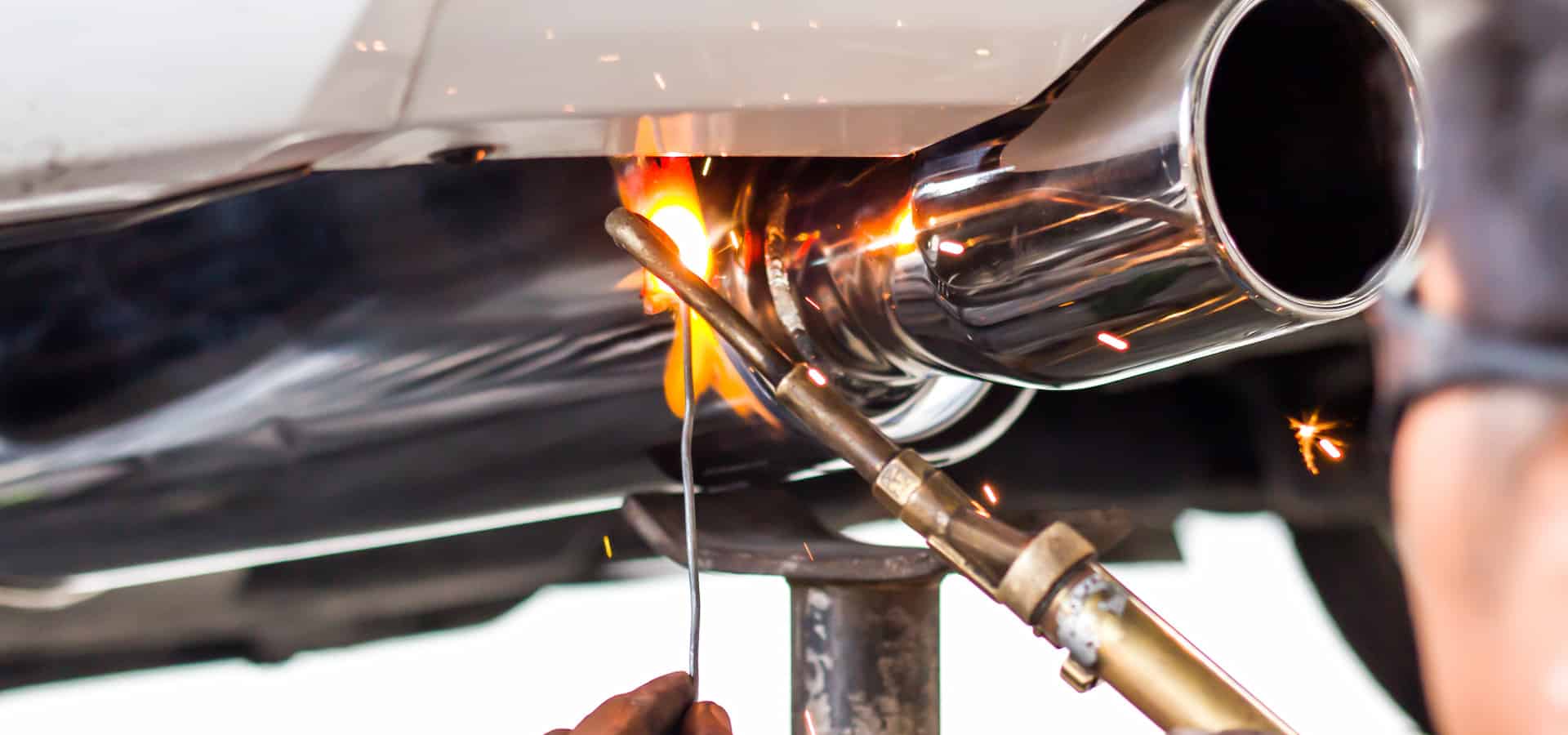
Leave welding, converter replacement, and O2 sensor work on hot exhaust systems to us – it's safety-critical and easy to get wrong. We'll handle the heavy lifting and keep your Lincoln running strong.
What to Expect When You Bring Your Lincoln In
That deep drone at highway speed, a rattle over bumps, or a P0420 catalyst-efficiency code on your MKZ, MKX, Aviator, or Navigator usually points at the exhaust. Here's how we handle it.
- Drop-off or scheduled appointment – Tell us the symptoms you're hearing and where. Grab personal items from the cabin; we'll note anything left for safekeeping.
- Initial inspection – We put your Lincoln on the lift and trace the whole system: manifolds, flex pipes, converters, resonators, hangers, and clamps. We pull codes with a scan tool and check upstream and downstream O2 sensor data.
- Written estimate – You get a clear breakdown of what's failing and why, with OEM-grade parts options laid out before anything gets torn apart.
- Repair with updates – We call or text as work progresses. If we find a cracked flex joint or a seized clamp mid-job, you hear about it first.
- Pickup walkthrough – We show you the replaced parts and explain what changed.
Shuttle and loaner options help you keep your day moving, and after-hours pickup is available when your schedule runs late. Every repair ends with a road test and a scan-tool re-check to confirm catalyst efficiency and clean fuel trims. If something still feels off, bring it back and we'll re-verify at no runaround.
Why Choose Elevation Auto Repair for Lincoln Exhaust & Catalytic Converter Repair
Lincoln exhaust work has its own quirks, and we treat them accordingly. The 3.7L and 3.5L EcoBoost V6 in MKZ, MKX, and Continental models often throw catalyst-efficiency codes tied to failing downstream O2 sensors rather than a bad converter, so we verify before condemning a costly part. Navigator and Aviator owners frequently deal with heat-shield rattles and rusted rear hanger brackets on higher-mileage trucks.
- We check for applicable Lincoln TSBs and PCM calibration updates that affect O2 sensor logic and catalyst monitoring before quoting a converter.
- We fit OEM-grade, emissions-compliant converters and correct flange gaskets so the repair seals and passes Colorado inspection.
- We own the whole job – diagnosis, welding or bolt-in replacement, and post-repair scan verification – so nothing gets handed off or guessed at.
You get straight answers, no padded parts lists, and a shop that handles everything from routine service to complex engine and drivetrain work under one roof. That's the difference between replacing a converter and actually fixing the problem.
Our Lincoln Services
- Air Conditioning AC Repair
- Battery Repair Replacement
- Brake Repair & Brake Fluid Change
- Check Engine Light Diagnostics
- Clutch Repair & Replacement
- Coolant Leak Repair
- Cooling System Repair
- Drive Shaft Repair
- Engine Repair
- Head Gasket Repair & Replacement
- Oil Change
- Oil Leak Repair
- Scheduled Service Maintenance
- Steering Repair
- Suspension Repair
- Cambelt Timing Belt Replacement
- Transmission Repair
- Tune Up
- Wheel Alignment