Lincoln Drive Shaft Repair at Elevation Auto Repair
That rhythmic clunk when you pull away from a stoplight in your Navigator, or the shudder that creeps in as your MKZ accelerates onto I-25 – those are the kinds of things Lincoln owners bring to us every week. Drive shaft repair isn't a job you want handed to a generalist who bolts things back together and hopes for the best.
Lincoln's mix of rear-wheel and all-wheel-drive platforms means the driveline setup varies a lot between models. The Navigator and its shared body-on-frame architecture use a two-piece shaft with a center support bearing that wears out, while AWD sedans and crossovers like the MKZ, MKX, and Nautilus route power through a transfer case and rear propeller shaft with sealed CV-style joints. Getting the pinion flange bolts and center bearing bracket to factory torque – and phasing the U-joints correctly to avoid a rebalanced vibration – is where the difference shows.
Here's what you can expect when you bring your Lincoln to us:
- A road test and lift inspection that isolates the shaft from wheel bearings, tires, and CV axles before we quote anything
- OEM-grade U-joints, center support bearings, and flex discs matched to your specific platform
- Proper driveshaft balancing and U-joint phasing to eliminate vibration
- Straight talk on pricing and only the repairs your vehicle actually needs
Symptoms – How to Know You Need This Service
Driveline problems tend to announce themselves gradually, then get worse fast. On a Lincoln, you may notice:
- A clunk or thud when shifting from Park to Drive or during throttle changes – often a worn U-joint or slop in the center support bearing
- Vibration that increases with speed, usually felt through the floor between 45 and 70 mph, pointing to an out-of-balance shaft or failing flex disc
- A squeaking or chirping at low speed that fades as you accelerate – a classic dry U-joint symptom
- A deep humming or growling from underneath, common when a Navigator's center support bearing starts to break down
- Shuddering on takeoff, especially on AWD models like the MKX and Nautilus where the rear propeller shaft joints bind
- Grease spray on the underbody or tunnel from a torn CV boot or leaking joint
Schedule soon if you hear squeaks or feel light vibration. Stop driving and have it towed if you feel a violent shudder, hear loud metallic banging, or notice the vehicle lurching – a shaft that separates at speed can damage the transmission, brake lines, or floor pan.
Common Drive Shaft Repair Issues on Lincoln Vehicles
You feel a vibration through the floor at highway speed, or hear a clunk when the transmission grabs from a stop. On many Lincoln models, that points straight at the drive shaft, U-joints, or the center support bearing. Here are the patterns we see most often across the Denver area.
- Center support bearing wear on RWD/AWD Town Car and Navigator platforms (UN146/U228): The rubber isolator around the mid-ship bearing dries and cracks with age and Colorado temperature swings, producing a droning vibration between 40–65 mph.
- Rear U-joint failure on 2007-2017 Navigator and Mark LT: Non-greaseable factory U-joints run dry over time, causing the classic clunk on throttle tip-in and a ratcheting feel when moving from park to drive.
- Power Take-Off (PTO) and rear driveshaft slip-yoke issues on AWD MKX/Nautilus (CD3/CD4 platforms): A binding or under-lubricated slip spline creates a shudder during tight parking-lot turns and low-speed acceleration.
- Aluminum driveshaft imbalance on 2003-2011 Town Car: A lost balance weight or a slightly bent tube after a curb or pothole strike shows up as a speed-sensitive vibration that worsens as it accelerates.
- Flex-disc (giubo) cracking on rear-drive sedans: The rubber coupling at the transmission or diff flange splits, letting the shaft shift under load and mimicking a U-joint clunk.
- CV-style front axle wear on AWD MKZ/Continental: Torn boots let grit into the joint, producing a clicking on turns that eventually loads the driveshaft and transfer unit.
Which Lincoln Models We See for Drive Shaft Repair
We service driveline work across the modern Lincoln lineup, both rear-drive and AWD. Find your vehicle below:
- Navigator (1998–present, U228/U554) – body-on-frame two-piece shaft with center support bearing; the most common drive shaft job we see on Lincolns
- MKZ (2013–2020, CD4 platform) – AWD variants use a rear propeller shaft prone to joint and coupler wear; FWD versions rarely need this work
- MKX / Nautilus (2007–present, CD3/CD4) – AWD crossovers with transfer-case-fed rear shafts and sealed CV joints
- Aviator (2020–present, CD6 platform) – shared RWD/AWD architecture with the Explorer; rear driveshaft and center bearing serviced here
- Corsair (2020–present) – AWD rear propeller shaft and coupling assembly
- MKT and MKS (2009–2019) – older AWD platforms where U-joint and center support wear is typical with age
- Town Car and older LS (Panther / DEW98) – classic rear-drive shafts with serviceable U-joints; we still handle these
AWD models generally involve more driveline components than front-drive versions, so the scope differs. If you drive an early classic Lincoln with unusual one-off driveline hardware, call us first – we'll tell you honestly whether it's a job we can source parts for.
Causes & Risks – What Happens if Ignored
Most Lincoln drive shaft problems trace back to age, mileage, and the sealed-for-life design of modern U-joints and bearings. Denver's dry climate accelerates rubber isolator breakdown, and mountain grades put extra torque load through the driveline on AWD models.
A small vibration is your early warning. Left alone, the parts around it start to take collateral damage – and a quick component swap turns into a driveline rebuild.
- Ignoring a worn U-joint clunk for a few months typically wallows out the yoke ears, so you replace the shaft instead of just the joint.
- A failing center support bearing that drones for a season can seize, whipping the shaft and damaging the transmission tailshaft seal or output flange.
- Torn CV boots on AWD Lincolns let contamination destroy the joint, then load the Power Transfer Unit and rear differential.
- A cracked flex-disc can let the shaft drop at speed – a sudden, dangerous failure rather than a gradual one.
- Prolonged imbalance loosens the transmission mount and can crack the crossmember over time.
What starts as a minor vibration becomes unsafe once the shaft develops play you can feel in the steering or shifter. We'll tell you plainly which stage yours is at and what it actually needs.
Safety Impact – Why Drive Shaft Repair Matters
The drive shaft ties your engine's power to the wheels. When it degrades, the effects reach well past a noise – on AWD Lincolns, driveline binding can feed false inputs into stability control, traction control, and ABS wheel-speed logic.
- Stop driving now: Loud metallic banging on acceleration, a shaft you can visibly wobble, or a vibration severe enough to shake the steering wheel – a shaft can separate and strike the road or brake lines.
- Stop driving now: Grinding paired with a burning smell, which points to a seizing center bearing.
- Schedule soon: A single clunk on tip-in, a mild speed-related hum, or a click on tight turns from an AWD front axle.
A separated shaft can lock a rear wheel momentarily or puncture the floor and fuel/brake lines. If a known driveline symptom goes unaddressed and contributes to a crash, that can complicate an insurance or liability claim. Getting it documented and repaired protects both you and everyone sharing the road.
How Lincoln Drive Shaft Repair Actually Works
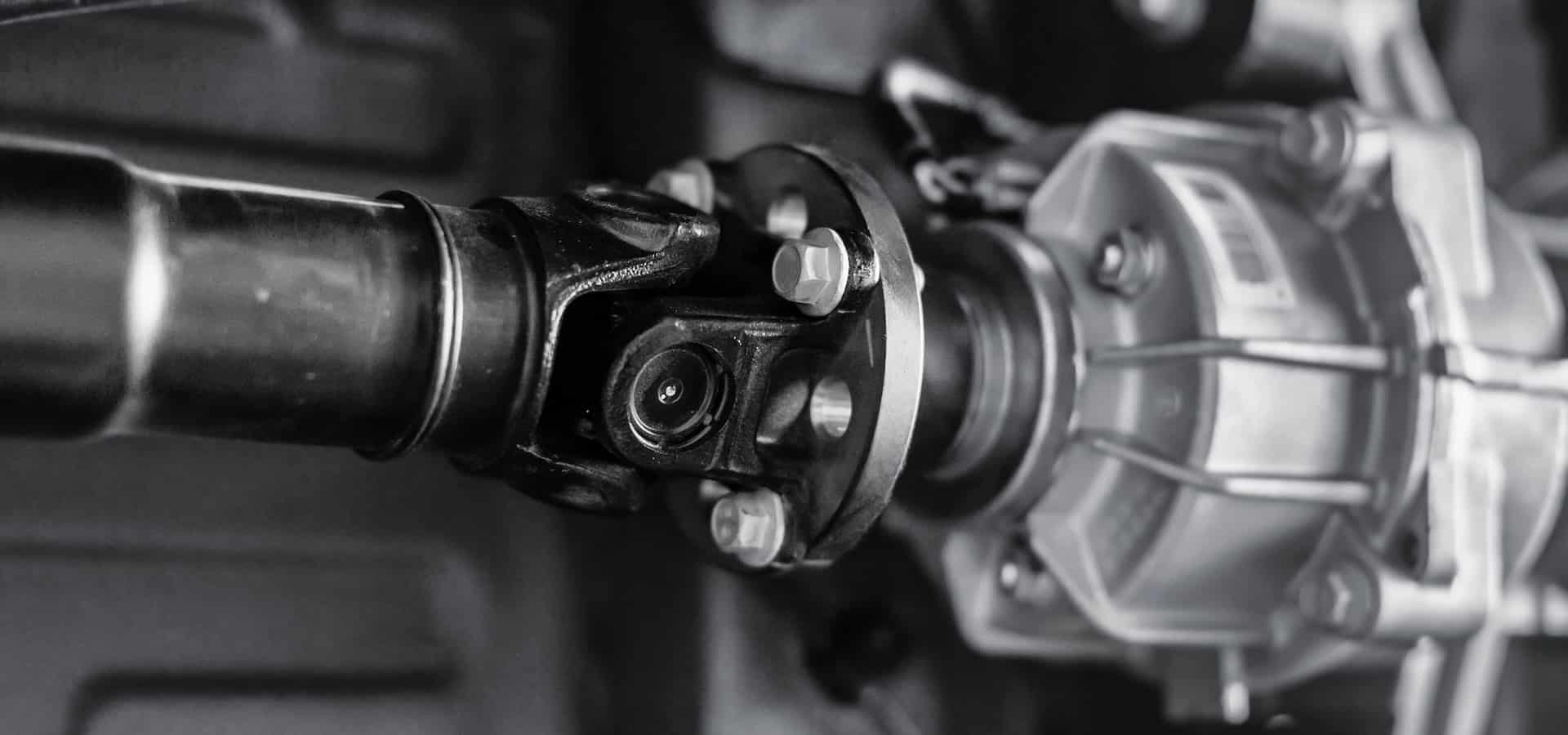
Your Lincoln's drive shaft transfers rotation from the transmission or transfer case to the differential through U-joints or CV joints, supported mid-span by a rubber-cushioned bearing on longer RWD and AWD shafts. Every joint has to flex as the suspension moves while keeping the whole assembly balanced at thousands of RPM.
Lincoln's implementation adds a few wrinkles over a generic truck or sedan, which is why the work has to be done to spec rather than by feel.
- Balance-critical assemblies: Aluminum and multi-piece shafts must be reindexed to their original clocking marks, or re-balanced, to avoid re-introducing vibration.
- AWD driveline coordination: On MKX/Nautilus and Navigator AWD, the PTU, driveshaft, and rear unit share load – we verify the whole path, not just the noisy part.
- Torque-to-yield and sequence specs: Flange bolts, flex-disc hardware, and center bearing fasteners follow Lincoln torque values and patterns to prevent flange runout.
- Electronic systems: Newer Lincolns use electronic parking brakes and drive-mode systems that may require a scan tool to release, relearn, or clear codes after driveline service.
We use
You're driving your Lincoln down I-25 and feel a vibration that builds with speed, or maybe there's a clunk from underneath when you shift from park to drive. Those symptoms often point to the drive shaft, and on rear-wheel and all-wheel-drive Lincolns like the Aviator, Navigator, and MKX, they deserve a proper look before they get worse. Here's how we approach it.
How We Diagnose Drive Shaft Repair Issues on Lincoln
A driveline vibration can mimic a bad wheel bearing, worn CV joint, or unbalanced tire, so we confirm the source before quoting anything.
- Scan first: We connect Ford/Lincoln IDS or FDRS to pull chassis and powertrain codes. On AWD Aviators and Navigators, this reveals PTU and transfer case status, wheel speed sensor faults, and driveline-related DTCs that hint at a failing shaft or coupling.
- Road test: We replicate the complaint at the speed and load where it appears – vibration under acceleration usually points to worn universal joints or a bent shaft, while a clunk on takeoff suggests a failing center support bearing or slip yoke.
- Lift inspection: With the vehicle raised, we check U-joints for play, inspect the carrier/center support bearing rubber for cracking, and look at CV boots on AWD half-shafts for torn boots leaking grease.
- Measurement: We check driveline angles and runout, and verify the balance weights are intact on multi-piece shafts common to long-wheelbase Navigators.
Once we pinpoint the worn component, we walk you through exactly what we found and give you a clear, itemized repair plan and quote before any work begins.
Drive Shaft Repair on Lincoln: Repair vs. Replacement
Not every driveline complaint means a full shaft. We match the fix to the actual wear.
- Genuine repair: A dry or lightly worn U-joint on an older Town Car or a loose flange bolt can often be serviced or replaced on its own, keeping the original shaft. Rebalancing after replacing a small component is frequently all that's needed.
- Partial replacement: On multi-piece shafts found in Navigators and Aviators, a failed center support bearing can sometimes be replaced while retaining the rest of the assembly. Torn CV boots caught early may allow a single half-shaft replacement rather than the whole driveline.
- Full replacement: When wear cascades – a spun bearing that scored the shaft, a bent tube from impact, or non-serviceable staked U-joints on newer sealed designs – replacing the complete shaft is safer and often more cost-effective than chasing individual parts.
We lay out each option with its trade-offs so you decide based on your budget and how long you plan to keep the vehicle. We won't push the most expensive path when a targeted repair does the job.
How to Make Your Lincoln Drive Shaft Repair Last Longer
Good habits protect the work and the surrounding driveline components.
- Drive smoothly: Ease off hard launches and abrupt shifts between drive and reverse, which shock-load U-joints and slip yokes. Let AWD Aviators warm up briefly in cold Denver mornings before heavy throttle.
- Mind the load: Stay within towing and payload limits on Navigators – overloading stresses the center support bearing and driveline angles.
- Listen and look: Note any new clunk, whine, or vibration and check your driveway for grease flung from a torn CV boot. Watch for AWD or drivetrain warning lights.
- Use the right parts: Insist on OEM-grade U-joints, bearings, and Lincoln-specified driveline grease and PTU/transfer case fluids at the correct intervals. Keep control module software current, since AWD calibration updates can affect driveline behavior.
Visual checks and listening for changes are safe for any owner. Leave U-joint replacement, shaft balancing, and anything requiring the vehicle on a lift to us – these are safety-critical and need proper tooling and torque specs. Bring it in at the first sign of change and we'll keep you safely on the road.
What to Expect When You Bring Your Lincoln In
That vibration through the floorboard on your Navigator, or the clunk you feel when your MKZ shifts from park to drive – those are the sounds owners recognize before a drive shaft or U-joint gives up. Here's how a visit to our Denver shop unfolds.
- Drop-off or appointment – Schedule ahead or drop by. Clear personal items from the cabin; we'll note anything left inside. Ask about shuttle or loaner availability when you book.
- Initial inspection – We put the Lincoln on the lift and check the driveline for worn U-joints, a failing center support bearing, damaged CV boots, or a bad flex disc – common on AWD MKX and Aviator platforms.
- Written estimate – You get a line-item breakdown with transparent pricing before any wrench turns. No surprise add-ons.
- Communication during the work – We call or text with findings and wait for your approval before proceeding.
- Pickup walkthrough – We show you the old parts, explain what we replaced, and cover after-hours pickup if that fits your schedule.
Before you leave, every Lincoln gets a road test to confirm the vibration or clunk is gone, plus a scan-tool re-check on AWD models. If something still feels off after you drive away, bring it back – we'll re-inspect and make it right.
Why Choose Elevation Auto Repair for Lincoln Drive Shaft Repair
Drive shaft work on modern Lincolns isn't a bolt-on job. Balanced two-piece shafts, center support bearings, and driveline angles all have to match factory spec, and AWD Aviator, Nautilus, and Navigator systems add PTU and rear-drive-unit considerations that generic shops skip.
We handle Lincoln driveline repair end-to-end:
- Platform familiarity – Center support bearing wear on Navigator and older MKX/MKS AWD shafts, flex-disc failures, and CV joint issues seen across the Ford-Lincoln CD4 and D2C-derived platforms.
- TSB and software awareness – We check for driveline-related bulletins and control-module updates before assuming a mechanical fault, so you don't pay for parts that a recalibration would fix.
- Precision on reassembly – Proper phasing, torque-to-spec fasteners, and driveline angle checks to eliminate the vibration rather than mask it.
One shop diagnoses, repairs, and verifies the work – no handoffs, no finger-pointing. You get clear communication at every step and a Lincoln that drives smooth again.
Our Lincoln Services
- Air Conditioning AC Repair
- Battery Repair Replacement
- Brake Repair & Brake Fluid Change
- Check Engine Light Diagnostics
- Clutch Repair & Replacement
- Coolant Leak Repair
- Cooling System Repair
- Engine Repair
- Exhaust & Catalytic Converter Repair
- Head Gasket Repair & Replacement
- Oil Change
- Oil Leak Repair
- Scheduled Service Maintenance
- Steering Repair
- Suspension Repair
- Cambelt Timing Belt Replacement
- Transmission Repair
- Tune Up
- Wheel Alignment