Lincoln Wheel Alignment at Elevation Auto Repair
Your Lincoln was engineered to glide down the road with the steering wheel dead center and the cabin quiet. When it drifts, tugs, or chews through a set of tires early, alignment is usually the reason – and getting it right on a Lincoln takes more than a quick toe-and-go.
Wheel alignment sets the caster, camber, and toe angles so your suspension geometry matches factory spec. On modern Lincolns this is tied to more than mechanics.
- Adaptive suspension models like the MKZ and Continental (CD4 platform) use ride-height and damping inputs that should be respected during setup.
- Aviator and Corsair (CD6 and C2 platforms) require the steering angle sensor to be recalibrated after alignment so lane-keeping and Co-Pilot360 systems read center correctly – a step generic shops routinely skip.
We treat the alignment as part of the whole picture, checking worn control-arm bushings and tie-rod ends before we ever set a number. Here is what you can expect:
- A full pre-alignment suspension and steering inspection so we align a sound car, not a worn one
- Angles set to Lincoln factory specifications on calibrated equipment
- Steering angle sensor and ADAS-related recalibration where the platform calls for it
- A clear before-and-after readout so you see exactly what changed
Symptoms – How to Know You Need This Service
Alignment problems announce themselves in small ways first, then get expensive. Here is what you may notice from the driver's seat.
- The steering wheel sits off-center even though you are driving straight
- Your Lincoln pulls to one side and you constantly correct to stay in the lane
- Uneven or feathered tire wear – inner or outer edges wearing faster than the rest
- A vibration through the steering wheel that grows with speed
- Squealing tires on turns that used to be quiet
- Lane-keeping or Co-Pilot360 warnings acting up after new tires or curb contact
- The car feels loose or wanders on the highway, requiring frequent small corrections
A gentle pull or an off-center wheel means schedule soon before the tires pay the price. A sudden hard pull, clunking over bumps, or a vibration that shakes the whole car after hitting a pothole or curb points to possible steering or suspension damage – stop driving and have it inspected right away.
Common Wheel Alignment Issues on Lincoln Vehicles
If your Lincoln is pulling to one side, chewing through the inside edge of a tire, or the steering wheel sits off-center on a straight road, alignment is usually the culprit. These patterns show up in predictable ways across the current lineup.
- Rear camber wear on the Aviator and Nautilus (CD6/CDX707 platforms): Independent rear suspension with adjustable upper links tends to drift toward negative camber, feathering the inner rear tire edges long before the tread wears evenly.
- Front toe drift on the Navigator (2018+ U554): The heavy full-size body and large 22-inch wheel packages accelerate tie-rod and control-arm bushing wear, throwing front toe out and causing a steady pull.
- MKZ and Continental (2013-2020) after pothole impact: Denver's freeze-thaw road damage bends lower control arms and knocks caster out on these unibody sedans, producing a wandering feel at highway speed.
- Air suspension ride-height errors on Navigator and Aviator: A sagging air spring or failed height sensor shifts the reference point the alignment is measured from, so geometry reads out of spec even when links are fine.
- Adaptive steering recalibration needs: Lincoln models with Adaptive Steering can hold a crooked steering-wheel angle after alignment if the sensor isn't reset, mimicking a toe problem.
- Lowering or oversized wheel fitments: Aftermarket setups on older MKX and MKS models routinely push camber and toe past factory windows.
Which Lincoln Models We See for Wheel Alignment
We align the full modern Lincoln lineup and most late-model years. Find your car below.
- Lincoln MKZ (2013–2020, CD4 platform): shares underpinnings with the Fusion; watch for rear toe drift and adaptive-suspension variants that need proper setup.
- Lincoln Continental (2017–2020, CD4): AWD versions and adaptive dampers benefit from a full four-wheel alignment with ride-height reference.
- Lincoln Corsair (2020–present, C2 platform): compact crossover with heavy reliance on ADAS calibration after alignment.
- Lincoln Nautilus (2019–present) and MKX (2016–2018, CD4): common for uneven front tire wear tied to worn lower control-arm bushings.
- Lincoln Aviator (2020–present, CD6): RWD and AWD, plus Grand Touring plug-in hybrid – air suspension models require correct ride height before angles are set.
- Lincoln Navigator (2007–present, T1/U-series body-on-frame): caster and camber adjustment differs from the car-based platforms; larger wheels make alignment critical for tire life.
- Lincoln MKC, MKS, and MKT: we still service these older platforms routinely.
On air-suspension and adaptive-damper Aviators and Navigators, and on any Lincoln with active driver-assist features, the recalibration step matters as much as the angles themselves. For pre-2005 Town Car and older LS models, availability of factory alignment specs can vary – call ahead and we will confirm before you come in.
Causes & Risks – What Happens if Ignored
Most Lincoln alignment problems trace back to a mix of road conditions and the weight these vehicles carry. Colorado's broken pavement, curb strikes, and worn bushings on higher-mileage cars all nudge the geometry off. Air-suspension height variance on the Navigator and Aviator adds another layer that generic shops often miss.
Waiting rarely makes it cheaper. A small toe error that would only cost a set of tires early on can drag suspension and steering parts down with it over a few thousand miles.
- Ignoring inner-edge rear tire wear on an Aviator for a few thousand miles typically ruins an otherwise healthy tire and can expose cords – a blowout risk.
- A steady front pull on a Navigator left unaddressed accelerates tie-rod end and wheel-bearing wear, turning a simple adjustment into a parts job.
- Running on a bent control arm after a pothole strike stresses the strut mount and can loosen ball joints.
- An uncorrected ride-height fault keeps re-throwing alignment specs, so the car never tracks straight until the air suspension is fixed first.
Driving becomes genuinely unsafe once wear reaches steering components or tire cords – that is the point to stop and get it checked. We sort the safety-critical items from the maintenance items before any work starts.
Safety Impact – Why Wheel Alignment Matters
Alignment isn't just about tire life on a Lincoln – it feeds directly into the systems that keep the vehicle planted. When geometry drifts, the steering angle sensor reports a false baseline, and that affects several electronic aids.
- Stability control and traction control: Rely on the steering angle sensor; an off-center wheel can confuse yaw calculations and delay intervention.
- ABS and braking balance: Uneven tire wear from bad alignment lengthens stopping distance and can cause pull under hard braking.
- Lane-keeping and Co-Pilot360 features: Lincoln's driver-assist systems assume the car tracks straight; a crooked baseline degrades steering assist accuracy.
Stop driving now if you notice:
- Visible tire cords or a bulge on any tire edge.
- A sudden hard pull or clunk after hitting a curb or pothole.
- Loose, vague steering that wanders on its own.
Schedule soon if you notice: a slight steady pull, an off-center steering wheel, or faster wear on one tire edge. Addressing a known geometry problem promptly also matters from a liability standpoint if a collision ever gets reviewed.
How Lincoln Wheel Alignment Actually Works
A proper Lincoln alignment sets three angles – camber, caster, and toe – at each corner so the tires meet the road the way the factory intended. On these vehicles the process leans heavily on electronics, not just turnbuckles and wrenches.
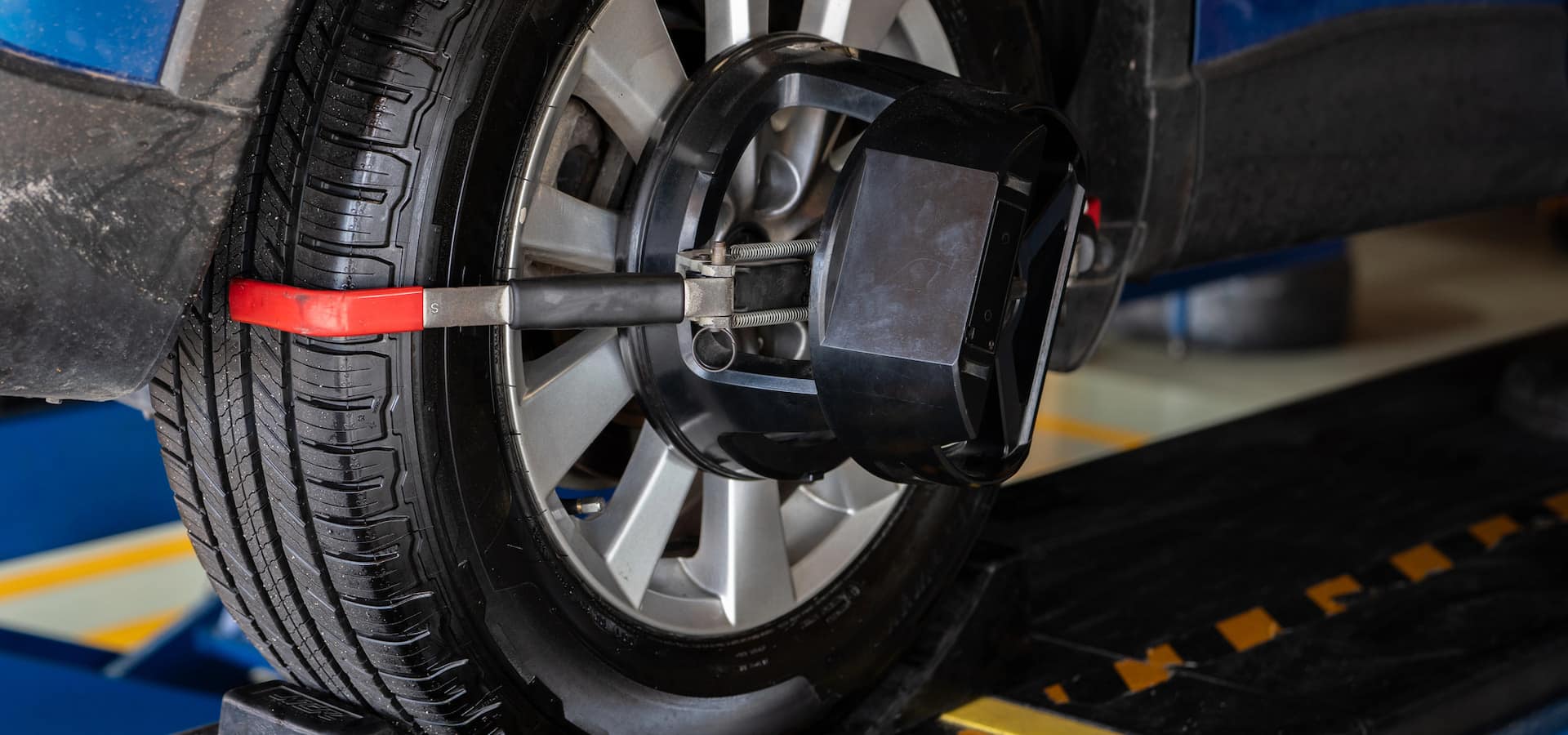
We mount the vehicle on precision alignment equipment, verify ride height first (essential on air-suspension Navigators and Aviators), then adjust to Lincoln's published specs and complete the electronic resets so the car's systems agree with the corrected geometry.
- Ride-height reference: Air-suspension models must be at correct height before any angle is trusted – we confirm this with factory-level scan data.
- Steering angle sensor reset: Required after alignment on models with stability control and Adaptive Steering so the center point matches the straight wheel.
- Adaptive Steering calibration: Some Navigator and Continental builds need a software relearn so assist stays accurate.
- Torque and sequence specs: Cam bolts and control-arm fasteners get torqued to Lincoln values, since over- or under-tightening lets settings creep back out.
These OEM steps are why alignment on a modern Lincoln is more than a quick
How We Diagnose Wheel Alignment Issues on Lincoln
Your Lincoln is pulling to one side, the steering wheel sits off-center, or the tires are wearing on the inside edges. Those are the signs that bring most drivers in, and each one points to a specific alignment angle worth checking.
We work through a repeatable process so nothing gets missed on your MKZ, MKX, Nautilus, Aviator, or Navigator.
- Owner interview and road test – We confirm the symptom on the same roads you drive, feeling for wander, pull, or a crooked wheel under load and braking.
- Visual inspection on the rack – Control arm bushings, tie rod ends, and ball joints get checked for play. On Aviator and Navigator (CD6 platform), we inspect the air suspension height sensors and links that directly affect measured angles.
- Tire and wear read – Feathering, camber wear, and cupping each tell a different story about what's out of spec.
- Factory-level scan – Using Ford/Lincoln IDS/FDRS, we read steering angle sensor data and, on models with adaptive systems, verify no chassis or driver-assist codes are skewing the geometry.
- Hunter alignment measurement – We capture live camber, caster, and toe against Lincoln's factory specs, front and rear.
Once we see the numbers next to the OEM targets, we build a plain-language repair plan and quote before any adjustment starts – no surprises.
How to Make Your Lincoln Wheel Alignment Last Longer
A fresh alignment holds far longer when the driving and upkeep support it.
Driving habits that help
- Slow down for potholes, curbs, and Denver's rough winter road edges – hard impacts knock toe and camber out fastest.
- Avoid overloading a Navigator or Aviator beyond its rated capacity, which stresses suspension geometry.
- Ease off aggressive cornering and hard braking that accelerate bushing and tie rod wear.
Maintenance you can do yourself
- Check tire pressures monthly and watch for uneven edge wear – an early warning sign of drift.
- Listen for new clunks over bumps or a wandering steering feel.
- Rotate tires on Lincoln's recommended interval to spread wear evenly.
Brand-specific care
- Use OEM-spec tires and matched sizes – mismatched tires on AWD models create pull that mimics misalignment.
- Keep suspension and driver-assist software current so steering angle and lane-keeping systems read correctly.
- Follow Lincoln's service intervals for suspension inspection.
Tire checks and pressure are safe DIY. Leave ball joints, control arms, air suspension, and the actual alignment to us – these are safety-critical and need the rack, factory specs, and a proper sensor reset to get right.
What to Expect When You Bring Your Lincoln In
Maybe your Navigator drifts on I-25, or the steering wheel sits off-center after clipping a Denver pothole. Uneven tire wear on your MKZ or Aviator points the same direction. Here's how a visit works.
- Drop-off or appointment – Schedule ahead or leave the vehicle with us. Grab your garage remote and personal items; anything left behind stays untouched and secured.
- Initial inspection – We check tie rods, ball joints, control arm bushings, and the electric power steering rack before touching the alignment rack. Worn components get flagged first, since aligning a loose suspension is wasted effort.
- Written estimate – You get a clear breakdown of what needs correction and what's healthy. No surprise add-ons.
- Communication during the work – We call or text with findings and wait for your approval before proceeding.
- Pickup walkthrough – We show you before-and-after alignment readings and explain what changed.
Loaner and shuttle options help you keep your day moving, and after-hours pickup is available when your schedule runs late. Every alignment closes with a road test and a scan-tool re-check of steering angle sensor data. If anything feels off afterward, bring it back and we'll recheck it.
Why Choose Elevation Auto Repair for Lincoln Wheel Alignment
Lincoln alignments aren't one-size-fits-all. The D4 platform under older Navigator and MKS models, plus the CD4-based MKZ and Continental and the newer Aviator, each carry their own caster and camber specs and adaptive steering behavior.
- Platform-specific knowledge – We reference current Lincoln TSBs and steering software updates, including the electric power-assist and Lane-Keeping calibrations that a generic four-wheel alignment can miss.
- Sensor recalibration – On models with Adaptive Steering and driver-assist cameras, we address the steering angle sensor and ADAS relearn so the systems match the new geometry.
- End-to-end ownership – The same shop diagnoses worn tie rods or sagging bushings, performs the repair, sets the alignment, and verifies the result.
We're your Denver dealership alternative – honest diagnostics, precise setups, and follow-through that protects your tires and keeps your Lincoln tracking straight.
Wheel Alignment on Lincoln: Repair vs. Replacement
Most alignments are a straightforward adjustment. The question is whether worn hardware needs attention first.
- Genuine repair (adjust only): Angles have drifted from curb impacts or normal settling, but all components are tight. We correct toe, caster, and camber and reset the steering angle sensor.
- Partial replacement: A single worn part – an outer tie rod end on an MKZ, a lower control arm bushing on an MKX, or a sagging air spring on an Aviator – gets replaced, then we align to spec while the rest of the assembly stays.
- Full replacement: When wear cascades – ball joints, control arms, and bushings all loose, or a bent knuckle from a hard impact – we replace the assembly so the alignment actually holds and the car stays safe.
On air-suspension Navigator and Aviator models, we confirm ride height is correct before touching alignment, since a tired compressor or leaking strut throws every angle off. We lay out each option side by side and let you decide – we won't push the biggest ticket when a targeted fix does the job.
Our Lincoln Services
- Air Conditioning AC Repair
- Battery Repair Replacement
- Brake Repair & Brake Fluid Change
- Check Engine Light Diagnostics
- Clutch Repair & Replacement
- Coolant Leak Repair
- Cooling System Repair
- Drive Shaft Repair
- Engine Repair
- Exhaust & Catalytic Converter Repair
- Head Gasket Repair & Replacement
- Oil Change
- Oil Leak Repair
- Scheduled Service Maintenance
- Steering Repair
- Suspension Repair
- Cambelt Timing Belt Replacement
- Transmission Repair
- Tune Up