Cadillac Exhaust & Catalytic Converter Repair at Elevation Auto Repair
Botch a catalytic converter job on a modern Cadillac and you pay twice – once for the part, again when the check engine light returns because the downstream oxygen sensor never saw the readiness monitors complete. These vehicles run tight air-fuel strategies and sophisticated OBD-II catalyst efficiency logic, so guesswork gets expensive fast.
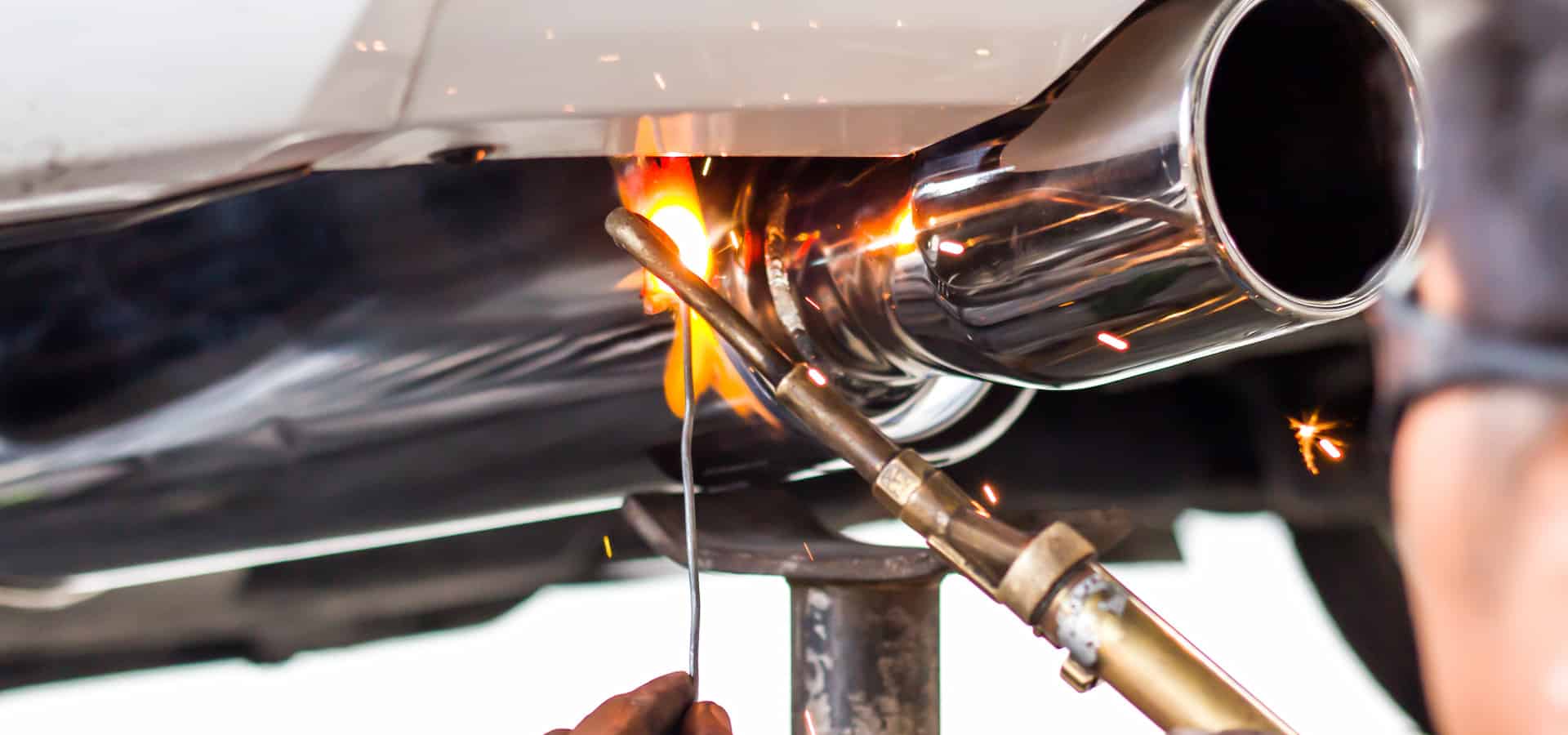
Exhaust and catalytic converter repair covers everything from the manifold and flex pipe back through the cats, resonators, mufflers, and the oxygen and NOx sensors that keep the system in spec. On a Cadillac this differs from generic work in real ways:
- Turbocharged 2.0T and 3.0TT/4.2TT engines (CT4, CT5, CT6, Escalade) route close-coupled cats near the turbos, where heat and flange corrosion complicate removal and require precise torque on studs.
- Northstar V8 platforms are prone to exhaust manifold bolt breakage and warped flanges, meaning proper extraction and gasket sealing matter more than a quick clamp-and-go.
- Clearing catalyst efficiency codes (P0420/P0430) demands a full GM drive-cycle to reset monitors – something we verify with factory-level scan tools, not a parts-store reader.
What you can expect from us:
- Honest diagnostics that separate a failed cat from an upstream misfire or oil-consumption cause
- OEM-grade or CARB-compliant converters that pass Colorado emissions
- Proper sensor calibration and monitor verification before you leave
- Clear communication on what needs attention now versus what can wait
Symptoms – How to Know You Need This Service
Cadillac exhaust problems usually announce themselves before the system fully fails. You may notice:
- A check engine light with P0420 or P0430 catalyst efficiency codes – schedule soon before you fail emissions
- A deep drone or rasp under acceleration, often a cracked flex pipe or blown muffler seam
- A metallic rattle from beneath the car, which frequently signals a broken catalyst substrate
- A rotten-egg or sulfur smell pointing to a saturated or failing converter
- Noticeably weaker throttle response and dropping fuel economy on turbo CT4/CT5 models
- Ticking that grows with RPM near the manifold – a classic Northstar exhaust manifold bolt or gasket leak
- A hissing or puffing sound at idle from a leaking gasket or cracked pipe
If you smell exhaust inside the cabin or the car feels sluggish with a glowing red-hot converter, stop driving and have it towed – a plugged cat can overheat and damage the engine. Rattles, mild rasp, and a steady check engine light are safe to drive on briefly, but get them booked before small leaks become manifold or valve problems.
Common Exhaust & Catalytic Converter Repair Issues on Cadillac Vehicles
Getting exhaust work wrong on a Cadillac usually shows up as a lingering check engine light, a lit catalyst code that comes back after a parts swap, and a repair bill that doubles because the wrong converter was installed. Cadillac's mix of Northstar V8s, turbocharged 4-cylinders, and small-block V8s each carries its own exhaust quirks worth naming.
- P0420/P0430 catalyst efficiency codes on Northstar V8 DeVille/DTS/STS – these engines were prone to head gasket seepage and oil consumption that contaminates the catalyst substrate over time, killing efficiency well before high mileage.
- Manifold and downpipe cracking on 2013-2019 ATS/CTS 2.0T (LTG engine) – the integrated exhaust manifold and turbo housing sees severe heat cycling in Denver's stop-and-go, leading to cracks and boost/exhaust leaks.
- Rusted mid-pipe and flex joints on Escalade (GMT900/K2XX platforms) – Colorado road salt attacks the flex coupling and clamps, producing a ticking exhaust leak that mimics an engine tap.
- Rear catalyst failure on CTS-V and V-Sport twin-turbo LF3/LF4 engines – high exhaust gas temperatures accelerate substrate breakdown, especially on tuned or hard-driven cars.
- O2 sensor and wideband sensor drift – aging upstream and downstream sensors on early-2010s platforms often trigger false catalyst codes when the real fault is the sensor.
- Resonator and muffler perforation on higher-mileage SRX and XT5 crossovers from internal condensation and short-trip driving.
Which Cadillac Models We See for Exhaust & Catalytic Converter Repair
We service exhaust and catalytic converter work across most modern and late-model Cadillac platforms. Find your car below:
- CT4 / CT5 (2020–present) – Alpha-derived platform with 2.0T LSY and 2.7T; close-coupled cats and turbo-adjacent piping. CT4-V Blackwing (3.6TT) and CT5-V Blackwing (6.2L supercharged LT4) run dual exhaust that needs balanced work.
- ATS / CTS (2013–2019) – Alpha chassis; 2.0T LTG, 3.6L V6, and CTS-V LT4 variants. Common flex-pipe and downstream sensor concerns.
- CT6 (2016–2020) – 3.0TT LGW twin-turbo and 2.0T; dual converter setups requiring correct bank identification.
- Escalade (GMT900, K2XX, and T1XX 2021+) – 6.2L L86/L87 V8s with dual exhaust; watch for manifold gasket leaks and AFM-related exhaust codes.
- SRX / XT5 / XT6 – 3.6L V6 crossovers with front and rear converter placement.
- Northstar-era DTS, STS, and earlier models – prone to broken manifold bolts and warped flanges; we handle the extraction work these need.
We're candid about limits: very early or rare hand-built classic Cadillacs fall outside our routine wheelhouse, but for anything from the Northstar era forward we've got the tooling and experience to do it right.
Causes & Risks – What Happens if Ignored
Most Cadillac exhaust failures trace back to a blend of heat cycling, Colorado's road-salt winters, and oil or coolant contamination that poisons the catalyst from the inside. Short-trip driving keeps the system from fully drying out, which speeds internal corrosion on mufflers and resonators.
A small leak or a soft catalyst code rarely stays small. Ignore a manifold crack on an LTG turbo engine for a few months and you'll often chase misfires, uneven idle, and a compromised turbo seal that turns a gasket job into a major repair.
- A minor exhaust leak grows into a failed flex joint and a full mid-pipe replacement.
- Oil contamination on a Northstar clogs the catalyst, dropping power and eventually throwing a restriction code.
- A neglected P0420 lets a crumbling substrate send debris downstream, damaging the rear converter and O2 sensors.
- Ignoring turbo-side exhaust cracks on the 2.0T can overheat surrounding wiring and boost hardware.
- Carbon monoxide entering the cabin through a corroded joint becomes a real health risk in winter with windows up.
Safety Impact – Why Exhaust & Catalytic Converter Repair Matters
Exhaust problems on a Cadillac reach beyond emissions. A leak upstream of the O2 sensors feeds bad data to the ECM, which affects fuel trims, traction control behavior under load, and stability system response when the engine hesitates. A restricted catalyst can also put the car into reduced-power mode at the worst moment.
The most immediate danger is exhaust gas – including carbon monoxide – entering the cabin through a cracked manifold, failed flex joint, or rusted seam.
- Stop driving now: exhaust fumes in the cabin, loud roaring under acceleration, a glowing-hot smell with reduced power, or a strong sulfur odor.
- Schedule soon: a persistent P0420/P0430, a faint ticking that grows on cold starts, or a check engine light with no drivability change.
There's also a liability angle. If a known exhaust defect goes unaddressed and contributes to an incident or a failed emissions test, that documentation can matter. Fixing it promptly keeps you compliant and keeps everyone in the cabin safe.
How Cadillac Exhaust & Catalytic Converter Repair Actually Works
Your Cadillac's exhaust is a monitored system, not just pipes. Upstream and downstream oxygen sensors let the ECM compare gas readings before and after the catalyst to confirm it's still scrubbing pollutants. When those numbers drift out of range, you get a catalyst code – which is why proper diagnosis matters more than throwing a new converter at it.
Cadillac's implementation differs from generic vehicles in ways that change how the work is done. Many models use platform-specific converter designs, integrated turbo manifolds on the 2.0T, and OEM-matched sensor calibrations that off-brand parts don't satisfy.
- OEM-grade or CARB-compliant converters are required so the substrate loading matches what the ECM expects – cheap universal cats frequently re-trigger P0420.
- Factory-level scan tools (GM GDS2/MDI) read live fuel trims and sensor data to separate a bad catalyst from a drifting O2 sensor.
- Torque and gasket sequence specs on manifold and downpipe bolts prevent repeat leaks on heat-cycled turbo hardware.
- Post-repair drive cycles and readiness monitors must complete so the car passes emissions and clears the code correctly.
We handle the full process at one shop – honest di
A misdiagnosed exhaust problem on a Cadillac gets expensive fast, especially on the Northstar V8 platforms and the twin-turbo LF3/LF4 CT6 and CTS-V models where converter placement and manifold design leave little room for guessing. Replace a healthy converter because someone chased a phantom code, and you've spent serious money without fixing the real fault. We work the diagnosis first so the repair actually solves the problem.
How We Diagnose Exhaust & Catalytic Converter Repair Issues on Cadillac
A P0420 or P0430 rarely tells the whole story on a Cadillac. We confirm the root cause before recommending any parts.
- Full scan with a capable scan tool: We pull codes and read live data across both banks, checking upstream and downstream O2 sensor behavior and long-term fuel trims that point to efficiency loss versus a sensor or exhaust leak.
- Freeze-frame and history review: We look at the conditions that set the code – common on Northstar N* engines where oil consumption fouls converters over time.
- Cadillac-specific TSB and calibration check: Some efficiency codes on GM platforms are addressed by ECM software updates. We verify the vehicle is on current calibration before condemning hardware.
- Visual inspection: We check flex pipes, welds, manifold studs (a frequent CTS/SRX failure), gaskets, and heat shields for cracks, rattles, and rust-through.
- Backpressure and temperature measurement: We test for a plugged converter using backpressure readings and inlet/outlet temperature differentials.
- Road test: We confirm under load, listening for changes and watching trims respond in real driving.
From there we build a clear repair plan and quote – you see what failed, what's still good, and exactly what the fix requires.
Exhaust & Catalytic Converter Repair on Cadillac: Repair vs. Replacement
Not every exhaust complaint means a new converter. We match the repair to the actual condition of the parts.
- Genuine repair: A cracked flex pipe, leaking manifold gasket, broken exhaust hanger, or loose heat shield on a CTS or Escalade is a straightforward fix – weld, clamp, or single-part replacement with the rest of the system intact.
- Partial replacement: When one converter section fails but the muffler, resonator, and opposite bank are sound, we replace only the affected component. This is common on the dual-bank Northstar and 3.6L V6 layouts where one side ages faster.
- Full replacement: Oil-fouled converters caused by chronic Northstar consumption, cascading rust across the mid-pipe and rear assembly, or a repair cost that approaches new-part cost all point to replacing the assembly. Safety-critical exhaust leaks near the cabin also get full attention.
We walk you through each option with the tradeoffs laid out, so you choose based on facts – not the biggest invoice.
How to Make Your Cadillac Exhaust & Catalytic Converter Repair Last Longer
A little attention keeps a fresh exhaust job healthy, especially in Denver's road-salt winters.
- Drive to warm it up: Let the engine reach operating temperature before hard acceleration – short, cold trips shorten converter life and worsen carbon buildup.
- Address oil consumption early: On Northstar V8s, unburned oil is the number-one converter killer. Fixing leaks and consumption protects the new part.
- Listen and look: Watch for new rattles, a droning exhaust note, or a lit check engine light, and glance underneath for rust streaks or hanging heat shields.
- Use OEM-grade parts and fluids: Correct-spec oil and quality sensors keep fuel trims stable and readings accurate.
- Keep software current: Stay on top of GM calibration updates and Cadillac's published service intervals.
Visual checks and noise monitoring are fine to do yourself. Leave exhaust welding, converter service, and anything involving hot components or emissions systems to the shop – these are safety-critical and best handled with the right tools.
A botched exhaust or catalytic converter repair on a Cadillac gets expensive fast – think GM part numbers keyed to specific emissions calibrations, downstream O2 sensor logic that trips a P0420 all over again, and NVH complaints that only show up once the car is warm and under load. On CUE-equipped models and the 3.6L LGX/LFX and 2.0L LTG turbo platforms, a converter swap done without matching the correct GM part and clearing adaptations often comes right back with a check engine light. We approach the work with that in mind from the first inspection.
What to Expect When You Bring Your Cadillac In
From the moment you drop off, the process is structured so you always know where your Cadillac stands.
- Drop-off or appointment – Schedule ahead or use after-hours drop. Shuttle and loaner options are available so you're not stranded.
- Initial inspection – We put the car on the lift, inspect the flex coupler, resonator, and converter flanges for cracks or rot, and pull codes with a scan tool to see live O2 sensor and fuel-trim data.
- Written estimate – You get a clear breakdown of parts and labor before anything is touched, including whether a converter, sensor, or gasket is actually the culprit.
- Communication during the work – We reach out with updates and never proceed on added repairs without your approval.
- Pickup walkthrough – We show you what was replaced and explain what we found.
Leave personal items in the car if you like – we protect the interior. Before any Cadillac leaves, we complete a road test to confirm the exhaust note and drivability are right, then re-scan to verify no pending codes and that fuel trims have settled. If anything feels off afterward, bring it back and we'll recheck it.
Why Choose Elevation Auto Repair for Cadillac Exhaust & Catalytic Converter Repair
Cadillac exhaust work rewards attention to detail, and that's where our shop separates itself from a generic muffler stop.
- Brand-specific diagnosis – We check for relevant GM TSBs and ECM/PCM software updates before condemning a converter, since a stored P0420 on an LGX or LTG car can trace to sensor calibration rather than a failed cat.
- Correct parts matching – We source converters that meet the emissions spec for your specific engine and model year, so the monitor readiness completes and the light stays off.
- Attention to Cadillac quirks – flex-pipe fatigue, heat-shield rattle, and downstream sensor threads that seize on higher-mileage cars all get handled properly.
We own the job start to finish – diagnosis, the actual repair, and the post-repair verification with a road test and scan-tool confirmation. That's what keeps your Cadillac quiet, emissions-legal, and off the diagnostic bench for a repeat visit.
Our Cadillac Services
- Air Conditioning AC Repair
- Battery Repair Replacement
- Brake Repair & Brake Fluid Change
- Check Engine Light Diagnostics
- Clutch Repair & Replacement
- Coolant Leak Repair
- Cooling System Repair
- Drive Shaft Repair
- Engine Repair
- Head Gasket Repair & Replacement
- Oil Change
- Oil Leak Repair
- Scheduled Service Maintenance
- Steering Repair
- Suspension Repair
- Cambelt Timing Belt Replacement
- Transmission Repair
- Tune Up
- Wheel Alignment