Chevrolet Wheel Alignment at Elevation Auto Repair
Most shops slap a Chevy on the rack, level the toe, and call it done. That approach ignores what actually makes GM platforms drift out of spec – electric power steering that needs to relearn center after adjustment, and rear suspensions that carry their own toe and camber settings. A Silverado 1500 rides on completely different alignment logic than a Malibu, and neither responds well to a one-size-fits-all rack setup.
On a Chevrolet, doing it right means respecting the details generic shops skip. The 2019+ Silverado/Sierra T1 platform uses a Steering Angle Sensor that must be recalibrated with a GDS2 scan tool after any alignment, or you get a crooked steering wheel and false lane-keep warnings. Rear-heavy independent setups on the C7 Corvette and camber-sensitive struts on the Cruze and Malibu demand OEM torque specs on the adjustable eccentric bolts – overtighten and you'll strip the cradle threads.
Here's what you can expect when you bring your Chevrolet to us:
- Four-wheel alignment measured against GM factory specs for your exact platform and trim
- Steering angle sensor recalibration with dealer-level scan tools when required
- Pre-alignment inspection of tie rods, ball joints, and control arm bushings
- Clear before-and-after readouts so you see exactly what changed
Symptoms – How to Know You Need This Service
Your Chevrolet tells you when the alignment has slipped, usually through the steering wheel and your tires. Watch for these signs:
- The vehicle pulls left or right on a flat, straight road even with your hands relaxed on the wheel
- Uneven tire wear – feathered edges or a worn inside/outside shoulder, common on Equinox and Malibu front tires
- Steering wheel sits off-center while driving straight, often after hitting a Denver pothole
- A vibration through the wheel that gets worse at highway speed
- Lane Keep Assist or driver-assist warnings firing incorrectly on newer Silverado and Traverse models
- The truck or SUV wanders and requires constant small corrections
- Squealing from tires during normal cornering
If you feel a sudden hard pull or a clunk paired with loose, sloppy steering, stop driving and have it inspected right away – that points to a broken tie rod or ball joint, not just alignment. Gradual pulling or slow tire wear means you can schedule soon before the tires are ruined.
Common Wheel Alignment Issues on Chevrolet Vehicles
Most alignment problems on Chevrolet vehicles trace back to specific suspension geometry and worn components that a generic tire-shop rack often skips. Here are the patterns we see roll through our Denver bays most often.
- Silverado/Sierra 1500 (2014-2018, K2XX platform) front camber drift – The upper control arm bushings and factory cam bolts seize with road salt, throwing camber and caster off after off-road use or heavy loads. Tires wear on the inner edge fast.
- Malibu and Cruze (2016+ D2XX) inner tire scrub – These FWD platforms are toe-sensitive. Worn front lower control arm bushings and tie rod ends push toe out of spec, chewing shoulder tread within thousands of miles.
- Equinox/Traverse (C1XX crossovers) rear toe misalignment – The independent rear suspension has adjustable toe links that shift after pothole impacts, producing feathered rear tire wear owners rarely notice until it is severe.
- Colorado/Canyon mid-size trucks – Torsion-bar front suspension means ride-height changes directly alter camber and caster. Lifted or lowered trucks almost always need a full re-alignment.
- Camaro (Alpha platform, 2016+) performance alignment – Aggressive factory negative camber accelerates inner-edge wear, and lowered setups on aftermarket coilovers demand careful re-set.
- Older Impala/Tahoe front-end wear – High-mileage examples develop loose ball joints and idler/pitman arm play that make any alignment temporary until the worn parts are replaced.
Which Chevrolet Models We See for Wheel Alignment
We align the full Chevrolet lineup, from daily commuters to work trucks and performance cars. Find your platform below:
- Silverado 1500 (T1/GMT-T1, 2019–present) – requires steering angle sensor relearn; earlier GMT K2XX (2014–2018) trucks use different rear specs
- Silverado HD 2500/3500 – heavy front axle setups needing caster and toe attention, especially on lifted or plowed trucks
- Malibu (2016–present, Epsilon II) and Cruze (2011–2019) – camber-sensitive front struts and adjustable rear toe links
- Equinox and Traverse – FWD and AWD crossovers with driver-assist calibration needs on 2018+ models
- Camaro (2016–present, Alpha platform) – SS and ZL1 variants run aggressive factory alignment specs for the wider tires
- Corvette (C7 2014–2019, C8 2020–present) – performance alignments where rear camber and toe directly affect handling and tire life
- Colorado (2015–present) – midsize truck with independent front geometry, including ZR2 off-road variants
- Trax, Blazer, Tahoe, and Suburban – routine four-wheel alignments across recent model years
We're most experienced with 2010-and-newer Chevrolet platforms where GM scan-tool support and current alignment data are strongest. Pre-2005 rear-drive trucks and classic Chevys can still be aligned, but performance and race-oriented custom suspensions are best discussed with us first so we set the right target specs.
Causes & Risks – What Happens if Ignored
Denver's mix of pothole-scarred streets, mountain runs, and hard winter freeze-thaw cycles is tough on Chevrolet steering and suspension. Add heavy towing on the trucks and age-related bushing wear, and alignment slips out of spec faster than most owners expect.
A slight pull or off-center wheel feels minor at first. Left alone, the same misalignment cascades into parts replacement that a quick adjustment could have prevented.
- Ignoring inner-edge tire wear on a Silverado for a season typically ruins a set of tires and can expose the belts, risking a blowout.
- A neglected worn tie rod end on a Cruze or Malibu progresses to steering slop, then to a component that must be replaced before alignment even holds.
- Rear toe drift on an Equinox that goes unaddressed feathers the rear tires and forces early replacement while the vehicle tramlines on grooved highway.
- Seized cam bolts on K2XX trucks that aren't freed early often need to be cut out later, turning a straightforward alignment into a bigger job.
- Bad camber loads wheel bearings and hubs unevenly, shortening their life and adding cost.
The safety line gets crossed once steering wander or pulling forces constant correction – that is the point to stop putting it off.
Safety Impact – Why Wheel Alignment Matters
Alignment is not just a tire-wear issue. On modern Chevrolet vehicles it ties directly into the systems that keep the truck or car predictable in an emergency.
- StabiliTrak stability control and ABS rely on the steering angle sensor reading a true straight-ahead. Bad alignment can confuse those inputs and blunt corrective braking.
- Electric power steering on Cruze, Malibu, and newer Silverados constantly fights a pull, masking wear and tiring the driver.
- Braking distance lengthens when misaligned tires wear unevenly and lose grip patch.
- Lane-keep and forward-collision systems on newer models depend on the car tracking straight and may need recalibration after suspension work.
Stop driving now if you notice:
- Strong pull toward oncoming traffic or a shoulder
- Steering wheel shudder or looseness at highway speed
- Visible cords or belts showing on inner tire edges
Schedule soon if you notice: slight off-center wheel, mild pull, or uneven tread wear starting on one edge. Addressing a known suspension issue before an incident also keeps you clear of liability questions down the road.
How Chevrolet Wheel Alignment Actually Works
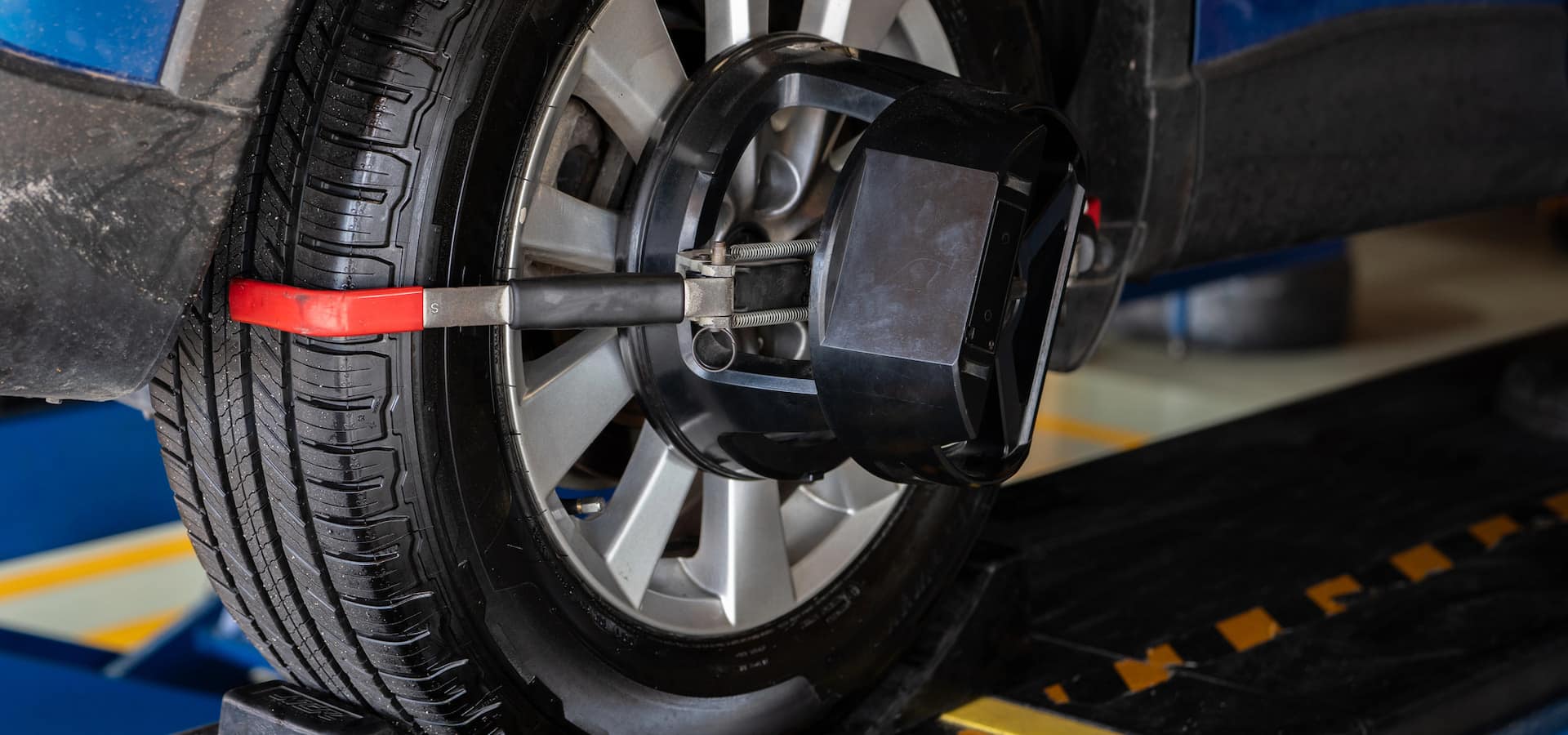
A wheel alignment sets three main angles – camber, caster, and toe – so all four tires point the way the chassis is designed to run. On a Chevrolet, we mount the vehicle on a rack, attach sensor heads to each wheel, and adjust the factory hardware until every angle lands inside GM's spec range for that platform.
What separates a Chevrolet-correct alignment from a generic one comes down to the details built into each platform:
- Ride-height first – On Colorado torsion-bar and any lifted/lowered truck, camber and caster follow ride height, so height must be set to spec before angles are touched.
- Four-wheel geometry – Equinox, Traverse, Malibu, and Cruze have adjustable rear toe that a front-only alignment ignores. We correct the thrust angle so the vehicle tracks straight.
- Steering angle sensor reset – Vehicles with StabiliTrak and EPS need the SAS centered and relearned so stability control reads true, a step that requires GM-compatible scan software.
- Correct torque and cam-bolt procedure</str
How We Diagnose Wheel Alignment Issues on Chevrolet
Chevrolet alignment problems rarely start at the alignment rack – they start with a worn control arm bushing or a sagging spring that generic shops never check before pulling angles. On platforms like the Silverado GMT900/K2XX trucks and the Malibu/Cruze compacts, we look for the root cause first.
- Pull codes and steering angle data with a GM-capable scan tool, checking the SAS (steering angle sensor) and any electric power steering faults that skew centering.
- Road test to feel for pull, wander, or off-center steering wheel – often a giveaway on Equinox and Traverse crossovers.
- Lift and inspect tie rod ends, ball joints, and control arm bushings by hand for play – rear cradle bushing wear is common on FWD Chevy sedans.
- Measure tire wear patterns; feathering points to toe, inner-edge wear points to camber or a bent component.
- Mount on the alignment rack and capture live camber, caster, and toe against Chevrolet factory specs for that VIN and trim.
The scan and rack readings tell us what's adjustable versus what's worn beyond spec. From there we build a clear repair plan with a straightforward quote – no surprise add-ons, just what your Chevrolet actually needs to track straight.
Wheel Alignment on Chevrolet: Repair vs. Replacement
Not every out-of-spec Chevrolet needs new parts. The right call depends on what's still serviceable.
- Straight adjustment (repair): When components are tight and only the angles have drifted – common after hitting a Denver pothole – we simply reset toe, and adjust camber/caster where the factory provides slots or cam bolts.
- Partial replacement: A single worn outer tie rod on a Silverado or a cracked lower control arm bushing on a Cruze gets replaced, then the alignment is dialed in around the fresh part while the rest of the assembly stays.
- Full assembly replacement: When wear cascades – ball joint, bushing, and control arm all sloppy on a high-mileage Equinox – replacing the complete control arm is often smarter than chasing individual parts, especially on safety-critical steering links.
We show you the measurements and the worn parts, explain which path restores proper geometry, and let you decide. The goal is a Chevrolet that drives true and protects your tires – not the biggest possible ticket.
How to Make Your Chevrolet Wheel Alignment Last Longer
A fresh alignment holds up when the components underneath stay healthy. A few habits go a long way on Colorado roads.
- Ease over potholes, curbs, and rough construction zones – hard impacts knock toe and camber out fast on Chevy struts and tie rods.
- Avoid overloading the bed or cargo area beyond rating; sustained heavy loads accelerate rear bushing and spring wear on trucks and crossovers.
- Rotate tires on Chevrolet's recommended interval and keep pressures at the door-jamb spec – uneven wear masks and worsens alignment drift.
Owner checks that are safe to do yourself:
- Watch for a steering wheel that sits off-center or a pull to one side.
- Listen for clunks over bumps that hint at ball joint or bushing wear.
- Inspect tire edges monthly for feathering or inner-shoulder wear.
Use OEM-grade suspension and steering parts and keep power steering software current on newer models – aftermarket bargain arms often shift geometry. Leave ball joint, tie rod, and strut work to the shop; those are safety-critical. Bring your Chevrolet in at the first sign of pull and we'll keep it tracking straight for the long haul.
What to Expect When You Bring Your Chevrolet In
A Chevrolet alignment that ignores the steering angle sensor (SAS) relearn is only half done. On electric-power-steering platforms like the Cruze, Malibu, Equinox, and later Silverado/Colorado, the SAS has to be reset with a scan tool after any toe or camber change – skip it and the lane-keep and stability systems fight the wheel. Here is how a visit flows:
- Drop-off or appointment – Schedule ahead or bring it by. Shuttle and loaner options are available, and after-hours pickup can be arranged so your schedule stays intact. Clear valuables from the cabin; we secure the vehicle either way.
- Initial inspection – We check tire wear patterns, tie rod ends, control arm bushings, and rack condition before touching the alignment rack, since worn parts skew every reading.
- Written estimate – You get a clear breakdown of what the alignment needs and any related steering or suspension work, with no add-ons you didn't approve.
- The work – We set toe, camber, and caster to GM factory specs and keep you updated on anything we find along the way.
- Pickup walkthrough – We review before-and-after alignment numbers with you.
Every job ends with a road test and a scan-tool re-check of the SAS and driver-assist calibrations. If the wheel feels off-center or the car pulls after you leave, bring it back and we'll recheck it.
Why Choose Elevation Auto Repair for Chevrolet Wheel Alignment
We align Chevrolets with the platform quirks in mind, not just generic numbers on a screen. Rear toe drift on independent-rear Malibu and Impala models eats inner tire edges fast, and heavier trucks like the Silverado 1500 need caster set correctly to stop wander at highway speed.
- Brand-specific knowledge – We track Chevrolet TSBs and EPS software updates that affect steering feel and centering, so a bad alignment complaint doesn't turn into a repeat visit.
- Full ownership – Diagnosis, any tie rod or bushing repair, the alignment itself, and the post-repair SAS relearn all happen here under one roof.
- Real verification – Road test plus scan-tool confirmation that stability control and lane-keep read a centered wheel.
As your Denver dealership alternative, we handle everything from the alignment to the worn front-end parts causing it – honest diagnostics, clear communication, and repairs built to protect your tires and handling for the long haul.
Our Chevrolet Services
- Air Conditioning AC Repair
- Battery Repair Replacement
- Brake Repair & Brake Fluid Change
- Check Engine Light Diagnostics
- Clutch Repair & Replacement
- Coolant Leak Repair
- Cooling System Repair
- Drive Shaft Repair
- Engine Repair
- Exhaust & Catalytic Converter Repair
- Head Gasket Repair & Replacement
- Oil Change
- Oil Leak Repair
- Scheduled Service Maintenance
- Steering Repair
- Suspension Repair
- Cambelt Timing Belt Replacement
- Transmission Repair
- Tune Up