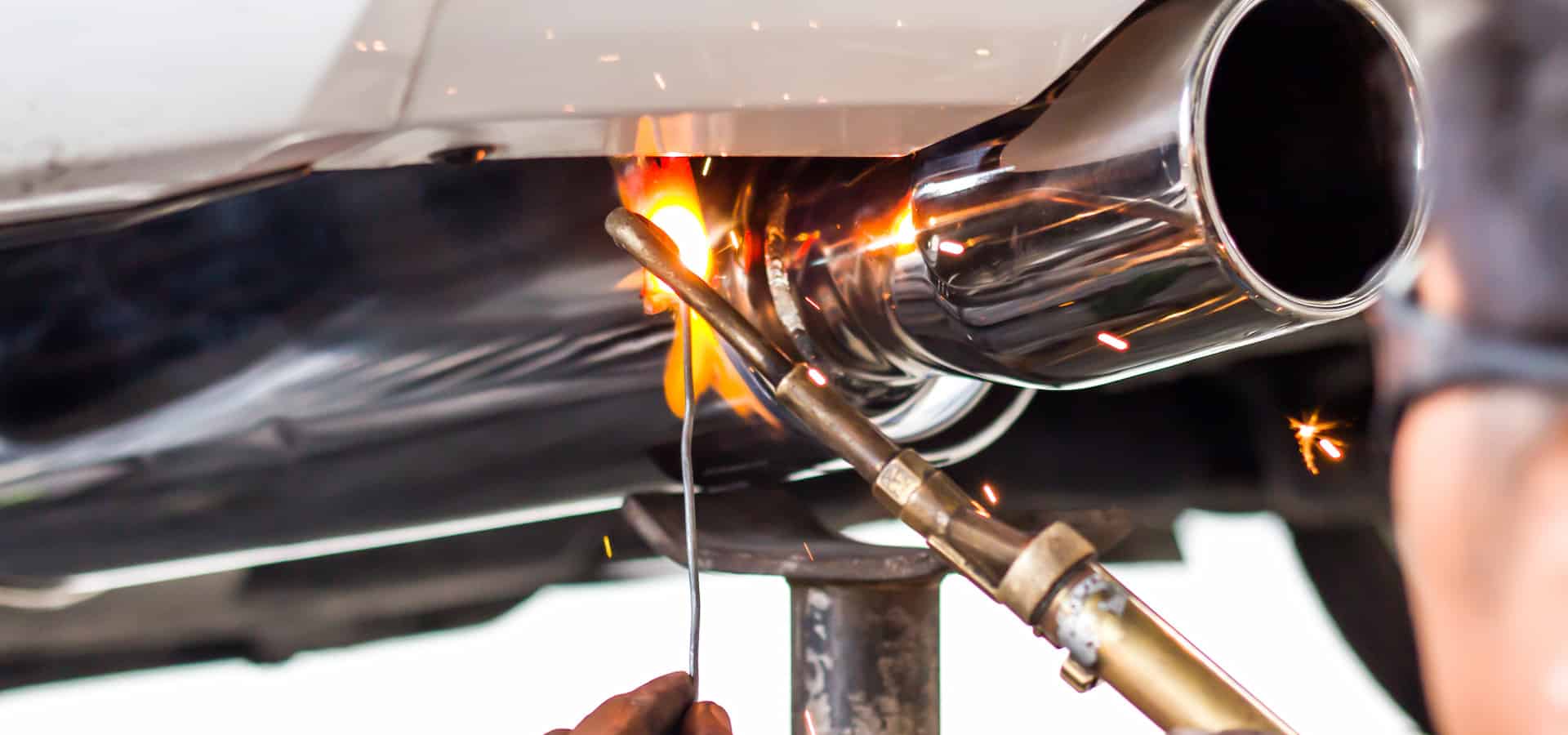
Buick Exhaust & Catalytic Converter Repair at Elevation Auto Repair
A customer rolled into the shop with a 2013 Enclave, worried the deep drone under acceleration meant a blown engine. The real culprit was a cracked flex pipe feeding a partially clogged converter – a fix that cost far less than the disaster she feared. That kind of fast, honest diagnosis is what Buick owners deserve.
Exhaust and catalytic converter work on a Buick isn't a bolt-off, bolt-on job. Many V6 Buicks route dual close-coupled converters tight against the manifolds, and the downstream oxygen sensor readings have to fall within GM's expected catalyst efficiency window or the check engine light returns. We pull live O2 sensor data through GDS2/Tech2-style scan procedures rather than guessing, and we torque flanges and sensor bungs to spec so nothing seeps or shears.
Getting it right on a Buick also means matching converter substrate and sensor placement to the specific engine calibration – a cheap universal cat often trips a P0420 within days.
- Data-driven diagnosis using upstream and downstream O2 readings – no parts thrown at the problem
- OEM-grade or CARB-compliant converters that satisfy Buick's catalyst efficiency monitor
- Proper flange, gasket, and sensor torque to prevent leaks and codes
- Fast turnaround so you're back on Denver roads quickly
Symptoms – How to Know You Need This Service
Buick exhaust problems usually announce themselves through your ears, nose, and dash before they leave you stranded. Here's what to watch for:
- A rotten-egg or sulfur smell from the tailpipe – a classic sign of a failing catalytic converter
- A deep drone or roar under acceleration, pointing to a cracked flex pipe or leaking gasket
- A rattle from underneath, often a broken converter substrate or loose heat shield
- A check engine light with P0420/P0430 catalyst efficiency codes
- Noticeably sluggish acceleration or reduced fuel economy from a clogged converter
- A hissing or ticking near the manifold that changes with engine speed
- Failed emissions testing here in the Denver metro area
Schedule soon if you notice odors, mild drone, or a steady check engine light. Stop driving right away if you smell strong exhaust inside the cabin, see smoke, or feel excessive heat and power loss – a fully plugged converter can overheat and become a fire risk. Bring it in and we'll pinpoint the source fast.
Common Exhaust & Catalytic Converter Repair Issues on Buick Vehicles
Buick's lineup spans naturally aspirated V6s and turbocharged four-cylinders, and each has its own exhaust quirks. These are the patterns we see most often in the shop.
- Catalytic converter efficiency codes (P0420/P0430) – Common on 3.6L LFX/LLT V6 Enclave, LaCrosse, and Regal models as they pass higher mileage. The downstream O2 sensor reports the cat is no longer scrubbing efficiently.
- Turbo-related cat contamination on 2.0L LTG Regal GS and Verano turbo – Oil consumption or a rich condition from the direct-injection setup can coat and clog the converter substrate early.
- Rusted flex pipes and mid-pipe corrosion – Colorado's salted winter roads eat through the flexible coupling behind the manifold, especially on 2008-2017 Enclave and 2010-2016 LaCrosse.
- Loose or corroded heat shields – That idle rattle on the Encore and Envision usually comes from spot welds giving way to rust.
- Exhaust manifold gasket leaks – The 3.6L V6 develops ticking leaks at the manifold-to-head joint as gaskets age and studs loosen.
- Failed O2 and air-fuel sensors – A lazy upstream sensor on turbo Buicks throws fuel trims off and can mimic a bad cat.
Which Buick Models We See for Exhaust & Catalytic Converter Repair
We service the full modern Buick lineup and many earlier models. If your car isn't listed, call – we likely still handle it.
- Enclave (2008–2017 first-gen, 2018+ second-gen) – 3.6L LLT/LFY V6 with dual close-coupled converters that commonly clog with mileage
- LaCrosse (2010–2016, 2017–2019) – 3.6L V6 and 2.4L eAssist; downstream O2 sensor and flex-pipe cracking are frequent finds
- Regal (2011–2017 GS/Turbo, 2018–2020 TourX/Sportback) – 2.0L turbo LTG models where turbo-back exhaust heat stresses gaskets and mid-pipe joints
- Encore & Encore GX (2013–2022) – 1.4L turbo LUV/LE2 and 1.3L turbo three-cylinder; compact packaging makes proper converter fitment important
- Verano (2012–2017) – 2.4L and 2.0L turbo, shared Ecotec exhaust concerns
- Envision (2016–2020, 2021+) – 2.0L/2.5L with catalyst efficiency codes on higher-mileage examples
- Lucerne, Century, LeSabre (older 3.8L V6) – durable but prone to rusted flanges and manifold-side leaks
Turbocharged models (Regal GS, Encore, Verano Turbo) run hotter and often need turbo-outlet and mid-pipe attention alongside the converter. We're candid about limits – heavily rust-damaged exhaust on very old models may need full-system replacement rather than spot repair, and we'll tell you plainly which route saves you money long term.
A Denver Enclave owner rolls in with a rattle that sounds like a coffee can full of gravel every time the engine idles at a stoplight. Nine times out of ten, that noise traces back to a failing catalytic converter or a heat shield that has rusted loose after too many winters of road salt. Fast diagnosis is where we shine – a quick chassis scan and a look under the car usually tells us whether we're chasing a substrate, a sensor, or a leaking flex pipe. Here's how we approach exhaust and catalytic converter work on Buick vehicles.
Causes & Risks – What Happens if Ignored
Most Buick exhaust problems come down to three factors: age, Colorado road salt, and the operating conditions of turbocharged and direct-injection engines. A cat rarely dies on its own – it's usually killed by an upstream issue like an oil leak, misfire, or rich fuel condition feeding it contaminants. Ignore the root cause and you replace the converter twice.
Waiting turns a simple sensor or gasket job into something far bigger. A small exhaust leak this month becomes a warped flange and a scorched wiring harness by spring.
- Ignoring a P0420 code for months lets the substrate keep breaking apart, eventually clogging and choking engine power.
- A cracked flex pipe left unrepaired stresses the mid-pipe and can snap it, dropping exhaust under the cabin.
- An unaddressed misfire on the 3.6L V6 dumps raw fuel into a healthy cat and destroys it in short order.
- Rich fueling on the 2.0L turbo overheats and melts the converter core, turning a sensor fix into a full cat replacement.
- Loose heat shields eventually contact rotating or hot components, creating a fire and burn risk.
Safety Impact – Why Exhaust & Catalytic Converter Repair Matters
A compromised exhaust isn't just a noise problem. Leaks ahead of the cabin can push carbon monoxide toward passengers, and a clogged converter starves the engine right when you need power to merge or climb an on-ramp. Failing O2 sensors also feed bad data to fuel and emissions systems, and on some Buicks a persistent misfire can trigger reduced-power modes that affect how the car responds.
- Stop driving now: exhaust fumes smell inside the cabin, loud roaring under the floor, or a burning smell with visible smoke.
- Stop driving now: sudden power loss with a flashing check-engine light – raw fuel may be reaching the cat.
- Schedule soon: a steady P0420 code, mild rattle at idle, or a slightly louder exhaust note.
- Schedule soon: failed emissions test or a check-engine light without drivability changes.
There's also a liability side – driving with a known exhaust defect that leads to a fire or emissions violation can complicate insurance claims. We prioritize fast turnaround on these so you're not gambling on your safety.
How Buick Exhaust & Catalytic Converter Repair Actually Works
The exhaust system routes gases from the manifold through the catalytic converter, where precious-metal coatings convert harmful compounds, then out through the muffler. Upstream and downstream O2 sensors constantly compare readings so the ECM can judge cat efficiency and trim the fuel mixture. On turbocharged Buicks the converter sits close-coupled to the turbo, so heat management and sensor placement differ from a generic V6 layout.
What makes Buick work different is the reliance on OEM software and correct parts matching:
- OEM-grade converters – Buick's efficiency thresholds are tuned tight, so cheap universal cats often re-trigger P0420 codes. We match substrate specs to the platform.
- GDS2 diagnostic tooling – GM's factory software lets us read live fuel trims and O2 response to confirm whether the cat, a sensor, or an upstream leak is the real culprit.
- Torque and sequence specs – Manifold studs and flange bolts on the 3.6L V6 have specific torque values to prevent
A Buick LaCrosse rolls in with a droning rattle at idle and a check engine light throwing a P0420. The owner assumed the whole exhaust was shot. After a quick look, the real culprit was a cracked flex pipe upstream of a still-healthy converter – a fast fix that saved a lot of money. That's the difference a real diagnosis makes.
How We Diagnose Exhaust & Catalytic Converter Repair Issues on Buick
Getting to the root cause quickly is what keeps a Buick exhaust job from turning into a guessing game. Here's how our technicians work through it.
- Pull codes with a full scan. We connect a bidirectional scan tool to read GM Global A/B network data – P0420/P0430 (catalyst efficiency), P0138/P0141 (downstream O2 sensor and heater circuit), and misfire counts common on the 3.6L LFX/LGX V6 and the 2.0T LTG turbo four.
- Review live data. We compare upstream and downstream oxygen sensor waveforms to confirm whether the converter is actually failing or a lazy sensor is faking the code – a frequent false alarm on high-mileage Enclave and Verano models.
- Visual inspection on the lift. We check flex pipes, weld seams, hanger rubber, and the mid-pipe for rust perforation, which shows up on Colorado-driven Buicks after road salt exposure.
- Physical measurements. Backpressure testing and infrared temperature readings across the converter reveal internal restriction from a melted or clogged substrate.
- Road test. We confirm the drone, hiss, or rattle under load and at the RPM range where the owner hears it.
Once we've pinpointed the failing component, you get a clear written plan and quote – no filler repairs, just what your Buick actually needs.
Exhaust & Catalytic Converter Repair on Buick: Repair vs. Replacement
Not every exhaust complaint means a new converter. The right call depends on what's actually worn.
- Genuine repair: A leaking gasket, a loose clamp, a broken hanger, or a single failed downstream O2 sensor triggering a P0141 – often the fix on a Regal or LaCrosse whose converter still tests healthy.
- Partial replacement: A cracked flex pipe or a rusted-through mid-pipe section can be replaced while keeping a good converter and rear muffler. This is common on older Lucerne and Enclave exhaust systems where corrosion hits one section first.
- Full replacement: When the converter substrate is melted from a chronic misfire, when internal rattle confirms a broken monolith, or when rust has compromised multiple sections at once. We also replace when converter efficiency codes persist after upstream causes are ruled out on the 3.6L V6.
We walk you through each option with the data behind it, so you decide based on facts – not pressure to buy the biggest job on the menu.
How to Make Your Buick Exhaust & Catalytic Converter Repair Last Longer
Good habits keep a fresh exhaust system healthy far longer, especially in Colorado's salt and altitude conditions.
- Drive to full temperature. Short trips leave condensation inside the exhaust, accelerating rust on Buick mid-pipes – let the engine reach operating temp when you can.
- Address misfires fast. A rough-running 3.6L or 2.0T dumps raw fuel into the converter and can melt the substrate quickly. Don't ignore a flashing check engine light.
- Rinse the underbody after winter driving to slow corrosion on hangers and pipe seams.
Owner-friendly maintenance that helps:
- Listen for new rattles, hissing, or drone and report changes early.
- Check for rust streaks or hanging pipes during oil changes.
- Keep the check engine light from being ignored – code it early.
- Use OEM-spec oxygen sensors and proper fuel; keep GM software updates current, since ECM calibrations affect fuel trim and catalyst protection.
Safe DIY is limited to visual checks and monitoring. Leave welding, converter replacement, and sensor diagnostics to us – exhaust work involves heat, emissions compliance, and safety-critical fitment best handled in the shop.
What to Expect When You Bring Your Buick In
A LaCrosse owner rolled in recently after a droning rattle turned into a check engine light and a P0420 code. Turned out the rear catalyst was breaking down internally – the kind of thing you can hear before a scan tool confirms it. Here's how a visit typically flows:
- Drop-off or appointment – Schedule ahead or leave the vehicle with us. Grab personal items from the cabin; we'll keep the keys and paperwork organized.
- Initial inspection – We pull codes, inspect the exhaust from manifold to tailpipe, check for cracked flex pipes, rusted-through resonators, and failed oxygen sensors.
- Written estimate – You get a clear breakdown of what the exhaust or catalytic converter repair involves before any work starts.
- Repair with updates – We text or call as the job moves along, so there are no surprises when you return.
- Pickup walkthrough – We show you the old parts, explain what we found, and answer questions.
Shuttle and loaner options help you stay on schedule, and after-hours pickup is available when your day runs long. Before we hand back the keys, every Buick gets a road test and a scan-tool re-check to confirm the codes clear and readiness monitors set. If anything feels off afterward, bring it back and we'll re-verify our work.
Why Choose Elevation Auto Repair for Buick Exhaust & Catalytic Converter Repair
Exhaust work on Buicks isn't a one-size-fits-all job. A 3.6L LFX/LGX V6 in an Enclave or LaCrosse routes exhaust differently than the 2.0T LTG in a Regal, and catalyst placement, sensor threading, and gasket specs all vary by platform.
- Buick-specific knowledge – We reference GM TSBs and software updates that affect catalyst efficiency codes, and we check for PCM calibration issues before condemning a converter on Lambda-platform crossovers.
- Accurate diagnosis – A P0420 or P0430 doesn't always mean a bad cat. We test upstream and downstream O2 sensors, look for exhaust leaks and rich fueling, and rule out cheaper fixes first.
- End-to-end ownership – Diagnosis, repair, and post-repair verification stay under one roof, so nothing gets handed off or lost in translation.
We torque flanges and sensors to spec, use quality gaskets and hardware built for Denver's road-salt corrosion, and confirm the fix with a scan-tool re-check. You leave knowing the problem was solved – not just the light reset.
Our Buick Services
- Air Conditioning AC Repair
- Battery Repair Replacement
- Brake Repair & Brake Fluid Change
- Check Engine Light Diagnostics
- Clutch Repair & Replacement
- Coolant Leak Repair
- Cooling System Repair
- Drive Shaft Repair
- Engine Repair
- Head Gasket Repair & Replacement
- Oil Change
- Oil Leak Repair
- Scheduled Service Maintenance
- Steering Repair
- Suspension Repair
- Cambelt Timing Belt Replacement
- Transmission Repair
- Tune Up
- Wheel Alignment