Buick Wheel Alignment at Elevation Auto Repair
Get a Buick alignment wrong and the receipt shows up months later in cupped tires, a crooked steering wheel, and premature wear on control arm bushings. Buicks like the Enclave and Regal ride on GM platforms with sensitive steering geometry, and a rushed alignment leaves money on the table every time you replace tires early.
A proper alignment sets camber, caster, and toe back to GM factory specs and re-centers the steering angle so the system reads level. Doing it right on a Buick is different from a generic rack-and-go shop for a couple of reasons:
- Electric power steering calibration – Regal (Epsilon II) and later Enclave models often need a steering angle sensor reset after alignment, or the lane-keep and stability systems throw faults.
- Platform-specific eccentric adjusters – rear toe and camber on the Lambda-platform Enclave use cam bolts that demand correct torque and a settled suspension for repeatable numbers.
We move fast without cutting corners. Here's what you can expect:
- Digital pre-alignment reading so you see the before-and-after numbers
- Suspension and steering inspection to catch worn tie rods or bushings first
- Adjustment to GM factory specs, not a shortcut range
- Steering angle sensor reset when your model calls for it
Symptoms – How to Know You Need This Service
Alignment problems announce themselves early if you know what to listen and feel for. You may notice:
- Steering pull – the car drifts left or right on a flat, straight road when you relax your grip.
- Off-center steering wheel – you're holding it slightly crooked to drive straight.
- Uneven tire wear – feathered edges or inside-shoulder scrubbing, common on Enclave rears with worn cam bolts.
- Vibration through the wheel that changes with speed, often paired with tire wear.
- Squealing on turns from tires fighting bad toe settings.
- Lane-keep or stability warning lights on later Regal and Enclave models after curb impacts.
- Loose, wandering feel that has you constantly correcting on the highway.
Schedule soon for pull, off-center wheel, or uneven wear – these cost you tire life daily. Stop driving and call us if you feel sudden looseness, clunking over bumps, or the car darts unpredictably after hitting a pothole or curb. That points to a damaged tie rod or control arm, not just alignment.
Common Wheel Alignment Issues on Buick Vehicles
A botched alignment on a Buick doesn't just chew through tires – it masks worn suspension parts and sends you back for the same complaint weeks later. Getting it right the first time means reading the platform, not just the printout. Here's what we see roll through the bay on Buick models.
- Inside-edge tire wear on 2010-2016 LaCrosse and 2011-2017 Regal (Epsilon II platform): Rear camber and toe drift as the multi-link bushings age, producing feathered inner tread that owners often blame on tire quality.
- Steering pull and off-center wheel on 2008-2017 Enclave (Lambda platform): Heavy front-end weight loads the lower control arm bushings, shifting front toe and caster after Denver pothole season.
- Front camber wander on 2013-2022 Encore (Gamma II platform): The compact strut design is sensitive to curb strikes, throwing camber out on one corner while the other reads fine.
- Post-repair misalignment on Verano and Regal after strut or control-arm work: These platforms require a re-set of toe and thrust angle any time front suspension is disturbed.
- Rear thrust-angle error on Buick sedans: A shifted rear axle line makes the car "dog-track" and forces the steering wheel off-center even with front specs correct.
- Electric power steering (EPS) complaints mistaken for alignment: Later Buicks use rack-mounted EPS, and a lazy return-to-center feel often traces to alignment angles rather than the steering motor.
Which Buick Models We See for Wheel Alignment
We align the full modern Buick lineup and most of the older sedans still on Denver roads. Find your car below:
- Enclave (Lambda, 2008–2017; C1XX, 2018–present) – frequent rear cam-bolt adjustment; the newer C1XX platform needs steering angle reset after service.
- Regal (Epsilon II, 2011–2017; E2XX/Opel Insignia-based, 2018–2020) – GS and TourX variants with adaptive setups and AWD get extra attention to rear toe.
- LaCrosse (2010–2016; 2017–2019) – electric steering models require sensor recalibration after alignment.
- Encore (2013–2022) and Encore GX (2020–present) – compact platforms sensitive to toe for even front-tire wear.
- Envision (2016–2020; 2021–present) – AWD variants aligned to spec front and rear.
- Verano (2012–2017) – Delta II platform, straightforward four-wheel alignment.
- Older Century, LeSabre, and Lucerne – we handle these front-drive sedans, though parts availability for worn steering components can affect turnaround.
AWD Regal TourX and Envision models take a bit longer because rear geometry is fully adjustable. If you're driving a rare imported or heavily modified Buick with aftermarket suspension, call ahead so we can confirm we can dial it to spec before you come in.
Causes & Risks – What Happens if Ignored
Most Buick alignment problems trace back to Colorado's rough roads, curb contact, and the simple fact that rubber bushings soften with age and heat cycles. Front-heavy models like the Enclave accelerate that wear. Once the geometry drifts, the damage compounds fast.
Waiting on an obvious pull or a crooked wheel rarely stays a cheap fix. What starts as a quick toe adjustment can turn into new tires and worn suspension components.
- Ignoring inner-edge wear on a LaCrosse or Regal for a few months typically ruins otherwise good tires down to the belts.
- A steady pull on the Enclave overloads one side, wearing the outer control-arm bushing and eventually the wheel bearing.
- Uneven scrub on the Encore's front tires stresses tie-rod ends and can loosen the outer joint over time.
- Continued dog-tracking from a rear thrust-angle error wears both axles unevenly and hides a bent trailing component.
- Neglected alignment paired with worn shocks lets the car float in crosswinds, a real hazard on I-70 and mountain grades.
The safety line gets crossed once the car darts under braking or the steering feels vague at highway speed – that's the point where a simple adjustment has already become a parts job.
Safety Impact – Why Wheel Alignment Matters
Alignment ties directly into the systems that keep a Buick planted. When geometry drifts, the electronic stability control, traction control, and ABS all work against a chassis that no longer tracks straight, and the steering angle sensor can log a false center.
- StabiliTrak and traction control: A bad thrust angle feeds the yaw sensor conflicting data, so the system may intervene late or unnecessarily.
- Braking stability: Uneven tire wear and a pulling chassis lengthen stopping distance and can pull the car out of its lane under hard braking.
- Steering response: An off-center wheel and vague return-to-center dull how quickly you can react to an emergency swerve.
Stop driving and schedule now if:
- The car darts or pulls hard when you brake.
- You feel wandering or a shimmy above highway speed.
- A tire shows cords or the tread edge is gone.
Schedule soon if: the wheel sits slightly off-center, tires wear a touch uneven, or the car drifts gently on level road. Documenting an alignment on a known-worn suspension also protects you if a component failure is ever questioned after an incident.
How Buick Wheel Alignment Actually Works
A proper Buick alignment sets three angles at each corner – camber, caster, and toe – then verifies the rear thrust angle so the wheel ends up centered and the car tracks true. On modern Buicks the job doesn't end at the rack; the electronics have to agree with the mechanical fix.
Because most current Buicks run electric power steering and a full suite of driver-assist sensors, a corrected alignment often requires a steering angle sensor relearn so the computer recognizes the new center. Skip that step and you get a straight car with a warning light.
- Steering angle sensor relearn: Required after adjustment on EPS-equipped Buicks so StabiliTrak reads true center.
- Thrust-angle first approach: We square the rear before touching front toe, which many quick-lube shops skip.
- Platform torque specs: Epsilon II and Lambda cam bolts and tie-rod jam nuts get set to spec so the settings hold.
- ADAS awareness: On Buicks with forward cameras or lane-keep, alignment changes can require sensor calibration to keep those systems accurate.
That combination of factory-level tooling, correct sequence, and honest diagnostics is why we get Buicks aligned right and back on the road fast – no guesswork, no rep
A botched alignment on a Buick doesn't just wear tires unevenly – it masks worn suspension parts and lets the real problem keep spreading. On front-drive platforms like the Enclave, LaCrosse, Regal, and Verano, a pulling steering wheel or feathered tire edge often traces back to worn control arm bushings or a tired outer tie rod, not the alignment itself. We sort out the root cause fast so you're not paying twice.
How We Diagnose Wheel Alignment Issues on Buick
Getting the cause right the first time is what keeps your Buick straight and your tires even. Here's the order we work in:
- Owner interview and road test – We confirm the symptom: steering pull, off-center wheel, wander, or a cupping/chirping noise on Encore and Envision models.
- Scan for chassis codes – On newer Buicks with electric power steering and StabiliTrak, we pull codes and check the steering angle sensor and EPS data. A miscalibrated steering position sensor mimics a bad alignment.
- Suspension inspection on the lift – We check control arm bushings, ball joints, outer tie rod ends, and strut mounts. Front-drive Buicks are hard on lower control arm bushings, which throws camber and caster off.
- Tire and wear read – Inside-edge wear points to camber/toe; feathering points to toe.
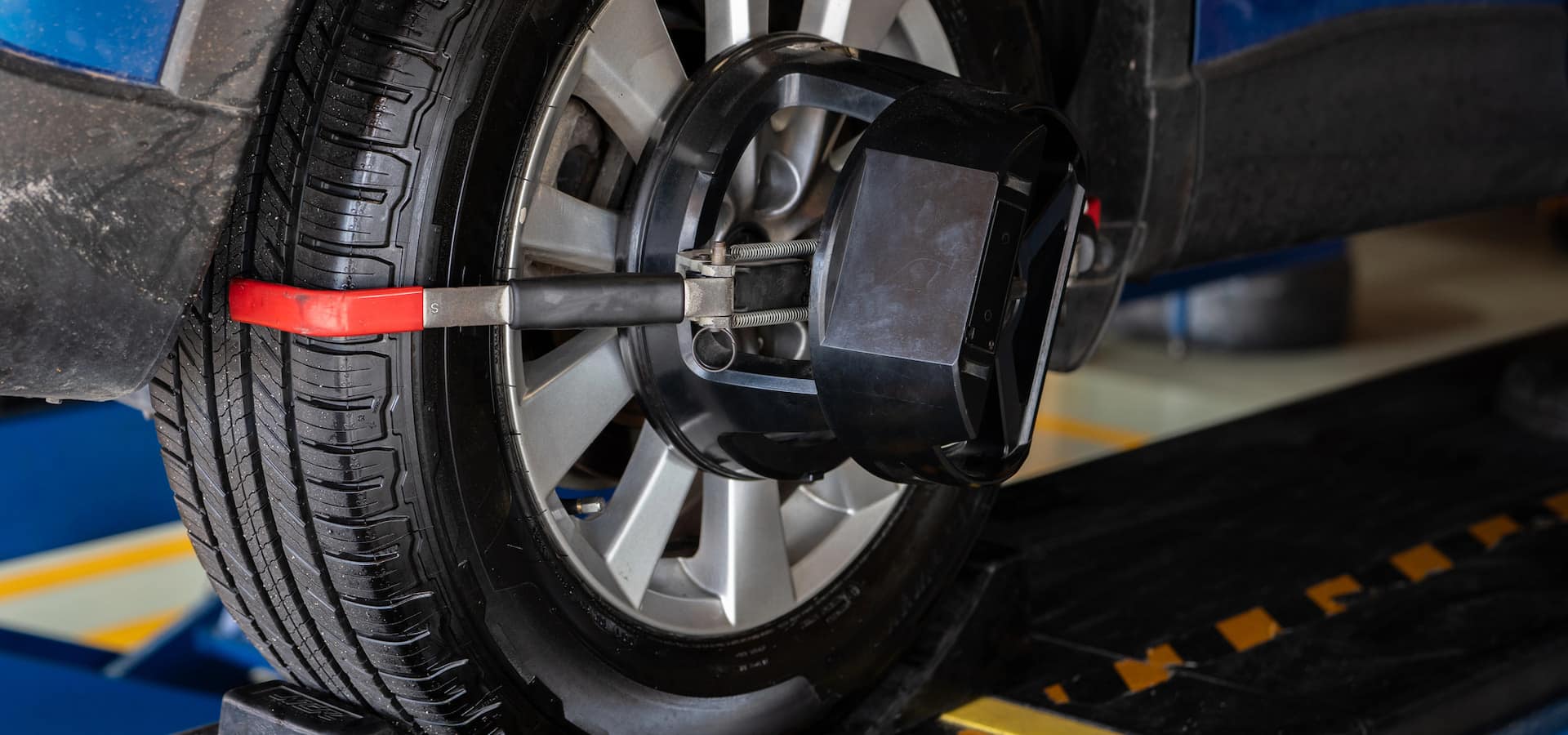
- Alignment rack measurement – We put it on the rack and compare live camber, caster, and toe against Buick's factory specs before adjusting anything.
- Post-alignment calibration – Where equipped, we reset the steering angle sensor and verify StabiliTrak is happy.
Once we know whether it's a pure alignment or a worn part driving it, you get a clear plan and a straight quote before we touch the wheel – no surprises.
Wheel Alignment on Buick: Repair vs. Replacement
Not every misaligned Buick needs new parts. We match the fix to what the components are actually telling us.
- Adjustment only (true repair) – If the suspension is tight and toe or camber has simply drifted, we set it back to Buick spec. Common after curb strikes or new tire installs on LaCrosse and Regal.
- Partial replacement – A single worn outer tie rod end or a cracked control arm bushing gets replaced, then we align. On many Enclave and Traverse-platform units, the front lower control arm bushing wears while the rest of the arm is fine – we replace only what's needed.
- Full replacement – When a ball joint is loose, a strut is leaking, and bushings are shot together, piecemeal repair costs approach a full control arm or strut assembly. Safety-critical wear like a failing ball joint always gets addressed before any alignment is meaningful.
We show you the worn part, explain what stays serviceable, and let you decide with the full picture instead of pushing the biggest ticket.
How to Make Your Buick Wheel Alignment Last Longer
A fresh alignment holds up when the suspension underneath it stays healthy. A few habits go a long way on Denver roads.
- Ease off potholes and curbs – The single biggest cause of knocked-out toe and bent components. Slow down for our winter road damage.
- Watch your load – Consistently overloading an Enclave or Envision stresses rear bushings and shifts rear toe.
- Rotate tires on Buick's schedule – Even wear lets you catch alignment drift early.
- Listen and look – New clunks over bumps, a wandering feel, or a steering wheel that sits off-center are early warnings.
What you can safely do yourself:
- Check tire pressure and eyeball tread for inside-edge wear.
- Keep tire pressure at the door-jamb spec.
- Stay current on software and StabiliTrak updates during service visits.
Leave ball joints, tie rods, control arms, and the alignment rack itself to us – these are safety-critical and need OEM-grade parts and factory specs. Bring it in when something feels off and we'll get you back on the road straight and quick.
What to Expect When You Bring Your Buick In
A sloppy alignment on a Buick costs you fast – uneven wear on those wide touring tires, a steering wheel that fights center on I-25, and a stability system that starts throwing codes because the steering angle sensor no longer agrees with reality. Here's how we handle your visit from start to finish.
- Drop-off or appointment – Schedule ahead or bring it in. Grab a shuttle ride or ask about a loaner so your day keeps moving. Pull personal items from the cabin, though we treat everything left inside with care.
- Initial inspection – Before touching alignment specs, we check tie rod ends, ball joints, control arm bushings, and strut mounts. A worn component on an Enclave or LaCrosse will pull specs right back out if we skip this.
- Written estimate – You get a clear breakdown of what the numbers show and what needs correcting. No surprise add-ons.
- During the work – We text or call with updates. If we find a bent lower control arm or seized adjuster, you hear about it before we proceed.
- Pickup walkthrough – We show you before-and-after alignment readouts and explain what changed.
Every alignment ends with a road test and a scan-tool re-check of the steering angle sensor so the electric power steering and stability control read true. After-hours pickup is available. If the wheel feels off a mile down the road, bring it back – we make it right.
Why Choose Elevation Auto Repair for Buick Wheel Alignment
Buicks ride on GM Epsilon and C1XX platforms that share quirks worth knowing – the Regal and LaCrosse are sensitive to rear toe drift, and the Enclave and Encore rely on precise steering angle sensor calibration after any alignment or suspension work. We know where these cars go wrong.
- Brand-specific know-how – We reference Buick TSBs and required software updates for EPS and stability systems, not just generic toe-and-go numbers.
- Full component ownership – Diagnosis, worn-part replacement, and the alignment itself happen under one roof, so nobody's guessing what the last shop touched.
- Post-alignment calibration – We reset the steering angle sensor and verify lane-keep and traction inputs with factory-level scan tools before you leave.
You get honest diagnostics with no padded repair list, and a technician who understands why your Encore's tires cupped or why your LaCrosse tracks left. That's the difference between a quick pull correction and an alignment that actually holds.
Our Buick Services
- Air Conditioning AC Repair
- Battery Repair Replacement
- Brake Repair & Brake Fluid Change
- Check Engine Light Diagnostics
- Clutch Repair & Replacement
- Coolant Leak Repair
- Cooling System Repair
- Drive Shaft Repair
- Engine Repair
- Exhaust & Catalytic Converter Repair
- Head Gasket Repair & Replacement
- Oil Change
- Oil Leak Repair
- Scheduled Service Maintenance
- Steering Repair
- Suspension Repair
- Cambelt Timing Belt Replacement
- Transmission Repair
- Tune Up