Chrysler Battery Repair Replacement at Elevation Auto Repair
Modern Chrysler models don't treat the battery as a simple bolt-in part anymore. On platforms like the LX/LD 300 and the RU-generation Pacifica, the battery ties into the Intelligent Battery Sensor (IBS) and the body control module, which means a swap done without registration can leave you with erratic charging, stop-start faults, and premature failure of the replacement.
Battery replacement on these vehicles is about matching the correct group size and chemistry, then teaching the powertrain control module about the new battery so the smart charging strategy behaves. Skipping that step is where generic shops create repeat problems.
Two Chrysler-specific factors shape how we do this work:
- Many post-2011 Chryslers use an IBS on the negative terminal that requires a scan-tool battery reset so the alternator charges the new unit properly.
- Under-hood and remote battery locations – like the trunk-mounted setup on some 300 models – demand correct venting, hold-down torque, and terminal sealing to prevent corrosion and vibration failure.
What you can expect when you bring your Chrysler to us:
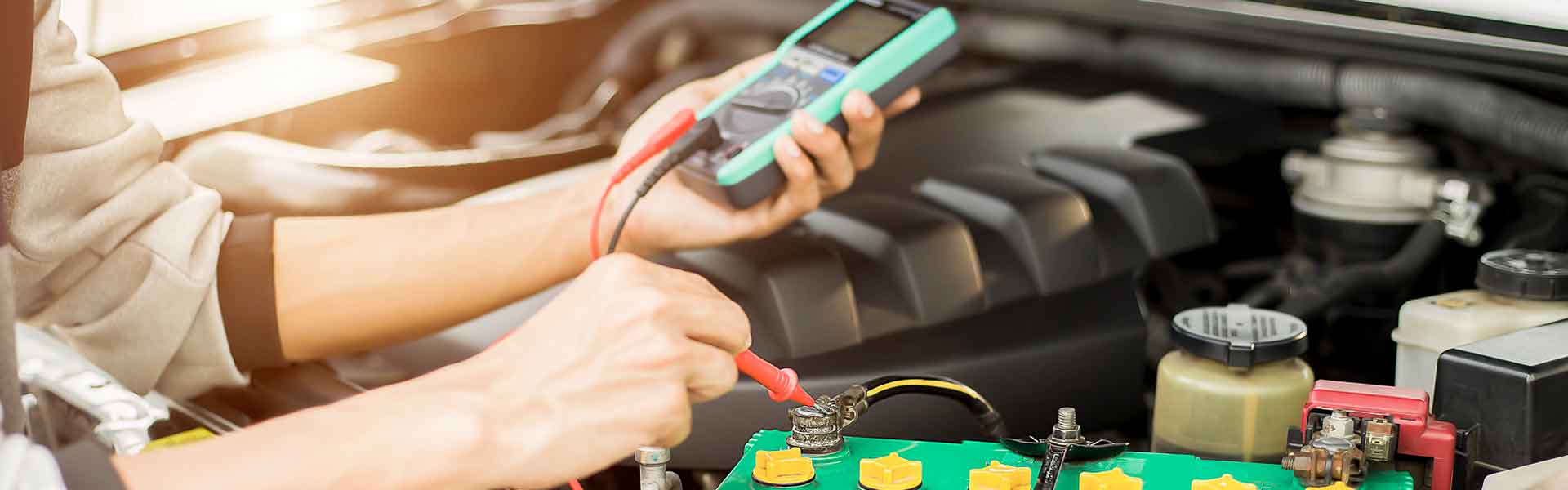
- Load testing and charging-system analysis before we recommend replacement
- Correct OEM-spec battery with proper CCA and case fitment
- Battery registration and reset using factory-level diagnostic tooling
- Terminal cleaning, hold-down torque to spec, and a corrosion-resistant seal
Symptoms – How to Know You Need This Service
Chrysler charging issues rarely announce themselves all at once. You may notice small quirks weeks before the car refuses to start.
- Slow, labored cranking – the starter drags before the engine catches, especially on cold Denver mornings.
- Stop-start disabled – the auto stop-start warning appears, since a weak battery disables the feature first.
- Dashboard battery or charging warning light, or flickering interior and dash lighting.
- Electronics acting strangely – Uconnect rebooting, power seats or memory settings resetting, or windows moving slowly.
- A swollen or leaking battery case, or a sulfur smell near the battery, which points to overcharging or internal failure.
- Corrosion buildup on the terminals causing intermittent no-starts.
- The car starts fine one day and needs a jump the next – classic sign of a battery losing its ability to hold charge.
Schedule soon if you're seeing slow cranks, warning lights, or stop-start faults. Stop driving and have the vehicle towed if you smell sulfur, see a swollen case, or spot leaking electrolyte – those signal a battery that can vent or fail dangerously.
Common Battery Repair Replacement Issues on Chrysler Vehicles
Chrysler batteries rarely fail in isolation. The charging system, IBS (Intelligent Battery Sensor), and parasitic draws all play a role, and each platform has its own quirks.
- IBS sensor faults on 2011+ 300 and Charger (LX/LD platform) – The negative-terminal battery sensor misreports state-of-charge, causing undercharging and premature battery death even with a good battery installed.
- Stop-start AGM battery wear on 2017+ Pacifica – These require a genuine AGM battery, not a flooded lead-acid unit. Installing the wrong type triggers stop-start faults and shortens battery life dramatically.
- Parasitic drain on 2011-2020 Town & Country and Grand Caravan (RT platform) – Power liftgate modules, radios, and TIPM-related draws keep drawing current after shutdown, killing batteries over a few days of sitting.
- TIPM-related charging complaints on 2011-2013 models – The Totally Integrated Power Module can cause erratic charging and no-start conditions that mimic a dead battery.
- Corroded terminals and cable degradation on higher-mileage Sebring and 200 – Under-hood heat and Colorado's dry-then-wet cycles accelerate terminal corrosion and increase resistance.
- Battery placement challenges – Some Chrysler models tuck the battery under the passenger seat or in tight fender wells, so a rushed replacement risks damaging surrounding trim or wiring.
Which Chrysler Models We See for Battery Repair Replacement
We service battery and charging-system work across the current Chrysler lineup and recent generations. If your car uses a smart charging strategy, we register the new battery so it lasts.
- Chrysler 300 (LX/LD, 2005–present) – includes trunk-mounted battery variants and the 300C 5.7L HEMI; remote location needs proper venting and torque.
- Chrysler Pacifica (RU, 2017–present) – gas models plus the Pacifica Hybrid, which uses a separate 12V auxiliary system alongside the high-voltage pack.
- Chrysler Town & Country (RT, 2008–2016) – common IBS and charging complaints as they age.
- Chrysler 200 (2011–2017) – both the JS and later UF platforms.
- Chrysler Voyager (2020–present) – shares the RU Pacifica architecture.
A few notes on where the work differs:
- Hybrid Pacifica service focuses on the 12V auxiliary battery – high-voltage pack work is handled separately.
- 2011-and-newer models with IBS require battery registration; pre-2011 vehicles usually don't.
If you have a rare import or older Chrysler product we don't commonly see, call first and we'll tell you honestly whether it's a fit before you make the trip.
Chrysler's electrical architecture leans heavily on integrated body control modules, intelligent battery sensors, and stop-start systems that make battery service more involved than a simple swap. From the Pentastar-equipped 300 and Pacifica to the Town & Country minivans, these vehicles talk to the battery constantly – and getting the replacement right means matching the exact chemistry, group size, and coding the module expects. That's where careful, platform-specific work separates a repair that lasts from one that leaves you stranded.
Causes & Risks – What Happens if Ignored
Most Chrysler battery problems trace back to a mix of Denver's temperature swings, short-trip driving that never fully recharges the battery, and the constant parasitic load from body modules. Age matters too – AGM batteries in stop-start applications degrade faster than owners expect.
Ignoring the early warning signs rarely stays cheap. A weak battery forces the alternator to overwork, and a Chrysler that isn't reading state-of-charge correctly will slowly cook a brand-new battery.
- Ignoring slow cranking for several weeks typically leads to a no-start that leaves you stranded, often at the worst time in cold weather.
- A failing IBS left unaddressed causes chronic undercharging, killing replacement batteries and eventually straining the alternator.
- Persistent parasitic draw on RT-platform minivans drains the battery deeply, and repeated deep discharges permanently reduce capacity.
- Corroded cables raise resistance, which can produce voltage drops that trigger random module faults and dashboard warning lights.
- What starts as an inexpensive battery replacement can grow into alternator, cable, and module diagnostics once secondary damage sets in.
Catching it early keeps the repair simple – and we'll pinpoint the real cause instead of just selling you another battery.
Safety Impact – Why Battery Repair Replacement Matters
On modern Chrysler vehicles, stable voltage feeds far more than the starter. Low or erratic battery power can disrupt the systems you rely on to stay in control.
- ABS and electronic stability control – Voltage drops can drop these modules offline, disabling anti-lock braking and traction assistance.
- Electric power steering – Undervoltage can cause steering assist to reduce or cut out, especially at low speeds.
- Airbag and restraint systems – Weak power can set restraint warning lights and compromise deployment readiness.
- Power sliding doors and liftgates – On minivans, low voltage causes unpredictable operation that can pinch or fail to latch.
Stop driving now if: your steering assist warning is on, the ABS and traction lights are lit together, or the vehicle stalls at idle. Schedule soon if: cranking is slow, the battery light flickers, or accessories reset intermittently. Addressing a known electrical fault before an incident also protects you from liability questions if a safety system fails when it mattered most.
How Chrysler Battery Repair Replacement Actually Works
A Chrysler battery isn't just a power source – it's a monitored component. The Intelligent Battery Sensor watches voltage, current, and temperature, then reports to the powertrain and body modules so the charging system can adjust output. Swap the battery without accounting for this and the vehicle may keep charging as if the old, tired battery were still installed.
That's why proper replacement on these platforms goes beyond loosening two terminals.
- Battery registration/relearn – Newer models need the new battery's type and capacity registered so the charging strategy resets correctly.
- AGM vs. flooded matching – Stop-start Pacificas require AGM chemistry and the correct group size, not a generic replacement.
- OEM-level scan tools – wiTECH-style software lets us clear stored faults, verify IBS operation, and confirm charging voltage under load.
- Torque and terminal care – Proper clamp torque and cl
Chrysler electrical systems demand more attention than a simple voltage check, especially on the 300 (LX/LD platform), Pacifica (RU), and Town & Country vans. Many of these vehicles run Intelligent Battery Sensors (IBS), stop-start systems, and body control modules that expect a specific battery type and a proper registration after any swap. Skip that step and you get erratic charging, false warnings, and premature failure – which is exactly why a Chrysler battery job is rarely just bolting in a new part.
How We Diagnose Battery Repair Replacement Issues on Chrysler
A dying battery on a Chrysler often masks a deeper charging or parasitic drain problem. We work through a repeatable sequence so the root cause gets found the first time.
- Interview and history – slow cranks, dash resets, stop-start not engaging, or a TIPM-related no-start on 2011-2014 models point us in specific directions.
- wiTECH scan – Chrysler's factory scan tool reads battery state-of-charge data from the IBS, logs BCM and PCM charging faults, and shows whether a prior battery was ever registered.
- Conductance and load testing – a midtronics-style test measures cold-cranking capacity against the OEM spec printed on the group-size label.
- Charging output check – we verify alternator ripple and regulated voltage under load, since a failing alternator kills a new battery fast.
- Parasitic draw measurement – an amp clamp on the negative cable catches modules that won't sleep, a frequent culprit on Uconnect-equipped vehicles.
- Visual and terminal inspection – corroded posts, swollen cases, loose hold-downs, and chafed cabling near the fender.
Once the data lines up, we hand you a clear repair plan and an honest quote – no guesswork, no padded add-ons.
Battery Repair Replacement on Chrysler: Repair vs. Replacement
Not every battery complaint means buying a battery. We match the fix to the actual fault.
- Genuine repair – cleaning corroded terminals, tightening a loose hold-down, replacing a fractured ground strap, or reseating a connector at the IBS often restores normal cranking on an otherwise healthy battery.
- Partial replacement – swapping a single failed component such as a corroded positive cable end, a worn battery tray, or the sensor pigtail while keeping a battery that still tests within spec.
- Full replacement – warranted when conductance testing shows collapsed capacity, the case is swollen from heat under the Pacifica's cowl, or a stop-start AGM battery has aged out. On these, we install the correct AGM or flooded type and register it through wiTECH so the charging strategy adapts.
When a repair cost creeps toward the price of a new battery, or when a weak battery threatens the TIPM and modules, replacement is the smarter long-term call. We lay out both paths, show you the test numbers, and let you decide – the goal is a reliable Chrysler, not the biggest invoice.
How to Make Your Chrysler Battery Repair Replacement Last Longer
Colorado's altitude, cold winters, and hot dry summers are hard on batteries. A few habits stretch the life of the work we do.
- Drive long enough to recharge – repeated short trips never let the alternator fully replenish the battery, especially with stop-start cycling.
- Manage accessory load – avoid running Uconnect, seat heaters, and lights with the engine off for extended periods.
- Watch for early signs – slower cranking on cold mornings, dimming interior lights, or stop-start dropping out are your cue to have it checked.
- Keep terminals clean and tight – a safe DIY task; inspect for white or green corrosion and confirm the hold-down is snug.
Use the correct battery group size and chemistry (AGM where Chrysler specifies it), keep BCM and PCM software current, and follow the factory service intervals. Terminal cleaning and visual checks are fine to do yourself. Leave battery registration, parasitic draw testing, and any charging-system diagnosis to the shop – guessing on these systems risks module damage. Bring it to us and we'll keep your Chrysler starting on the first turn, year-round.
What to Expect When You Bring Your Chrysler In
Modern Chrysler platforms – think 300, Pacifica, and the Ram-shared architecture – lean hard on their electrical systems, with body control modules, TIPM circuits, and stop-start hardware all watching battery health. That means a battery swap on these vehicles is rarely just a battery swap. Here is how a visit flows:
- Drop-off or appointment: Schedule ahead or bring it by. We confirm your concern – slow cranks, dash warnings, or repeated dead batteries – and log symptoms before touching anything.
- Initial inspection: We load-test the battery, check charging output from the alternator, inspect cables and grounds for corrosion, and scan for parasitic draw that drains Chrysler batteries overnight.
- Written estimate: You get a clear breakdown of parts and labor – including any needed battery registration or reset – before we proceed.
- During the work: We keep you updated by call or text, and we ask before adding anything unexpected.
- Pickup walkthrough: We review what we found and did, and hand back a vehicle that starts right.
Shuttle and loaner options are available depending on availability, and after-hours pickup can be arranged. Grab personal items from the console and glovebox, though we're careful with what stays behind. Before you leave, we road test and re-scan to confirm no stored codes remain, and if anything feels off afterward, bring it back and we'll recheck it.
Why Choose Elevation Auto Repair for Chrysler Battery Repair Replacement
Chrysler electrical gremlins have a reputation, and much of it traces back to the TIPM (Totally Integrated Power Module) on 2011–2014 platforms, along with stop-start systems that demand AGM batteries with proper capacity. Drop in a plain flooded battery and you invite repeat failures and false charging faults.
We handle the whole job in-house, from diagnosis to verification:
- We match the correct AGM or spec battery to your platform – wrong group size or chemistry causes charging-system complaints.
- We check for applicable Chrysler TSBs and software updates that address phantom drains and charging faults.
- We chase parasitic draws with a proper amp-draw test instead of guessing at "just the battery."
- We perform battery registration and BCM resets where the platform requires it, so the charging strategy adapts correctly.
As your Denver dealership alternative, we give you honest diagnostics and skip repairs you don't need. Every battery job ends with a post-repair scan and road test, so the fix holds and you're not back next week with the same dead battery.
Our Chrysler Services
- Air Conditioning AC Repair
- Brake Repair & Brake Fluid Change
- Check Engine Light Diagnostics
- Clutch Repair & Replacement
- Coolant Leak Repair
- Cooling System Repair
- Drive Shaft Repair
- Engine Repair
- Exhaust & Catalytic Converter Repair
- Head Gasket Repair & Replacement
- Oil Change
- Oil Leak Repair
- Scheduled Service Maintenance
- Steering Repair
- Suspension Repair
- Cambelt Timing Belt Replacement
- Transmission Repair
- Tune Up
- Wheel Alignment