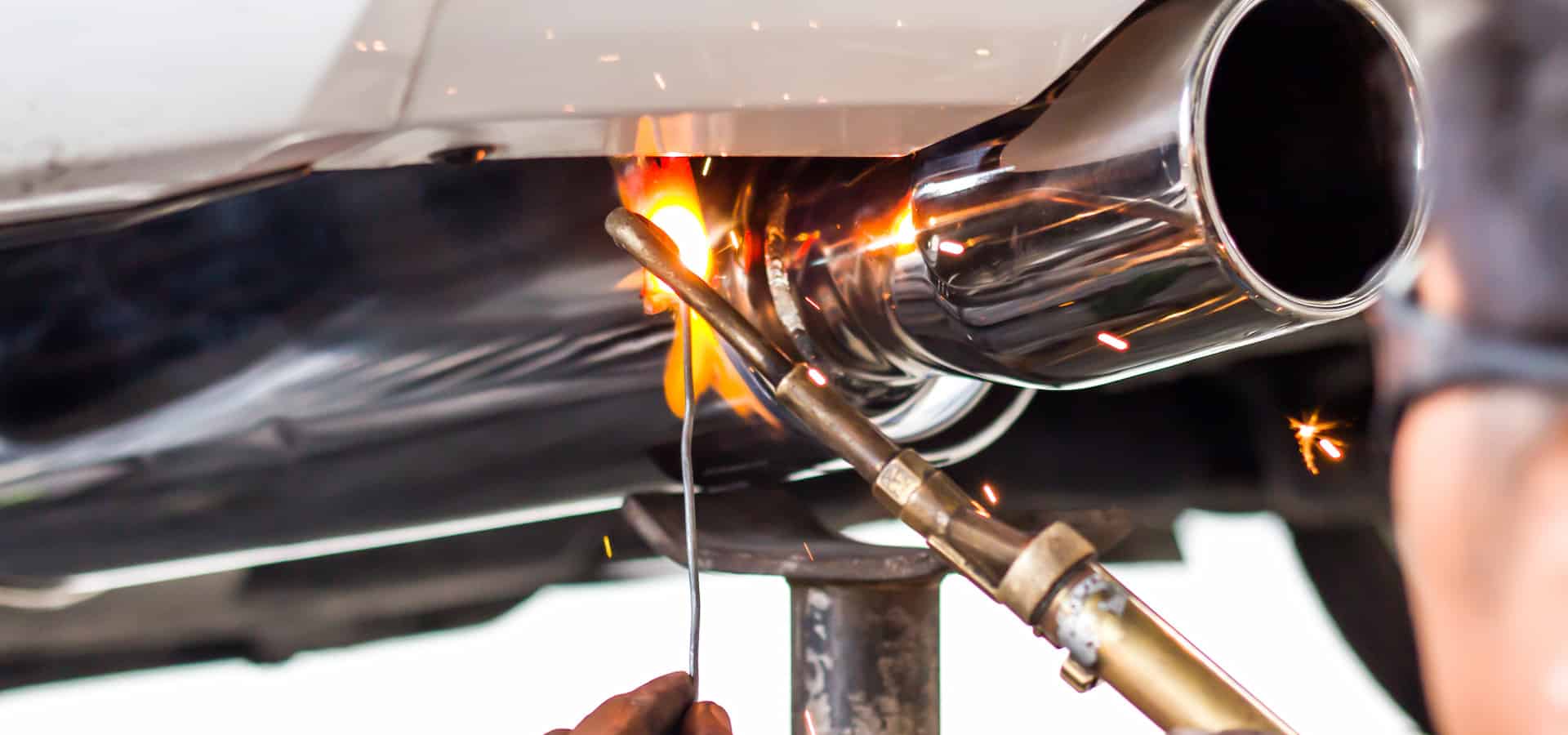
Chrysler Exhaust & Catalytic Converter Repair at Elevation Auto Repair
Chrysler exhaust systems carry their own personality, from the wide-body LX platform sedans to the mini-van and Pacifica lineup. Getting the repair right means understanding how Chrysler routes sensors, mounts converters, and handles the emissions software behind the check engine light – not just bolting on a generic pipe.
An exhaust and catalytic converter repair covers the manifolds, flex sections, resonators, mufflers, oxygen and air-fuel ratio sensors, and the catalyst itself. On many Chrysler vehicles the front converters live close-coupled to the exhaust manifold, so a failing catalyst often shows up as a P0420 or P0430 efficiency code long before you hear anything.
Two Chrysler-specific factors change how we approach this work:
- Pentastar 3.6L V6 platforms (300, Charger-based sedans, Pacifica, Town & Country) run downstream O2 sensors that demand correct threading and anti-seize to avoid stripping the bung.
- Post-repair drive cycles and catalyst monitor readiness often need a proper scan-tool reset – guessing here means a returning MIL and a failed emissions test.
What you can expect from us:
- Confirmation that the catalyst is actually the fault before we replace anything
- OEM-grade converters that meet Colorado emissions requirements
- Correct O2 and air-fuel sensor torque and seating
- Verified monitor readiness before you leave
Symptoms – How to Know You Need This Service
Chrysler exhaust trouble tends to announce itself. From the driver's seat, you may notice:
- A glowing check engine light with P0420 or P0430 catalyst efficiency codes
- A rotten-egg or sulfur smell, a classic sign of a failing catalytic converter
- A deep rumble or hissing that changes with engine speed, pointing to a cracked flex pipe or leaking manifold gasket
- Sluggish acceleration or a noticeable drop in fuel economy from a clogged catalyst
- A rattling sound under the floor, often the ceramic substrate breaking loose inside the converter
- Vibration through the floor or pedals from a loose or broken exhaust hanger
- Failed emissions test at the Colorado Air Care station
Stop driving and call us right away if you smell exhaust inside the cabin, hear loud roaring under the passenger area, or notice the smell of burning combined with reduced power – a plugged converter can build heat and become a fire risk. A steady check engine light with mild performance loss is safe to schedule soon, but the sooner we scan it, the more likely we catch a sensor issue before the catalyst is ruined.
Common Exhaust & Catalytic Converter Repair Issues on Chrysler Vehicles
Chrysler's mix of Pentastar V6 and HEMI V8 platforms shows recurring exhaust patterns worth knowing before parts start failing:
- P0420/P0430 catalyst efficiency codes on 3.6L Pentastar (2011+ 300, Charger, Town & Country, Pacifica): The Pentastar integrates the exhaust manifold into the cylinder head casting, so the close-coupled catalyst runs hot and ages faster than a mid-pipe unit.
- Cracked exhaust manifolds on 5.7L HEMI (2005+ 300C, Charger, Aspen): Heat cycling stresses the manifold bolts and the manifold itself, producing a cold-start "tick" that quiets as the metal expands.
- Rusted mid-pipe and flex joints on Colorado-driven vehicles: Road salt attacks the flex coupling and rear resonator on older Sebring, 200, and Town & Country vans, leading to leaks upstream of the rear O2 sensor.
- Failed downstream oxygen sensors on 4.7L V8 (Grand Cherokee, Durango era): Contaminated or lazy sensors throw false catalyst codes that mimic a bad converter.
- Broken exhaust hangers and dragging systems: Rubber isolators dry out and split, letting the system sag and rattle against the underbody.
- Oil-fouled converters from Pentastar oil consumption or valve seal wear: Burnt oil coats the ceramic substrate and kills catalyst efficiency prematurely.
Which Chrysler Models We See for Exhaust & Catalytic Converter Repair
We regularly handle exhaust and catalyst work across the modern Chrysler range. Find your platform below:
- Chrysler 300 (LX / LD, 2005–2023) – both the 3.6L Pentastar V6 and the 5.7L HEMI V8; the HEMI runs a pair of converters and four O2 sensors
- 300 SRT8 (6.1L / 6.4L) – performance exhaust routing that differs from the standard V8, so parts and headers vary
- Chrysler Pacifica (RU, 2017–present) – 3.6L Pentastar, including the plug-in Hybrid where exhaust behavior is tied to the engine's intermittent operation
- Chrysler Town & Country (RT, 2008–2016) – 3.3L, 3.8L, and later 3.6L V6 minivan applications
- Chrysler Sebring / 200 (2007–2017) – 2.4L four-cylinder and 3.6L V6, with front close-coupled converters
- Chrysler Voyager (2020–present) – shares the Pacifica RU underpinnings
On HEMI-equipped cars, catalyst diagnosis has to account for the multi-displacement system and the way cylinder deactivation affects sensor readings. Hybrid Pacifica models need extra care because the engine cycling can mask or delay a catalyst code.
We do less work on pre-2000 carbureted or older LH-platform Chryslers, and if your emissions setup is unusual we will tell you honestly before starting. Not sure where your vehicle fits? Bring it in and we will identify the platform and the correct catalyst configuration for you.
Chrysler's exhaust systems carry some platform-specific quirks that reward a shop paying close attention to detail. From the 3.6L Pentastar's integrated manifold-to-catalyst design to the older 4.7L and 5.7L HEMI setups with their dual pre-catalyst layout, these vehicles don't always respond well to one-size-fits-all exhaust work. Elevation Auto Repair handles Chrysler exhaust and catalytic converter repair with the model-year knowledge and OEM-aware approach these platforms need.
Causes & Risks – What Happens if Ignored
Most Chrysler exhaust trouble traces back to heat, age, and Colorado's road-salt winters combined with a few platform design choices. Close-coupled catalysts on the Pentastar sit near the head and cook, while HEMI manifold bolts loosen under repeated heat cycling.
Waiting rarely makes any of this cheaper. A small leak or a lazy sensor tends to snowball into converter replacement and secondary engine damage.
- Ignoring a P0420 code for several months often lets an oil-fouled or overheated converter fully clog, choking exhaust flow and dropping power.
- A minor manifold crack on a 5.7L HEMI, left alone, can warp the flange and take out the manifold bolts and gasket together.
- A leaking flex joint upstream of an O2 sensor feeds false air readings, driving the engine to run rich and accelerating catalyst failure.
- Dragging exhaust from a broken hanger can damage the mid-pipe, floor pan, or fuel line routing underneath.
- Persistent rich running from unaddressed sensor faults can foul spark plugs and wash cylinder walls over time.
What starts as a sensor or gasket job becomes a converter, manifold, and labor-heavy repair when it sits too long.
Safety Impact – Why Exhaust & Catalytic Converter Repair Matters
Exhaust problems on a Chrysler aren't only an emissions concern – they carry real safety weight. Leaks ahead of the cabin can push carbon monoxide toward the passenger area, and a clogged converter that strands power can leave you unable to accelerate into traffic. Rich or lean conditions from exhaust faults also feed bad data to the powertrain control module, which affects driveability.
- Stop driving now: exhaust fumes noticeable inside the cabin, a strong sulfur/rotten-egg smell, or sudden severe power loss with a glowing-hot underbody.
- Stop driving now: loud roaring paired with a dragging or scraping exhaust component under the car.
- Schedule soon: steady check-engine light for P0420/P0430, mild ticking on cold start, or a slight drone at highway speed.
- Schedule soon: failed emissions test or hesitation under load without cabin fumes.
Carbon monoxide intrusion is the serious one – it's colorless and odorless, and a known exhaust leak left unrepaired before an incident can complicate any liability or insurance discussion.
How Chrysler Exhaust & Catalytic Converter Repair Actually Works
Your Chrysler's exhaust routes gases from the head through the catalytic converter, where precious-metal coatings convert harmful compounds before they exit the tailpipe. Upstream and downstream oxygen sensors let the PCM compare readings across the converter to judge its efficiency – that comparison is what sets a P0420 or P0430 code. On Pentastar and HEMI platforms, the layout and integration differ enough that generic guesswork often replaces good parts unnecessarily.
Getting it right means confirming the converter is actually the problem before replacing it, then respecting Chrysler's spec sheet during the job.
- Integrated manifolds: Pentastar heads cast the manifold into the head, so torque sequence and gasket handling matter to avoid leaks and cracks.
-
Chrysler's exhaust systems carry a few personality traits worth knowing before you touch a wrench. The Pentastar 3.6L V6 found in 300, Pacifica, and Town & Country platforms runs close-coupled catalytic converters mounted right on the exhaust manifolds, which means heat cycling and oxygen sensor accuracy matter more here than on many rear-cat designs. Add in the HEMI 5.7L with its manifold-to-cat flange gaskets and the older 2.4L four-cylinders prone to flex-pipe fatigue, and you get a brand where exhaust work rewards a careful hand.
How We Diagnose Exhaust & Catalytic Converter Repair Issues on Chrysler
A rattle, a P0420, or a sulfur smell can all point back to the exhaust – but each has a different root cause. Here is how our technicians work through it:
- Full scan with a Chrysler-capable scan tool – we pull codes and freeze-frame data using a wiTECH-compatible platform, reading upstream and downstream O2 sensor voltages and catalyst monitor readiness on the Pentastar and HEMI ECMs.
- Live data comparison – we watch downstream sensor switching against the upstream signal to confirm whether the converter is actually dead or a lazy sensor is faking a P0420.
- Cold and warm visual inspection – checking manifold flanges, the flex pipe on transverse four-cylinder cars, hangers, and clamps for cracks, rust-through, or heat discoloration.
- Road test – listening for exhaust leaks under load, drone at cruise, and rattling honeycomb inside the converter.
- Backpressure and temperature checks – measuring pre- and post-cat temperature or backpressure to confirm a clogged or collapsed substrate.
Once we know whether the fault is a sensor, a gasket, a pipe, or the converter itself, we build a clear repair plan and quote so you approve the work before we start – no guessing, no upsell.
Exhaust & Catalytic Converter Repair on Chrysler: Repair vs. Replacement
Not every exhaust code means a new converter. We sort the job into three honest categories:
- Genuine repair – a leaking manifold-to-cat gasket on a HEMI 5.7L, a loose clamp, a broken hanger, or a failing downstream O2 sensor throwing a false P0420. Replace the small part, clear the code, done.
- Partial replacement – on Pentastar 3.6L cars where one close-coupled converter has failed but the rear section, muffler, and resonator are sound, we replace just the affected section and reuse serviceable hardware.
- Full replacement – when rust has cascaded through the flex pipe, mid-pipe, and hangers on higher-mileage 200 or Town & Country vehicles, or when a collapsed substrate has contaminated downstream components, replacing the assembly is safer and often more cost-effective than chasing one weld at a time.
We walk you through what we found, show you the worn parts, and lay out the options side by side. The right call is the one that keeps your Chrysler safe and reliable – not automatically the biggest invoice.
How to Make Your Chrysler Exhaust & Catalytic Converter Repair Last Longer
A little attention goes a long way toward protecting a converter and the pipes around it.
- Let it warm up briefly – short winter trips in Denver's cold cause condensation inside the exhaust that accelerates rust on flex pipes and mufflers. An occasional longer drive helps burn it off.
- Avoid running low on fuel or ignoring misfires – raw fuel from a bad coil or plug on a HEMI or Pentastar overheats and destroys the catalyst quickly.
- Watch for changes – new drone, ticking on cold start, or a sulfur smell are early warnings. A quick listen during your weekly drive catches problems while they are still small.
- Address the check engine light promptly – a lingering P0300-series misfire or rich-condition code shortens converter life fast.
Brand-specific care matters too: use OEM-spec oxygen sensors and correct converters for your emissions certification, keep the ECM/PCM software current so fuel trims stay accurate, and follow Chrysler's maintenance intervals for plugs and coils.
Visual checks and listening are safe to do yourself. Anything involving lifting the vehicle, welding, or working near hot exhaust components should be left to our technicians – it is a safety-critical system, and we would rather do it right than see you get hurt.
What to Expect When You Bring Your Chrysler In
Chrysler exhaust and catalytic converter work rewards a careful eye. Downstream O2 sensor readings, flex-pipe cracks on 300 and Pacifica models, and the manifold-integrated converters on the 3.6L Pentastar all behave differently, so our process is built around confirming the real fault before anything comes off the car.
- Drop-off or appointment – Schedule ahead or use after-hours key drop. Tell us the symptoms you noticed: a rotten-egg smell, a droning boom under load, or a glowing P0420 catalyst-efficiency code.
- Initial inspection – We lift the vehicle, inspect welds, hangers, gaskets, and the converter shell, then pull freeze-frame data and monitor pre- and post-cat O2 sensor switching with a scan tool.
- Written estimate – You get an itemized quote covering parts, labor, and any related fixes like a leaking manifold gasket or a failed upstream sensor skewing readings.
- Repair with updates – We call or text at decision points. Nothing extra gets done without your approval.
- Pickup walkthrough – We show you the old parts and explain what was corrected.
Loaner and shuttle options are available – just ask when booking. Clear personal items from the cabin ahead of time. Before we hand back the keys, we road test under load and re-scan to confirm catalyst monitors run clean. If anything feels off afterward, bring it back and we'll recheck it.
Why Choose Elevation Auto Repair for Chrysler Exhaust & Catalytic Converter Repair
Converter codes on Chrysler platforms are frequently misdiagnosed. A P0420 on a 3.6L Pentastar 300 or Town & Country can stem from a lazy downstream sensor or an exhaust leak rather than a failed converter – we verify the difference before recommending a costly part.
- Familiarity with Chrysler TSBs and PCM software updates that resolve false catalyst-efficiency flags on later Pentastar and 2.4L Tigershark applications.
- Attention to platform quirks like exhaust manifold cracks, warped flex couplers on LX-platform 300/Charger cars, and hanger fatigue on high-mileage minivans.
- Proper matching of CARB-compliant or OEM-grade converters so the new part actually clears monitors and holds up.
We own the job start to finish – diagnosis, repair, and post-repair scan verification – so you're not bouncing between shops chasing the same light. As your Denver dealership alternative, we handle Chrysler exhaust work with honest diagnostics and no unnecessary parts, backed by clear communication at every step.
Our Chrysler Services
- Air Conditioning AC Repair
- Battery Repair Replacement
- Brake Repair & Brake Fluid Change
- Check Engine Light Diagnostics
- Clutch Repair & Replacement
- Coolant Leak Repair
- Cooling System Repair
- Drive Shaft Repair
- Engine Repair
- Head Gasket Repair & Replacement
- Oil Change
- Oil Leak Repair
- Scheduled Service Maintenance
- Steering Repair
- Suspension Repair
- Cambelt Timing Belt Replacement
- Transmission Repair
- Tune Up
- Wheel Alignment