INFINITI Drive Shaft Repair at Elevation Auto Repair
A shuddering launch or a rhythmic clunk from underneath your INFINITI usually traces back to the drive shaft, CV joints, or a worn center support bearing. Getting it right on an INFINITI means respecting how these cars are built – rear-wheel-drive coupes and sedans on the FM platform use a two-piece propeller shaft with a center support bearing, while all-wheel-drive variants add front half-shafts and a transfer case output that both have to be phased and torqued correctly.
Generic shops often reuse worn hardware or skip the balancing and phasing steps that keep a V36 or Q50 smooth at highway speed. We follow INFINITI-specific torque values for companion flange and center bearing bolts, verify runout, and check the ATTESA-based AWD split on Q50/Q60 and G37x models so vibration doesn't return a week later.
- Accurate diagnosis that separates a bad CV joint from a failing center support bearing
- OEM-correct torque specs, phasing, and driveline runout checks
- Honest recommendations – we don't replace a whole shaft when a joint or boot will fix it
- A road test to confirm the vibration or clunk is truly gone before you leave
Symptoms – How to Know You Need This Service
Drive shaft trouble tends to announce itself gradually, then get worse fast. On INFINITI models you may notice:
- A repeating clunk when shifting from Park to Drive or letting off the throttle – often a worn center support bearing or U-joint
- Vibration that grows with speed, typically felt through the floor between 45 and 70 mph
- A clicking or popping during hard cornering on AWD models, pointing to a torn CV boot and dry joint
- A humming or growling that changes pitch with vehicle speed, not engine RPM
- Grease slung around the underbody near a split CV or driveshaft boot
- A shudder on acceleration from a stop, common when a joint is starting to seize
Schedule soon if you feel light vibration or hear occasional clunks. Stop driving immediately if the vibration becomes violent, you hear metallic grinding, or the shaft feels loose – a failing center bearing or U-joint can drop the shaft and damage the transmission or brake lines.
Common Drive Shaft Repair Issues on INFINITI Vehicles
A vibration under acceleration or a clunk when shifting into drive usually points at the driveline, and INFINITI's rear- and all-wheel-drive platforms have a few predictable weak points. Here's what we see roll through the shop most often.
- Rear driveshaft center support bearing wear (G35/G37, FX35/FX45, M35/M45 – FM platform): The rubber isolator around the center bearing dries out and cracks, producing a droning vibration at 40-60 mph that worsens under load. Common on higher-mileage VQ-powered rear-drivers.
- Front axle CV joint failure on AWD models (G37x, Q50 AWD, QX50, QX60): Torn outer CV boots let grease escape and grit in, leading to the classic clicking on turns. Colorado's grit and winter salt accelerate boot breakdown.
- Rear differential companion flange and pinion seal leaks (Q50/Q60 V37, older M-series): Weeping seals starve the flange splines and let play develop where the driveshaft mates to the diff.
- U-joint binding on two-piece driveshafts (QX56/QX80 body-on-frame): The larger truck-based platforms use serviceable U-joints that rust and seize, causing a shudder from a standstill.
- Transfer case output wear on QX-series AWD: Worn output bushings feed vibration into the front prop shaft and mimic a wheel-balance problem.
- Driveline slip-yoke wear: A dry or scored slip yoke on VQ/VK rear-drive INFINITIs produces a clunk on throttle tip-in.
Which INFINITI Models We See for Drive Shaft Repair
We regularly handle driveline work across the INFINITI lineup, with most jobs falling on the rear- and all-wheel-drive FM platform cars. Find your model below:
- G35 / G37 (V35, V36) – 2003–2013 coupes and sedans; center support bearing and rear U-joint wear are common, and G37x AWD variants add front half-shafts
- Q50 / Q60 (V37) – 2014–present; RWD and AWD versions, including the Red Sport 400 twin-turbo VR30 cars where driveline torque loads accelerate joint wear
- M35 / M37 / M45 / Q70 (Y50, Y51) – full-size sedans with two-piece prop shafts prone to center bearing failure at higher mileage
- FX35 / FX37 / FX50 and QX50 / QX70 – AWD crossovers where CV boots and front half-shafts see the most attention
- QX56 / QX80 – body-on-frame SUVs with longer prop shafts and slip yokes that benefit from proper lubrication and phasing
AWD models generally take more labor than RWD because of the added front half-shafts and transfer case output. We're candid about older or high-mileage units – if a shaft is beyond a joint replacement, we'll tell you straight rather than patch it. Bring us your INFINITI and we'll pinpoint the exact source before recommending any parts.
Causes & Risks – What Happens if Ignored
Most INFINITI driveline problems trace back to age, heat cycling, and Colorado's mix of highway speeds, gravel, and road salt. Rubber isolators harden, CV boots split, and moisture works into joints that were never meant to be exposed.
The trouble is that driveline parts fail progressively – a small symptom today becomes a stranded vehicle later.
- Ignoring a torn CV boot for a few weeks typically turns a simple boot replacement into a full axle assembly once the joint runs dry and the balls score the races.
- A worn center support bearing left alone lets the driveshaft whip, which chews the companion flange and can damage the transmission output seal.
- A seized U-joint on a QX56/QX80 can eventually let the driveshaft drop at speed – a serious safety event, not just a repair bill.
- Leaking pinion seals that go unaddressed drain the differential and cook the ring and pinion gear.
- Persistent driveline vibration loosens flange bolts and transmits stress into wheel bearings and mounts.
What starts as a low hum becomes a driveline vibration you feel in the seat, then secondary damage to the diff, transmission, or transfer case. Catching it early keeps the fix contained to the failing part.
Safety Impact – Why Drive Shaft Repair Matters
The driveshaft ties your engine's power to the wheels, so failures ripple into systems you rely on for control. On AWD INFINITIs, a compromised axle or prop shaft also disrupts the sensors that feed traction and stability logic.
- ABS and traction control: A failing CV joint or worn hub can throw wheel-speed data off, tripping warning lights and reducing braking authority in the snow.
- Stability control (VDC): Uneven driveline power delivery on AWD models can confuse the system during cornering.
- Steering feel: A badly torn front axle sends vibration and pull into the wheel.
Stop driving now if you notice:
- A loud metallic clunk followed by loss of drive or a shudder that suddenly worsens
- Grinding or banging from under the floor at low speed
- A driveshaft-area noise paired with burning smell or visible fluid
Schedule soon if you notice: a steady hum at highway speed, clicking on turns, or a mild vibration under acceleration. A known driveline defect left unrepaired before a collision can also complicate liability and insurance questions, so documented, honest repair protects you on more than one front.
How INFINITI Drive Shaft Repair Actually Works
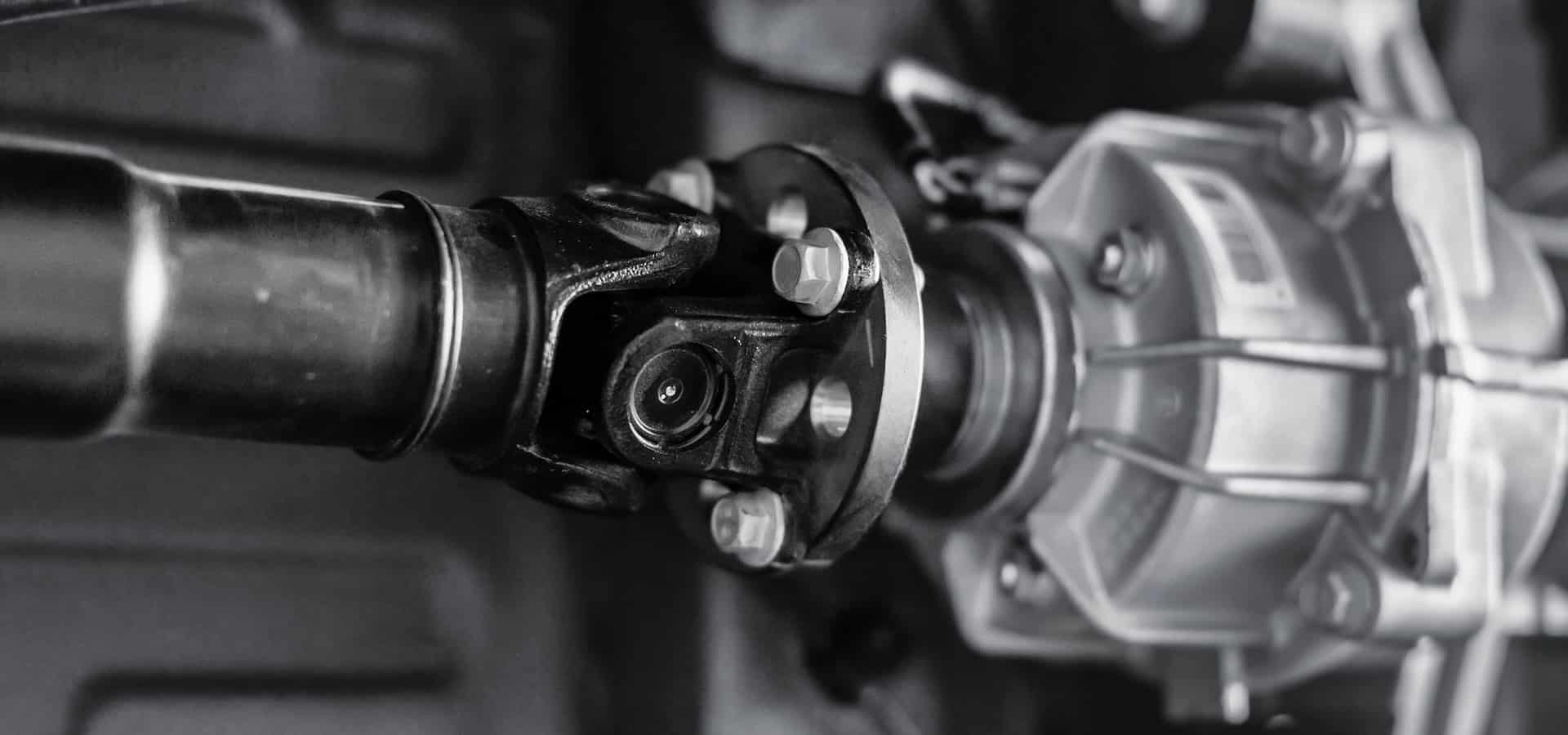
Your INFINITI's driveshaft carries rotational power from the transmission or transfer case to the differential, using precisely balanced tubes and joints that must run true at thousands of RPM. Rear-drive VQ and VK models often use a two-piece shaft with a center support bearing, while AWD platforms add front prop shafts and CV-jointed halfshafts – each with its own tolerances.
Because these components are balanced and torqued to spec, driveline work isn't a guess-and-check job. Getting it right matters.
- Phased flange marking: INFINITI two-piece shafts must be reinstalled in their original clocking to preserve factory balance.
- Torque and sequence specs: Companion flange and center bearing bolts follow OEM torque values to prevent runout and loosening.
- Balance verification: After service we confirm the shaft runs vibration-free rather than assuming.
- AWD calibration awareness: Front axle or transfer case work on Q50/QX AWD can require wheel-speed and stability checks so VDC and ABS read correctly afterward.
- Correct fluids and seals: Differential and trans
How We Diagnose Drive Shaft Repair Issues on INFINITI
A vibration that builds with speed, a clunk on acceleration, or a rhythmic droning under the floor usually points to driveline trouble. On rear-drive and all-wheel-drive INFINITIs – the G35/G37, Q50, Q60, FX/QX70, and QX56/QX80 – we start by pinning down whether the noise lives in the propeller shaft, the CV/half-shafts, or the differential.
- Pull the customer's description and any stored codes with CONSULT-III/CONSULT-III Plus, checking AWD control and ABS wheel-speed data for related faults.
- Road test to reproduce the symptom, noting whether vibration is speed-dependent (propshaft) or load-dependent (CV joints), and at what RPM the driveline buzz appears.
- Lift the vehicle and inspect the center support bearing, U-joints or the constant-velocity joint on the two-piece shaft, plus the flex disc used on some VQ-powered models.
- Check CV boots on the half-shafts for cracked rubber, slung grease, and play at the inner and outer joints.
- Measure runout on the propshaft and inspect the slip yoke and companion flange for wear, corrosion, or missing balance weights.
Those findings – scan data plus hands-on measurement – become a written repair plan and quote. You see exactly which component is worn and why, with no guesswork and no padded line items.
Drive Shaft Repair on INFINITI: Repair vs. Replacement
Not every driveline complaint needs a new shaft. We match the fix to the actual wear.
- Genuine repair: A dry or slightly clicking outer CV joint often just needs a new boot and fresh OEM grease before contamination destroys the joint. A loose companion flange or corroded slip yoke can sometimes be cleaned, re-greased, and torqued to spec.
- Partial replacement: On the G37 and Q50 two-piece propshaft, a failed center support bearing or worn U-joint can be replaced individually on shafts that allow it, rather than buying the whole assembly. A single failing half-shaft is replaced while the opposite side stays.
- Full replacement: Many INFINITI propshafts are sealed, balanced units where the U-joints aren't separately serviceable – a bad joint or bent tube means a complete shaft. Cascading wear, a torn boot that spun grease into a ruined joint, or repair costs approaching a new assembly all point to replacement.
We lay out both paths, explain what each buys you in reliability, and let you choose – we don't default to the most expensive option.
How to Make Your INFINITI Drive Shaft Repair Last Longer
Once the driveline is right, a few habits keep it that way.
- Ease into acceleration and avoid hard launches on AWD QX and Q-series models, which loads CV joints and the transfer case hardest.
- Let the drivetrain warm briefly in Denver cold before demanding full power, and avoid overloading a QX80 beyond its rating.
- Rinse road salt and winter grime off the underbody to slow corrosion on the slip yoke and center bearing.
Simple owner checks catch problems early:
- Peek at CV boots during tire rotations for cracks or grease spray.
- Listen for new clunks on shifts or a droning that rises with speed, and note when it happens.
- Keep an eye on the AWD and traction warning lights, and stay current on INFINITI service intervals.
Use OEM-grade CV grease, differential, and transfer-case fluid – INFINITI specs matter for AWD components – and keep control-module software updated. Visual checks and fluid-level monitoring are fine to do yourself. Anything involving propshaft balance, joint replacement, or torquing driveline fasteners is safety-critical and belongs in the shop, where we set it right the first time.
What to Expect When You Bring Your INFINITI In
Driveline vibration, a clunk when you shift into gear, or a rhythmic humming that builds with speed usually points to a worn drive shaft, failing center support bearing, or a tired CV/U-joint. Here's how we move from symptom to fix on your INFINITI.
- Drop-off or appointment: Tell us what you feel and hear – vibration under acceleration, a shudder on a G37 or Q50 during launch, or a growl from a rear-drive Q60. We ask when it started and at what speeds.
- Initial inspection: We lift the vehicle and check the flanges, slip yoke, center bearing, boots, and companion flange for play, torn boots, and grease slinging.
- Written estimate: You get a clear breakdown of parts and labor before anything moves forward – no surprise add-ons.
- During the work: We text or call with findings and photos. If runout or balance issues turn up, we explain the options.
- Pickup walkthrough: We show you what was replaced and confirm the repair on a road test.
Loaner and shuttle options help keep your day moving, and after-hours pickup is available when needed. Leave personal items in the cabin or take them with you – we'll keep the interior clean either way. Every job closes with a road test and a scan-tool re-check for stored driveline codes. If something feels off after you leave, bring it back and we'll recheck it.
Why Choose Elevation Auto Repair for INFINITI Drive Shaft Repair
Drive shaft work on rear- and all-wheel-drive INFINITIs rewards precision. On FM-platform cars like the G35, G37, Q50, and Q60, a two-piece shaft with a center support bearing means proper flange indexing and correct torque matter – get it wrong and you chase a vibration that never goes away.
- Platform familiarity: We know the driveline quirks across VQ-powered rear-drive coupes and sedans and the all-wheel-drive systems on FX/QX crossovers, including how transfer case and prop shaft angles affect balance.
- TSB and software awareness: We check applicable INFINITI service bulletins and controller updates that can influence driveline behavior before condemning hardware.
- End-to-end ownership: The same shop diagnoses, repairs, and verifies – no handing your car between vendors.
We follow OEM torque and indexing procedures for flange bolts and center bearing brackets, and we verify our work with a road test and scan-tool check rather than guessing. As your Denver dealership alternative, we handle everything from a single U-joint to a full shaft replacement, and we back the repair with honest diagnostics and clear communication.
Our INFINITI Services
- Air Conditioning AC Repair
- Battery Repair Replacement
- Brake Repair & Brake Fluid Change
- Check Engine Light Diagnostics
- Clutch Repair & Replacement
- Coolant Leak Repair
- Cooling System Repair
- Engine Repair
- Exhaust & Catalytic Converter Repair
- Head Gasket Repair & Replacement
- Oil Change
- Oil Leak Repair
- Scheduled Service Maintenance
- Steering Repair
- Suspension Repair
- Cambelt Timing Belt Replacement
- Transmission Repair
- Tune Up
- Wheel Alignment