Jeep Air Conditioning AC Repair at Elevation Auto Repair
Jeep A/C systems have a habit of failing in ways generic shops misdiagnose. On the JK and JL Wrangler, a leaking evaporator core buried deep in the HVAC box gets blamed on a low charge – so the system gets topped off, works for a few weeks, then quits again. That's throwing money at a symptom, not the cause.
Doing Jeep A/C right means finding the actual leak point before touching the refrigerant. We pull an electronic sniffer and UV dye across the condenser, compressor shaft seal, and the notorious rear-of-evaporator o-rings, then verify with proper vacuum decay. Jeep also runs specific R-134a and R-1234yf charge weights depending on model year, and overfilling a Grand Cherokee's system is just as damaging as running it low.
Newer Jeeps add software into the mix – blend door actuators and compressor clutch commands run through the body control module, so a wiring or calibration fault can mimic a mechanical failure. We check both.
- Full leak diagnosis with dye and electronic detection before any recharge
- Correct refrigerant type and factory charge weight for your exact model year
- Transparent pricing with clear communication before work begins
- Verification of cooling performance at the vents, not just a gauge reading
Symptoms – How to Know You Need This Service
Jeep A/C trouble usually shows itself gradually, then all at once. Here's what you may notice from the driver's seat:
- Warm or lukewarm air even with the system on max – often a low charge from a slow evaporator or condenser leak
- Air that cools then quits after highway driving – common with a failing compressor clutch or overheating condenser
- Musty or moldy smell at startup – a clogged evaporator drain or contaminated cabin filter
- Clicking or cycling from the compressor engaging and disengaging rapidly – low refrigerant or a failing pressure switch
- Squealing on startup – a worn serpentine belt or seized compressor pulley
- Air only blows from one vent – a stuck blend or mode door actuator
- Water pooling on the passenger floor – a blocked evaporator drain tube
A grinding or seized compressor means stop driving and schedule right away – a locked pulley can throw the belt and kill your steering and charging systems. Warm air alone or a faint smell is safe to drive on, but book service soon before a small leak drains the system completely.
Common Air Conditioning AC Repair Issues on Jeep Vehicles
Most shops slap in a can of refrigerant and send you on your way. On Jeeps, that skips the real culprit. Denver's dry air and high-altitude heat load push these systems hard, and certain platforms have predictable weak points.
- Blend door actuator failure (2007-2018 JK Wrangler): A clicking or knocking behind the dash and air stuck on one temperature. The plastic gears strip, and diagnosing which of the multiple actuators failed matters before anyone opens the dash.
- Front evaporator leaks (2011-2020 WK2 Grand Cherokee): Slow refrigerant loss with no obvious external sign. The evaporator core sits deep in the HVAC box, so a UV dye and electronic sniffer test is what confirms it, not guesswork.
- Compressor clutch and clutch coil failure (2014-2021 KL Cherokee): The A/C won't engage, or you hear a rattling clutch bearing. Often the 2.4L Tigershark and 3.2L Pentastar variants show this after high-mileage cycling.
- Condenser damage on JL Wrangler and JT Gladiator: Front-mounted condensers take rock and debris hits off-road, causing pinhole leaks in the fins.
- HVAC control head and mode-door faults (older KJ/KK Liberty): Vacuum-line and electronic mode control problems that switch airflow to the wrong vents.
- Expansion valve (TXV) clogging: Debris from a failing compressor circulates and starves the evaporator, causing weak cooling that a recharge won't fix.
Which Jeep Models We See for Air Conditioning AC Repair
We service A/C systems across the full Jeep lineup. Find your platform below:
- Wrangler JK (2007–2018) – frequent evaporator core and o-ring leaks; hardtop vs. soft-top affects rear-line routing
- Wrangler JL (2018–present) – condenser and front-line leaks; later years run R-1234yf refrigerant requiring dedicated equipment
- Grand Cherokee WK2 (2011–2021) – compressor clutch and blend door actuator faults; the 3.6L Pentastar and 5.7L HEMI share HVAC layouts, but SRT and Trackhawk models add heavier cooling loads
- Grand Cherokee WL (2021–present) – newer electronic controls and dual-zone calibration
- Cherokee KL (2014–2023) – condenser rock damage and evaporator leaks common in Colorado driving
- Compass and Renegade (2017–present) – compact systems prone to line fitting leaks
- Gladiator JT (2020–present) – shares much of the JL system with a longer refrigerant run
- Liberty KJ/KK and older Cherokee XJ – we handle these classic R-134a systems as well
Diesel EcoDiesel Grand Cherokees are welcome too – the A/C hardware matches the gas models. If you're driving something rare or heavily modified, call us and we'll confirm we can source the right parts before you come in.
Causes & Risks – What Happens if Ignored
Jeep A/C problems usually trace back to age, off-road exposure, and Colorado's extremes. Heat cycling degrades O-rings and hoses, road debris pits condensers, and plastic HVAC components simply wear out on higher-mileage rigs.
Waiting turns a contained problem into a chain reaction. A low refrigerant charge starves the compressor of oil, and a compressor that runs dry can grenade internally.
- Ignoring a slow leak for a season often lets the compressor run undercharged, wiping out the compressor and contaminating the entire system with metal debris.
- A failed compressor that sheds particles usually forces replacement of the condenser, expansion valve, receiver-drier, and a full system flush – far more than the original leak repair.
- A stripped blend door actuator left alone can jam the door and crack the housing, adding dash-removal labor.
- Moisture entering a low system corrodes the evaporator and lines from the inside out.
- A seized clutch bearing can throw the serpentine belt, taking out cooling and charging along with it.
Catching a leak early keeps the fix to a seal or hose. Let it linger and the same repair grows into a full-system rebuild. We tell you exactly where your system stands before any parts go on.
Safety Impact – Why Air Conditioning AC Repair Matters
A/C on a Jeep is tied to more than comfort. The same system runs your defrost, and a compressor that fails hard can drag down the belt-driven accessories around it.
- Defrost and defog: A dead A/C compressor cripples fast windshield and side-window clearing, hurting visibility in Denver's snow and freezing fog.
- Belt-driven systems: A seized compressor pulley can throw or shred the serpentine belt, which also drives the water pump, alternator, and power steering – leaving you without steering assist and cooling at once.
- Driver alertness: A stifling cabin on a long summer climb into the mountains fatigues the driver and slows reaction time.
Stop driving and call us now if:
- You hear grinding or squealing from the compressor followed by a burning-rubber smell.
- The belt is visibly frayed, loose, or partially off its pulleys.
- Defrost fails during winter driving and you can't keep the glass clear.
Schedule soon if: cooling is weak but present, you hear an occasional clutch click, or airflow won't switch vents. Addressing a known defect before it strands you also keeps you clear of the liability that comes with driving a vehicle you know is compromised.
How Jeep Air Conditioning AC Repair Actually Works
Your Jeep's A/C moves refrigerant through a closed loop – the compressor pressurizes it, the condenser sheds heat, the expansion valve drops the pressure, and the evaporator absorbs cabin heat. The catch is that late-model Jeeps run this through an electronically managed HVAC module, so charging and diagnosis aren't a hose-and-gauge job anymore.
Many 2014-and-newer Uconnect-equipped Jeeps report system pressures, blend-door positions, and actuator faults through the data bus, which means proper diagnosis needs the factory-level scan tool – not a generic code reader.
- System recovery and evacuation: The old charge is recovered, the system is pulled into a deep vacuum to remove moisture, then recharged to the exact factory refrigerant weight – overcharging is as damaging as undercharging.
- Refrigerant type matters: Newer Jeeps use R-1234yf, which requires dedicated equipment and can't be mixed with older R-134a.
- Actuator recalibration: After a blend or mode door replacement, the HVAC module often needs a relearn cycle so it knows the door's travel limits.
How We Diagnose Air Conditioning AC Repair Issues on Jeep
Jeep A/C complaints rarely trace back to just "low refrigerant." On Grand Cherokees (WK2), Wranglers (JK and JL), and Cherokees (KL), the real culprit is often a failing blend door actuator, a leaking condenser at the front of the stack, or an evaporator core weeping behind the dash. We chase the actual failure instead of topping off and sending you out the door.
- Pull HVAC and body control module codes using a scan tool that reads Jeep-specific PIDs – blend door calibration faults and actuator position data don't show on a generic OBD-II reader.
- Command the actuators and compressor clutch through bi-directional testing to confirm whether the fault is electrical, mechanical, or refrigerant-related.
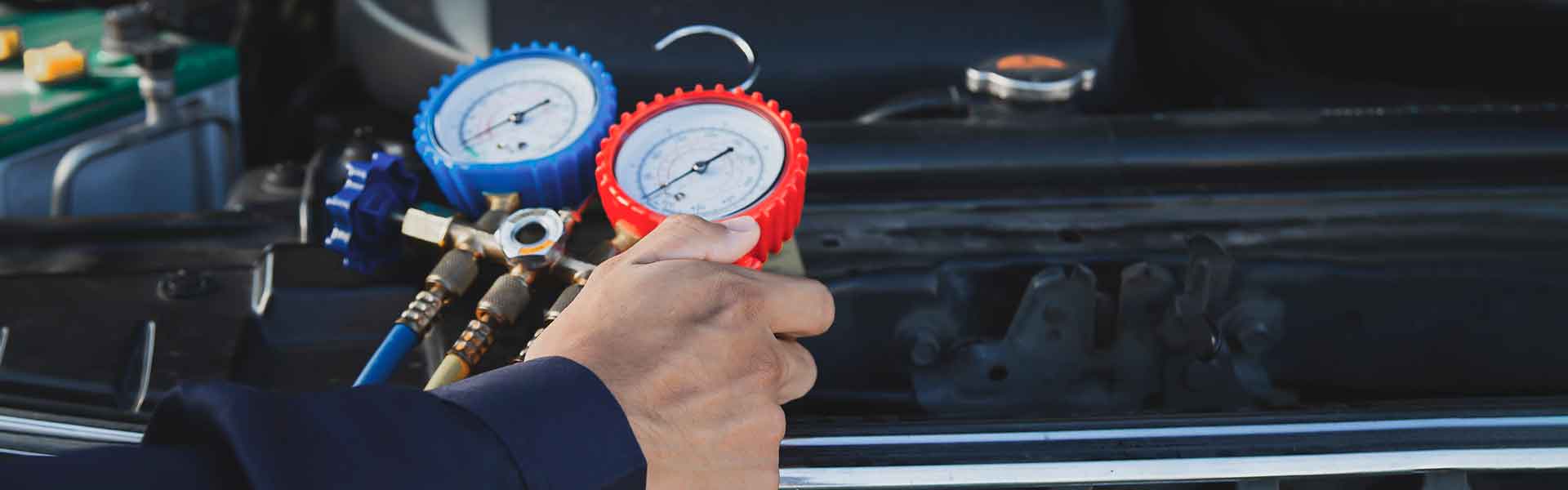
- Connect manifold gauges to read high and low side pressures, then compare against the system's design values for the ambient temperature.
- Run a dye or electronic sniffer leak test on the condenser, evaporator, compressor shaft seal, and O-ring connections – the WK2 condenser and JK evaporator are frequent leak points.
- Perform a vent-temperature and airflow check on a road test with the system loaded, listening for that clicking blend door tick common on JK Wranglers.
From there you get a written diagnosis and a plain quote – what failed, what it takes to fix it, and what the parts and labor break down to before we touch anything.
Air Conditioning AC Repair on Jeep: Repair vs. Replacement
Not every Jeep A/C job is a full system teardown. We match the fix to the failure.
- Genuine repair: A single leaking O-ring, a recharge after a confirmed and corrected leak, or a sticking blend door actuator on a JK or KL. Recalibrate, replace the one part, and the system is whole again.
- Partial replacement: A leaking condenser on a WK2 Grand Cherokee while the compressor and evaporator test fine – replace the condenser, receiver-drier, and O-rings, then evacuate and recharge. No reason to gut the dash.
- Full replacement: A seized compressor that sent metal debris through the loop. That contamination reaches the condenser, orifice, and lines, so replacing the compressor alone would just fail again. Here a compressor, condenser, drier, and full flush is the honest call.
Evaporator failures on Jeeps are the tough middle ground – the part is cheap but buried behind the dash, so labor drives the decision. We lay out both paths, show you the pressure readings and leak evidence, and let you choose. You'll never get pushed toward the biggest invoice without a reason you can see.
How to Make Your Jeep Air Conditioning AC Repair Last Longer
A fresh A/C job lasts far longer when the system stays clean and gets used correctly.
- Run the A/C for a few minutes even in winter – this circulates oil across the compressor seals and keeps them from drying out and leaking.
- Change the cabin air filter on schedule; a clogged filter on a KL Cherokee or JL Wrangler starves the evaporator and makes the whole system work harder.
- Rinse the condenser and radiator area – Jeeps that see trail dust and mud pack debris into the front stack, which drops cooling efficiency and traps corrosive grit against the condenser fins.
- Listen for new clicking, hissing, or a compressor that cycles rapidly, and note weaker cooling early instead of waiting for total failure.
Insist on the correct refrigerant type and charge amount for your model year – newer Jeeps use R-1234yf, and mixing or overcharging damages components. Keep body and HVAC module software current, since actuator calibration updates address known blend door quirks.
Filter swaps and condenser rinsing are fine to do yourself. Leave refrigerant handling, evacuation, and electrical actuator work to the shop – those need recovery equipment and proper charge specs to stay safe and effective.
What to Expect When You Bring Your Jeep In
Jeep A/C complaints often trace back to specific weak points – blend-door actuators clicking behind the dash on WK2 Grand Cherokees, evaporator leaks on JK Wranglers, or the TIPM-driven compressor clutch quirks that stump shops chasing a simple recharge. We start by identifying which one you're dealing with.
- Drop-off or appointment – Schedule ahead or leave it with us. Loaner and shuttle options are available, and after-hours pickup can be arranged so your schedule isn't held hostage.
- Initial inspection – We check static and high-side/low-side pressures, cycle the compressor, verify actuator movement, and dye-test for refrigerant leaks at the condenser, evaporator, and line fittings.
- Written estimate – You get a clear, line-item breakdown before any work begins. No surprises, no vague "diagnostic fee and we'll see" runaround.
- During the work – We text or call with findings and confirm before adding anything. Personal items can stay in the cabin, or set them aside and we'll leave them untouched.
- Pickup walkthrough – We show you what was replaced and why, and explain any related maintenance worth watching.
Before your Jeep leaves, we road-test it, re-check vent temperatures under load, and rescan for stored HVAC or TIPM codes. If anything feels off afterward, bring it back – we stand behind the fix and make it right.
Why Choose Elevation Auto Repair for Jeep Air Conditioning AC Repair
Jeep HVAC systems have platform-specific personalities, and treating them like a generic recharge job is how repeat failures happen. We know where these systems actually break.
- Platform knowledge – Blend-door actuator failures on Grand Cherokee WK/WK2, evaporator and condenser leaks common on JK and JL Wranglers, and compressor clutch control routed through the TIPM on many models.
- Software and TSB awareness – We check for relevant HVAC and body-control updates rather than throwing parts at a problem a reflash can resolve.
- End-to-end ownership – The same shop diagnoses, evacuates and recharges to factory refrigerant capacity, replaces failed components, and verifies the repair with a scan tool and vent-temp check.
You're getting a Denver dealership alternative that communicates in plain terms, prices the work transparently, and won't sell you a compressor when the real issue is a stuck actuator or a leaking O-ring. That's the difference between a temporary cool-down and a lasting fix.
Our Jeep Services
- Battery Repair Replacement
- Brake Repair & Brake Fluid Change
- Check Engine Light Diagnostics
- Clutch Repair & Replacement
- Coolant Leak Repair
- Cooling System Repair
- Drive Shaft Repair
- Engine Repair
- Exhaust & Catalytic Converter Repair
- Head Gasket Repair & Replacement
- Oil Change
- Oil Leak Repair
- Scheduled Service Maintenance
- Steering Repair
- Suspension Repair
- Cambelt Timing Belt Replacement
- Transmission Repair
- Tune Up
- Wheel Alignment