Jeep Battery Repair Replacement at Elevation Auto Repair
That slow crank on a cold Denver morning, the dash lighting up like a Christmas tree, the auto stop-start that suddenly quits working – these are how most Jeep owners find out their battery is on the way out. A modern Jeep is not a car where you drop in any battery from the parts store shelf and drive off.
Late-model Wranglers (JL), Grand Cherokees (WK2/WL), and Gladiators run absorbed glass mat (AGM) batteries tied into a battery management system. Swap in the wrong group size or skip the registration step, and the alternator overcharges the battery, stop-start stays disabled, and you shorten the life of a fresh battery in months.
Doing it right means matching the correct AGM chemistry and cold-cranking amps, then registering the new battery with a scan tool so the charging system relearns its state of charge. On many 3.6L Pentastar and 5.7L HEMI Jeeps, a memory-saver keeps the radio, seat, and window relearns from getting scrambled during the swap.
- Correct AGM battery matched to your Jeep's platform and CCA rating
- Battery registration and charging-system relearn with proper scan tooling
- Full charging-system test of alternator, cables, and ground straps
- Clean terminal service and secured hold-down to factory torque
Symptoms – How to Know You Need This Service
Battery trouble on a Jeep rarely shows up all at once. You may notice a few of these before it leaves you stranded in a parking lot.
- Slow or labored cranking – the starter drags before the engine catches, especially in cold weather.
- Auto stop-start stops working – the system disables itself when the battery can't hold enough reserve.
- Dashboard warnings – battery light, charging-system messages, or random electronic faults on the WK2/WL Grand Cherokee.
- Dim or flickering lights – headlights and interior lights fade at idle or brighten when you rev.
- Clicking with no start – a rapid clicking from the starter relay means voltage is too low to turn over.
- Electrical gremlins – Uconnect resets, power windows lagging, or the auto-transmission shifting oddly from voltage dips.
- Corrosion or a rotten-egg smell – white crust on terminals or a sulfur odor points to a leaking or overcharged battery.
Schedule soon if you're seeing slow cranks, stop-start dropouts, or intermittent warnings. Stop driving and call us right away if you smell sulfur, see swelling in the battery case, or the Jeep won't start reliably – a failing battery can damage the alternator and leave you stuck.
Common Battery Repair Replacement Issues on Jeep Vehicles
Slow cranks on a cold Denver morning, dashboard warnings flickering, an auto start-stop system that quits working – these are the signals most Jeep owners notice first. Battery trouble on modern Jeeps rarely stops at the battery itself because these platforms lean heavily on electrical management.
- Auxiliary battery failure on 2014-2023 Cherokee (KL) and 2018+ Wrangler (JL) with eTorque or ESS – the small secondary battery supporting stop-start fails long before the main battery, triggering "Stop/Start Not Ready" and charging faults.
- Main AGM battery degradation on JL Wrangler and JT Gladiator – factory AGM batteries in these platforms are sensitive to heat cycling and deep discharge, and swapping in a standard flooded battery causes charging errors.
- Parasitic drain on 2011-2020 Grand Cherokee (WK2) – TIPM (Totally Integrated Power Module) faults and modules that fail to sleep pull the battery down overnight, killing batteries prematurely.
- Corroded terminals and ground straps on TJ/JK Wranglers – off-road exposure and water crossings accelerate terminal corrosion and weaken chassis grounds, mimicking a dead battery.
- Missed battery registration/coding – WK2, KL, and JL platforms track battery state of charge through the body controller; a new battery installed without registration gets undercharged.
- Alternator overcharge or undercharge on high-mileage 3.6L Pentastar Jeeps – a failing voltage regulator boils an AGM battery or leaves it chronically low.
Which Jeep Models We See for Battery Repair Replacement
We service battery and charging-system work across the full modern Jeep lineup, including the platforms that need registration and AGM-specific attention.
- Wrangler JL (2018–present) – 3.6L Pentastar and 2.0L turbo, plus the dual-battery 4xe plug-in hybrid setup.
- Wrangler JK (2007–2018) – common battery and ground-strap wear on higher-mileage trail rigs.
- Grand Cherokee WK2 (2011–2021) and WL (2021–present) – AGM batteries with battery management; 3.6L, 5.7L HEMI, and EcoDiesel variants.
- Gladiator JT (2020–present) – shares the JL charging architecture; frequent for owners running winches and off-road lighting.
- Cherokee KL (2014–2023) – 2.4L Tigershark and 3.2L Pentastar with start-stop systems.
- Compass MP and Renegade BU (2015–present) – smaller AGM units that still require proper registration.
The 4xe and diesel models add high-current draws and secondary batteries, so those get extra charging-system checks. Older TJ and XJ Jeeps use simpler conventional batteries and are straightforward for us as well. If you're unsure which battery your Jeep needs, bring it in – we'll confirm the correct spec before we touch anything and keep your electronics happy through the swap.
Causes & Risks – What Happens if Ignored
Colorado's altitude, temperature swings, and heavy short-trip driving are hard on Jeep batteries. Stop-start systems cycle the battery constantly, and AGM chemistry loses capacity faster when it's repeatedly drained and never fully recharged on brief commutes.
A weak battery forces the alternator and voltage regulator to work harder, and that heat cascades into other components. Waiting turns a straightforward swap into a chain of failures.
- Ignoring a weak auxiliary battery for a few weeks often leads to full ESS shutdown and stored charging codes that mask the real fault.
- Chronic low voltage on WK2 Grand Cherokees confuses the TIPM, producing phantom warnings, erratic power windows, and locked shift interlocks.
- A battery left deeply discharged repeatedly sulfates internally and will not hold charge even after recharging – the alternator then overworks and fails.
- Corroded ground straps on Wranglers cause voltage drops that trigger multiple unrelated module faults, sending owners chasing the wrong repairs.
- A borderline battery in cold weather can leave you stranded without warning, and jump-starting modern Jeeps incorrectly can spike sensitive modules.
The safety line is simple: intermittent no-starts and flickering electronics mean the system is already unstable. Address it early and you replace one battery – wait, and you're often replacing an alternator, cleaning up module faults, and paying for a tow.
Safety Impact – Why Battery Repair Replacement Matters
A Jeep's electrical system feeds far more than the starter. Low or unstable voltage directly affects the systems you count on to stay in control.
- ABS and electronic stability control – these modules drop offline under low voltage, disabling traction control and stability assist.
- Electronic power steering on newer Jeeps can reduce assist or fault out when voltage sags.
- Airbag and restraint modules may log faults or become unreliable with an unstable supply.
- Backup cameras, blind-spot monitors, and forward collision systems glitch or shut down, removing safety nets you may not notice missing until you need them.
Stop driving now if you experience:
- ABS, traction, or airbag warning lights on together with cranking issues
- Loss of power steering assist
- Repeated stalling or hard no-start conditions
Schedule soon if you notice: slow cranking, stop-start disabled, dimming lights, or a battery light that comes and goes. Addressing a known-weak battery before an incident also keeps you clear of liability questions if a safety system fails at the wrong moment.
How Jeep Battery Repair Replacement Actually Works
On modern Jeeps, the battery is a managed part of the vehicle's power network, not just a box that stores charge. An Intelligent Battery Sensor on the negative terminal reports state of charge, temperature, and health to the body controller, which then tells the alternator how much to charge. That's why a proper replacement is more than loosening two bolts.
When we replace a battery on a WK2 Grand Cherokee, JL Wrangler, or KL Cherokee, the new battery has to be registered so the charging strategy matches its chemistry and age. Skipping this leaves the battery chronically undercharged and shortens its life.
- AGM chemistry matching – factory AGM must be replaced with AGM; substituting flooded batteries breaks the charging logic.
- Battery registration/coding using OEM-level tooling (wiTECH) so the body controller resets the aging counter.
- Auxiliary battery service on eTorque and ESS-equipped Jeeps, which many shops overlook entirely.
- Terminal, ground strap, and IBS inspection
How We Diagnose Battery Repair Replacement Issues on Jeep
Slow cranks on cold Denver mornings, a flickering dash, or a Wrangler that needs a jump every few days – those symptoms point straight to the battery and charging system. Here's how we track down the real cause before touching a single part.
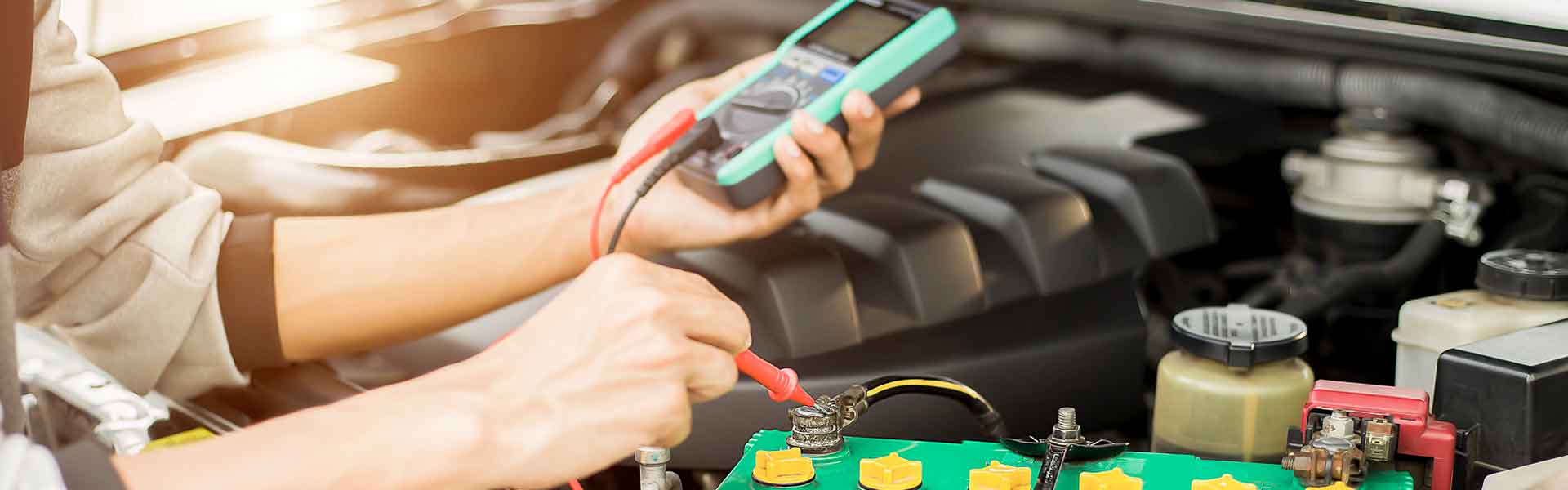
- We start with a full electrical load test and state-of-health check, reading cold cranking amps against the Jeep's factory spec rather than guessing from a voltmeter alone.
- We scan with a dealer-level tool (wiTECH-equivalent) to pull codes from the Body Control Module and, on newer Grand Cherokee WK2/WL and Wrangler JL models, verify the IBS (Intelligent Battery Sensor) is reporting correctly.
- We test alternator output and check for parasitic draw, which is common when the TIPM or an aftermarket accessory keeps a circuit awake.
- Visual inspection follows – corroded terminals, swollen AGM cases, loose grounds near the frame, and belt condition on the accessory drive.
- A short road test confirms whether voltage holds under real load with lights, blower, and defrost running.
On many Jeeps the "dead battery" is actually a failing IBS, a bad ground, or a phantom draw – not the battery itself. Once we know exactly what's happening, we give you a clear repair plan and a straightforward quote so there are no surprises.
Battery Repair Replacement on Jeep: Repair vs. Replacement
Not every battery complaint means buying a new battery. We match the fix to the actual fault.
- Genuine repair: Cleaning corroded terminals, re-torquing a loose ground strap, or repairing a chafed positive cable near the starter. On a JK or JL, a bad frame ground alone can mimic a dying battery.
- Partial replacement: Swapping just the failed component – a worn IBS sensor, a corroded cable end, or an alternator with weak output – while keeping a battery that still tests healthy.
- Full replacement: The right call when the AGM battery is swollen, sulfated, or failing under load. Grand Cherokee and Wrangler models with stop-start systems require a proper AGM battery, and the new unit must be registered to the BCM so the charging strategy matches.
When a repair cost climbs close to replacement, or when a weak battery is stressing the alternator, we'll say so. We walk you through each option and the trade-offs instead of defaulting to the priciest ticket.
How to Make Your Jeep Battery Repair Replacement Last Longer
A fresh battery should give you years of reliable starts if the system around it stays healthy. A few habits go a long way in Colorado's temperature swings.
- Drive long enough between starts to let the alternator fully recharge – frequent short trips leave AGM batteries chronically undercharged.
- Turn off accessories, heated seats, and lights before shutting down to reduce startup load.
- In extreme cold, let stop-start-equipped Jeeps stabilize for a moment before piling on electrical loads.
- Minimize accessory draw from winches, light bars, and aftermarket wiring that taps the battery directly.
Owner-friendly checks you can do safely:
- Look for white or green corrosion on terminals and clean it before it spreads.
- Confirm the hold-down bracket is tight so the battery isn't vibrating on the trail.
- Watch for battery or charging warning lights and note any slow-crank changes.
Use an OEM-spec AGM battery and keep the BCM software current so the charging logic works as intended. Terminal cleaning is fine to DIY – but battery registration, parasitic-draw testing, and any work near the TIPM should be left to us. Bring your Jeep in and we'll keep the whole electrical system healthy for the long haul.
What to Expect When You Bring Your Jeep In
Maybe your Wrangler cranks slow on cold Denver mornings, or your Grand Cherokee throws a random cluster of warnings – stop/start disabled, ESS light, flickering dash. Those are classic signs of a battery on its way out. Here's how a visit flows:
- Drop-off or scheduled appointment: Tell us the symptoms – slow crank, dead after sitting, ESS malfunction message. Leave personal items in the vehicle if you like; we note them and keep the cabin as you left it.
- Initial inspection and load test: We test state of charge, cranking amps, and check the parasitic draw that plagues many WK2 Grand Cherokees and JL Wranglers with the auxiliary battery setup.
- Written estimate: You get a clear line-item breakdown before any work starts – primary battery, auxiliary/ESS battery, terminals, and any needed BCM registration.
- Repair with updates: We text or call as work moves along, and shuttle service is available if you need a ride.
- Pickup walkthrough: We explain what was replaced and why, plus after-hours key drop when the schedule is tight.
Before you leave, we run a road test and a scan-tool re-check to confirm charging voltage, ESS re-enable, and no lingering codes. If anything feels off afterward, bring it back – we stand behind the fix.
Why Choose Elevation Auto Repair for Jeep Battery Repair Replacement
Jeep battery jobs are rarely just "swap and go." Many late-model Jeeps require the new battery to be registered to the BCM so the charging algorithm knows it's a fresh unit – skip that step and you'll shorten the battery's life.
- Dual-battery know-how: We handle the primary plus the small auxiliary battery on ESS-equipped WK2 Grand Cherokees, JL Wranglers, and Gladiators, a spot where generic shops often replace the wrong one.
- TSB and software awareness: We check for relevant Jeep bulletins and PCM/BCM software updates tied to false ESS and charging faults before condemning parts.
- Draw diagnosis: If a battery keeps dying, we trace parasitic drains – radio modules, aftermarket accessories, TIPM quirks on older platforms – instead of just selling another battery.
We own the whole job – diagnosis, correct battery spec, registration, and post-repair verification – so your Jeep starts strong through Colorado winters. That end-to-end approach is how we keep you reliably on the road, not back in the bay next month.
Our Jeep Services
- Air Conditioning AC Repair
- Brake Repair & Brake Fluid Change
- Check Engine Light Diagnostics
- Clutch Repair & Replacement
- Coolant Leak Repair
- Cooling System Repair
- Drive Shaft Repair
- Engine Repair
- Exhaust & Catalytic Converter Repair
- Head Gasket Repair & Replacement
- Oil Change
- Oil Leak Repair
- Scheduled Service Maintenance
- Steering Repair
- Suspension Repair
- Cambelt Timing Belt Replacement
- Transmission Repair
- Tune Up
- Wheel Alignment